Introduction
We are very fortunate to have here the follow up to the already incredibly helpful first interview with Alexandre Moryason on the trachings of Franz Bardon. In this second interview we were invited by Alexandre to source questions from the community at all levels of ability, so that this could be truly useful no matter where a student was in their practice (If you contributed a question then we would like to thank you, for contributing to a true community project that benefits us all).
I believe that what Alexandre has produced here has more than achieved that goal and along with the first interview stand out as valuable contributions to all students of Franz Bardon which I hope will be used as supporting material for decades to come. We cannot thank Alexandre Moryason and all those at Editions Moryason enough for making this happen, being so thorough and thoughtful in the answers to these community questions and for being an absolute pleasure to work with.
Once again please be sure to visit Editions Moryason website to see the titles they have available. As you can see from this interview anything that is there, you know is because it is truly useful for practitioners and comes from the best of intentions.
Visit Editions Moryason here
Visit Main Info Site here
For Clarity: These answers are given by Editions Moryason with the authorization of
Alexandre Moryason. The following interview has been reproduced as provided by Alexandre Moryason.

Alexandre Moryasons Answers to Perseus Arcane Academy’s Questions Second interview
Friday, October 24, 2025
For Clarity: Perseus’s questions are in blue. Edition’s answers are in black.
Nota: IIH = Initiation into Hermetics
PME = The Practice of Magical Evocation
KTQ = The Key to the True Kabbalah
You present your questions by classifying them by “student level” on the Path of Magical Training. We respect this principle with regard to the answers, specifying, however, that the understanding of this Path, to be correct, must be comprehensive, because the levels interpenetrate and, consequently, the results obtained depend on the student’s initial subtle structure.
To facilitate possible cross-references to our answers, we have numbered your questions within each level you mention.
Beginner Level
PAA: I Mental Discipline and Thought Control: Franz Bardon’s training begins with seemingly simple yet challenging mental exercises. In IIH Step I, he emphasizes observing and controlling one’s thoughts as the foundation for all further development.
Many beginners struggle to quiet the mind even for a few moments. What advice do you have for cultivating consistent mental discipline at this early stage? How can a student overcome frustration when the mind wanders, and what “little tricks” (as Bardon puts it) can help build concentration and focus in daily practice?
In our previous interview, we pointed out that Franz Bardon’s system shares strong similarities with the Indo-Tibetan teachings, which refine and cultivate mental discipline and thought control at an even deeper level, in order to become a “Buddha” and achieve “Liberation.”
Students should therefore understand that these exercises should not only be practiced by beginners, but also by extremely advanced individuals, because to no longer have to practice them, one must have attained “perfect and continuous present awareness,” which is the state of an Enlightened One.
We have already partially responded to our correspondents on this subject. Here is some additional key information.
In the set of exercises covering the Ten Steps of Frans Bardon’s magnificent work, “The IIH,” only two exercises are given, and “these alone” potentially contain Ultimate Realization. It is important to know that:
• the First Step alone encapsulates the Path;
• two exercises in this Step lead to Divine Consciousness.
1° The first exercise: this is the practice of Meditation, called Mindless Emptiness, which should be done for at least ten minutes, morning and evening. It is this exercise that we have been asked about for years, and we understand that you are asking us too.
• Mindless emptiness does not mean fighting the thought or thoughts that come in; this fight creates a tension that is counterproductive to the desired goal. The energy of the Collective Mind flows, and flows…; nothing can stop this flow. Therefore, it is a matter of being aware of the thought but not “jumping” on it and developing it (the thought of the cat comes and we think we have to buy its kibble; from there, we think of the usual supermarket, from there, the promotions… That’s it: we are out of the loop of the purpose of this exercise). We observe it, in fact, and we let it fade away; its energy dissolves; Another thought arrives, we don’t hold onto it, we don’t develop it; it leaves… After a certain time of this practice, the thoughts will become more and more spaced out. Between them, a “void” will appear. It is in this “void” that our Divine Self can manifest.
• The position of the eyes: they must be open and the gaze relaxed in front of us, as when we dream with our eyes open. Closed eyes create a fixation on the Lower Mind (kama manas) and we can’t escape; thoughts flow in.
• Breathing is done through the mouth, gently and without tension. Breathing through the nose does not immediately “connect” to the Divine.
We are taking the liberty of providing these last two pieces of information because they have been publicly disseminated by the Buddhist Tradition for about thirty years. Other teachings must certainly be kept confidential, but these details, reported here, are essential to success.
Why, you may ask, did Franz Bardon not provide this information? Because his Teachings were given in the 1950s, shortly after World War II, when “planetary karma” did not yet allow for this dissemination.
But this was permitted as early as the 1980s and beyond. As for the “Mindless Void,” it was explained in the “Yogas of Naropa,” written in India (1016-1100), and Éditions Maisonneuve published this work in the 1960s.
2° The second exercise: this is found in the “training of the mental body”; it consists of maintaining awareness in the present moment, thus not letting the mind wander and concentrating on what we are doing at each moment: when we eat, our awareness focuses on the act of eating, etc. This exercise is crucial; it was brilliantly formulated by Gautama Buddha. We have published a book: “The Sublime Practice or How to Attain Enlightenment in a Single Life.” We will publish the English translation and send it to you when it is available.
PAA: II Vacancy and Akasha – Does the work of Vacancy of Mind eventually lead to experience of Akasha?
Yes. The previous answer explains in detail how the deep practice of Mind Emptiness leads to the state of “Buddha.”
To understand this fully, we must first clear up two misconceptions:
1-The first confusion is perceived in the commonly used terms: mind and spirit. The “mind” is “the lower mind” (the “dense” mind or kama-manas in Sanskrit and “sem” in Tibetan: the four lower subdivisions of the Mental Plane, the three higher subdivisions being luminous, beyond the reach of the movements of the dense mind). And it is precisely this lower mind that must be emptied of thoughts. When referring to the higher subdivisions and beyond (Buddhi), we write “Spirit” with a capital “S” (Buddhi-Manas in Sanskrit, “the Sem linked to Rigpa” in Tibetan).
2- The second confusion is commonly made between the notion of “emptiness” or “Vacancy” in Sanskrit and Tibetan texts and that of “nothingness.” “Nothingness” means “absolute Nothingness.” But “Nothingness cannot give birth to anything,” as the sacred rites of the Rosicrucians remind us in the West.
Therefore, “Void” does not mean “empty of nothing,” but a full “void” that contains, in gestation, everything in the Universe when it “manifests.” Therefore, this “full void” is the Absolute Divine Reality that manifests in the Universe through the Creative Akasha.
The latter contains “Divine Ideation,” that is, “what the Absolute Divinity wants to create,” its Conception of its Creation. This conception is expressed by the Cosmic Divine Mind (“Mahat”). This same Divine Mind irrigates all thinking beings in the Universe and is called, for the sake of distinction, “Manas,” our Mind, when it concerns human beings.
The “void” also concerns what the Divine Mind creates (the Universe and everything it contains): this Creation “is empty of all intrinsic Reality.” This means that Manifestation and subsequent Creation are, in fact, an immense hologram representing what the Divine Mind wants, but that in truth, the only Reality resides in this “Void” which contains the “Seed of everything.”
In this view, the Mental Void leads to the experience of the creative Divinity (Akasha).
Akasha is our true nature: “Liberation,” reaching the state of “Buddha” or “Liberation,” is to experience this Truth.
PAA: III Step 2 Visualisation – Some people are natural visualisers and others have real problems ‘seeing’ anything other than blackness. What is your suggestion for students struggling with visualisation? Can they still progress? What is the reason hermetically that they cannot ‘see’ mentally within the mind.
Yes, these students can progress.
As F. Bardon explains, the problem stems from the imbalance of the Elements in the student’s structure: the Fire Element is weaker than the others. This does not mean that the student has “no willpower,” but rather that the other Elements in his or her structure (Water, Air, Earth) are more intense than the Fire Element and, in any case, function differently: Fire is clearly lacking, but also, the Air Element lacks the power to activate Fire… this is an imbalance.
This imbalance is, in reality, common to most human beings and is a reflection of the current state of development of humanity, still firmly anchored in the 3rd Dimension. The natural ability to visualize reveals a development linked to the 4th and 5th Dimensions. It is therefore by practicing visualization that the student will develop and thus reach these last two Dimensions, which definitively free them from the prison that confines ordinary humanity.
To improve their elemental balance, the student can:
• Practice the rituals revealed in Part II of “Light over the Kingdom”; through these rituals, each Element is purified of its density (it thus becomes increasingly luminous) and develops in power. These rituals automatically balance the Elements of their structure;
• Practice all types of willpower-strengthening exercises (these exercises are easy to identify : they are those that train us to resist a natural indolence tending towards the satisfaction of every desire.
By doing this, the student will eventually notice an improvement and will finally begin to “see” things, by truly concentrating and exercising a will that is both “strong” but “not too tense,” because strong tension disrupts Air and thereby blocks Fire…
The first steps: for example, he will place an apple on a table, then close his eyes and try to reproduce it on his mental screen, as if he had taken a photo of it. Once this exercise is successful, he will add the table to his visualization. Once this is successful, he will continue with landscapes, people, etc. Later, he will practice visualizing with his eyes open. This process is more difficult, but one can master it. It is very important because it allows us to create in the etheric and astral substance objects, situations, settings, positive and happy ensembles, which we wish to see manifest in our lives.
Depending on his elemental structure, the student will then begin to see, on his mental screen, shapes in color or black and white; he will thus see, without his control, images linked to his conscious memories, those hidden in his unconscious, and even perceptions of the historical past or the future (personal or general).
Visualization thus gradually becomes a “portal” through which the Universe sends them messages (mental clairvoyance).
PAA: IV Soul Mirrors and Self-Honesty: One of Bardon’s early requirements is the creation of the “soul mirrors” – a thorough inventory of one’s positive and negative traits categorized by the Four Elements. This introspective work can be daunting, as it forces an honest self-examination.
In your experience, how should a beginner approach the soul mirror exercise without becoming either overwhelmed by faults or overly proud of virtues? What practical steps can help maintain a balance between ruthless self-honesty and patient self-compassion during this process of character analysis and purification?
Also, in line with the previous interview could you perhaps go into detail about purification – conscious act of this from a dedicated student and perhaps how life may enforce this.
The suffering experienced during Soul Mirrors and self-honesty results from identification with the “ego,” our lower tripartite structure (mental, astral, and physical bodies, called the “personality”), when in reality, we are the Self, our Soul, a Divine Being without beginning or end (our Individuality). The approach should be as follows:
• Stop identifying with the “ego” and therefore perceive everything through its filter: this technique consists of seeing oneself as a third party observing this mass called “ego,” named John or Mary. There is a Disidentification and therefore an external observation of this whole that is our being here below, this “ego” that obstructs everything.
This observation allows us to see the defects and the qualities, this “Mirror of the Soul“, as being that of a person other than oneself. This “ego” must be observed as an object of study which must therefore not arouse any emotion, pride if it is a quality, or shame or violent rejection if it is a defect. Emotion is a very powerful astral energy (linked to the Water Element); whether it is laudatory or accusatory, it amplifies, by the very fact of its elemental nature, everything it touches; it therefore further fuels the initial imbalance of the student’s Elements. To counter this natural, very human phenomenon of the emergence of emotion as soon as anything concerns us (our ego), using our mind is the key to success: immediately thinking of “looking at” this emotion (pleasant or unpleasant), observing it as something foreign to ourselves. This “looking” empties the emotion, discharges its power, and allows the “Soul Mirror” exercise to continue properly, without the traps of the ego.
• Practice the purification rituals given in Part II of “Light over the Kingdom” and Bardon’s exercises: the structure will be purified and the ego will weaken;
• Purification is the key to unleashing occult powers: a structure with a low and dark (heavy) vibration cannot possess powers pertaining to higher dimensions.
PAA: V Intention and Ethical Foundation: Bardon’s system is not just about techniques but also about the aspirant’s inner attitude. He notes that any power obtained can be used for good or ill, but a true magician “will never think of any evil motives” and remains a faithful servant of Divine Providence.
How important is it for a beginner to cultivate pure intentions and ethical motives right from the start of magical training?
Can you share your perspective on how one’s intention – for example, whether one practices for spiritual growth versus ego or power – influences the effectiveness and safety of early magical exercises?
How can newcomers align their practice with higher ideals to build a strong moral foundation?
The inner attitude is essential because Universal Reality is based on the fundamental Good, absolute Compassion. As soon as a beginner in Hermeticism, in magical training, approaches this Path without having previously developed (work of past lives) the will to work for the Good of all beings, he walks on a path which is not linked to Universal or Divine Reality. Consequently, not only will his training be doomed to failure (the Elements will not obey him, whether for his personal development or to carry out magical works) but he risks awakening, more violently than the compassionate student would suffer, the negative aspects of his own structure, (the famous “Guardian of the Threshold”) “which is the absolute danger; “absolute” because he will not have within him the Force which is Compassion to “calm” and dissolve the mephitic substance of this “Guardian”. In fact, “Purity” cannot be accumulated on “impurity.”
Therefore, before venturing onto the Path of magical training, the beginner who lacks this naturally benevolent orientation toward others and who seeks to acquire occult powers in order to fulfill selfish desires must absolutely:
• reflect and force oneself to “feel” what those around oneself and in the world are experiencing, to grasp human suffering;
• practice acting and reacting—through actions and feelings—as Christ or a Bodhisattva would; at first, one imitates even if oneself is seething with selfishness; one strives despite everything; then gradually, Compassion arises in the heart.
This work is immediately aided by the Force of Universal Compassion, which is thus called upon, and also by the help of the Masters of Wisdom, including Franz Bardon Himself.
The effects of intention, when well-directed:
• It guarantees the effectiveness and power of practices; • It is secure, because we are undoubtedly following the path of Divine Magic and following the example of the Masters of Wisdom, the Mahatmas, Christ, and Franz Bardon. If the latter’s life has been entrusted to us by his son and disciple, Dr. Khulman, in such detail, it is to become a source of inspiration, a tool allowing us to understand how to consider higher objectives as a key aspect of our practice. Franz Bardon’s example clearly shows that, in the long term, higher powers must be used to help humanity.
PAA: VI Purpose of Basic Exercises: Beginning students often question the purpose of exercises like observing thoughts, visualizations, or simple energy work, perhaps feeling eager to jump into more “exciting” techniques. From a teacher’s perspective, how do these early-stage practices (thought control, visualization drills, elemental breathing,etc.) form the philosophical and practical foundation for later stages?
For instance, how might mastering one’s thoughts or imagination early on benefit the practitioner when they eventually move to more advanced work like evocation or quabbalah?
From the Student’s Perspective
Regarding the usefulness of the basic exercises, refer to the two essential exercises explained in Beginner Level – Question I.
For visualization: refer to the answer in Beginner Level – Question III. “Wanting to embark on more stimulating techniques!”… This question reveals a general ignorance regarding the merits of exercises that seem to the mind—in search of egoic stimulation—dull and, to say the least, unexciting. This demand is found in all initiatory schools or spiritual paths. It is human. It will be overcome, precisely with the help of these unstimulating exercises.
From the Teacher’s Perspective
The basis of these exercises is not philosophical in the strict sense of the term; rather, it stems from a very precise knowledge of the occult anatomy of the human being (channels, drops/tiglés, breaths, state of the “fires,” chakras, etc.). This true medicine of our subtle structure is exhaustively known in the Esoteric Tradition of India and Tibet. Fragments of it have reached the West: we find them in the exercises of Orthodox Christian monks, Catholic abbeys, notably Cistercian ones, among the Sufis, the Druzes and the Shamans of Europe and America. It is therefore a science and not metaphysical speculations.
Since Magic is a science, these exercises are essential for the success of everything it allows, including successful Evocation (without unpleasant surprises) or the use of Words in Kabbalah. Without this development of the student’s subtle centers and vehicles, which generates a constant increase in the vibratory frequency of the being, Divine Magic could not be practiced, in all its stages.
Franz Bardon states in his book “The Key to True Kabbalah” (KTQ), “This is why I emphasized at the beginning of this work that the practice of the first book, “The Path of True Magical Initiation,” was absolutely essential—at least up to and including the Eighth Degree—if one wanted to obtain satisfactory results in Kabbalah…”
PAA: VII Why is the order of practices in IIH as it is? It seems a lot of the easier stuff is in the later chapters, while the starting chapters are full of really hard material such as elemental manifestations and total control of mental faculties. Why was it arranged this way? (I think I know the answer, but I’d love to hear your take.)
The main course, that is, the basic training (difficult initial practices), is presented before the advanced practices, which are apparently easier to approach, since the latter only become easier in their complexity through mastery of the more complex exercises presented from the beginning.
Indeed, some practices may become easier with the energy used by the student, but the effectiveness of this energy’s action is based on a balanced astral and mental equilibrium. This balance is due to mastery of the exercises of the preceding Degrees.
*
Intermediate Level
PAA: I Elemental Balance and Astral Equilibrium: Bardon places great stress on achieving elemental equilibrium in the personality – balancing the qualities of Fire, Air, Water, and Earth within oneself (initiation-into-hermetics-franz bardon.pdf).
For an intermediate practitioner, what are the signs that they are approaching a genuine balance of the elements in their character?
Conversely, what indications might reveal that one element is still too dominant or deficient?
If imbalances persist (e.g. excess fiery temperament or an overly watery, passive nature), what practical steps would you recommend to harmonize that element ?
Perhaps through specific behavioral changes, meditations, or elemental exercises – so the magician can attain the “magic equipoise” Bardon says is absolutely necessary for further development.
Elemental balance is relative: students, disciples, initiates, Adepts, (Mahatmas) … At each stage of development, the person is supposed to reach a higher level of elemental balance, a higher level of perfection. Thus, for an intermediate practitioner, the approach to a better elemental balance translates into the development of certain abilities: better concentration/mental visualization, intuition, clairvoyance or any other aptitude that may emerge according to the structure and karma of the individual. However, from this description we must reflect on the meaning of the end of the previous sentence: “according to the structure and karma of the individual” because, according to the students, from the beginning of the Path, some have results of those who are at the intermediate or advanced level and vice versa, others, despite great efforts, cannot reach the intermediate and a fortiori advanced levels.
Signs revealing the approach of true elemental balance:
This is the manifestation of psychic abilities (clairvoyance, clairaudience, intuition, successful telepathy, etc.); better health, and very positive speech.
Indicators revealing an Element is still too dominant or deficient:
The negative attributes of the Elements manifest: Fire = aggression, agitation, continual thirst; Air = mental restlessness, lack of concentration, forgetfulness, etc.; Water = extreme sensitivity, neurasthenia, indolence, etc.; Earth = laziness, inaction, difficulty acting or reacting to something, etc.
Harmonizing an Element with the others is achieved:
• by practicing purification rituals that will automatically balance the Elements of our subtle and physical structure;
• by thinking/meditating on what relates to this failing Element (to activate a failing Fire, for example, one will act by meditating/thinking on the qualities and specificities of this Element: movement, action, strength, etc.; for Water: sensitivity, feelings, calm, empathy with others, etc.; for Air: liveliness in one’s senses, notably mental, intellectual curiosity, expansion, elevation, lightness of being, etc.; Earth: stability, endurance, constancy, certainty, etc.
PAA: II Four Regions Elemental Exercise: Can you discuss this part of Step 4, this seems like such an important part of training. Is this like a gateway towards working with our own Akasha? Like the result of this equanimity is the access to Akasha?
This is a highly advanced method aimed at balancing the Elements. We advise students to focus on purification rituals, unless, of course, they have mastered the previous steps.
For the average student, purification rituals offer similar benefits without any risk, which is why we encourage them in this regard.
The balance of the Elements leads to Akasha, and an imbalance creates a dissonance in consciousness that hinders access to it.
PAA: III Projection of the Elements Outward: In IIH Step V, students learn to accumulate the elements in the body and then project them outward into the surrounding space. This ability to externalize elemental energy marks a new level of practical magic.
What are some safe and meaningful applications of this skill for someone at the intermediate level?
For example, how might one use elemental projection in healing, ritual space cleansing, or protection?
Additionally, how can a practitioner ensure they handle the elements responsibly – avoiding any unintended effects on themselves or their environment – and properly reabsorb or dissolve the forces after working with them?
Elemental projection is used by:
• Focusing the heart on a Bodhisattva, Christ for example; this brings the Force of Compassion to the operation and energy to the practitioner; it is also a form of protection for the latter.
• Then defining the goal (healing someone, for example);
• Determining the Element or Elements to act (generally, regardless of the vector Element, Air is added, which either animates or calms it);
• Focusing the mind by visualizing the person to be healed, with the will for this healing and certainty in the use of this magical process.
• Concentrating/feeling compassion in the heart center for the illness and suffering of the recipient of this magical action;
• Sending/projecting/visualizing the final delivery of the predetermined Elements to the patient (on the etheric/physical plane, the Elements have the following colors, respectively: Fire = red; Water = green; Air = yellow; Earth = brown); for this delivery, visualize the Element with its color while breathing deeply through the nose, then exhale through the mouth quite abruptly, forcefully, visualizing the Element’s path to the patient; choose to send the main Element and then Air.
• Thanking Divine Providence for allowing us to be the channel of the healing It has granted.
Dissolving or “discharging” remaining forces:
When accumulating energy, the most important thing is to dissolve it at the end of the practice or to assign it a specific purpose. If we don’t, this energy flows without a destination, creating a vibrational chaos that attracts less evolved, even highly negative, entities, and, as Franz Bardon says, “the result always goes against your interests.”
We dissolve the remaining forces by visualizing their sending either to Earth or to infinite space, visualizing, in this case, their dissolution. In both these destinations, breathing effectively accompanies the process: we inhale empty and exhale forcefully, visualizing the Elements disappearing in turn. We can repeat this inhalation and exhalation three or seven times, depending on how we feel.
PAA: IV Formation of Elementaries and Thought-Forms: As training progresses, Bardon introduces the creation of thought-forms and artificial beings – from simple elementals in Step VI to more complex elementaries in Step VII. What is the purpose of learning to create these energies or entities?
In practical terms, how does creating a temporary elemental for a task (like a charged thought-form) differ from crafting a more enduring elementary with a set lifespan and independent influence?
Many students feel both excitement and caution here, given Bardon’s warnings about maintaining control over one’s creations. What guidance can you provide on the ethical and safe formation of elementaries?
For instance, how should an intermediate practitioner decide on a clear purpose and lifespan for a created being and ensure they remain the master of their creation – including knowing how to properly reabsorb or dissolve it when its task is complete?
The purpose of creating these entities
Fundamental rule: the creation of these entities must be for the benefit of others. The entity will act, in the space and time determined by the Magician, to facilitate mental work that seems difficult in a given situation for a given individual, etc.: harmonize a romantic encounter, with the instruction, however, not to interfere with the free will of the people involved, protect a child from night terrors, etc.
A corollary to this rule: the compassionate aspect of this creation calls upon the luminous, high-vibration Elements; this being so, the entity will be docile to the Magician’s commands regarding the goals of its action and will be more malleable at the key moment when its dissolution is necessary. This is explained by the very nature of the Elements in action: of high vibration, therefore less dense, more volatile in a way, the Elements composing the entity will not offer much resistance to their dissolution.
Unlike this process, entities created by black magic—where the Elements vibrate at heavy, obscure, and therefore very dense frequencies—tend to disobey the sorcerer; they initially carry, depending on the Element in action, a charge of violence or inertia (laziness and inaction) and offer great resistance to their dark creator, even provoking a fight… We can see the destiny of this sorcerer, whose subsequent lives will be haunted by this or these entities.
We must point out, however, that while the preceding explanations tend to suggest that this process of entity creation is easy and risk-free, even when operating in White Magic, it is an extremely dangerous practice.
Dangers Faced Due to the Failure of the Entity Dissolution Process
More than four decades of contact with the Hermetic community clearly demonstrate that an abnormally high number of imperfect “magicians” reincarnate and must confront a previous life of an undissolved entity. These magicians do not know, at the beginning of their lives and for a certain time, the origin of a perpetual ambient malaise leading to depression, the cause of their very restless, sometimes even terrifying, nights, etc.
Their karma, however, leads them to the Occult Sciences, including Magic. At this point, they are helped to realize that they are not victims of a harmful action perpetrated by a family member, a neighbour, etc., as they once believed, but rather of their own creation of an entity, in a past life, whether it was once through White Magic or Black Magic. Indeed, the sorcerer created, in a past life, a negative entity that resisted its dissolution; therefore it vampirized all those it approached and tyrannizes its creator, pursuing him through time. Since it is a negative entity, this is logical. However, an entity originally created by White Magic and which, by accident (energetic weakness of the creator Mage) could not be dissolved, began to wander due to a lack of direction due to the absence of the Mage (deceased). This wandering in the Ethers and the Astral Plane, gradually led the substance of this entity (which is only substance, in fact, because it is devoid of Soul) towards the lower subdivisions of the Ethers and the Astral, generating an energetic and therefore disruptive chaos, which, according to Cosmic Law, pursues its creator in a distressing way.
It is recommended not to attempt to create an entity, even for beneficial purposes, because the practitioner of Magic cannot be certain of having dissolved it. Certainty can only be achieved if one’s etheric and astral vision is as stable as that which one has in everyday material life, a vision that will then allow one to clearly and surely see the dissolution.
Even if one believes one has reached the VIIIth Degree of the IIH, it is better to avoid this type of Magic and act for the good of others through other means (visualization, sending Divine Force to a given situation or person, etc.).
Difference between an elemental with a short, restricted task and one with a long-term task
An elemental with a short task will have a less “nourished” substance because the Magician’s charge of the Element will be short-lived; it will therefore dissolve more easily.
Conversely, an elemental with a long-term task will have a stronger substance and will therefore be more resistant at the time of its dissolution.
How to be sure…
One can never be sure; unless one is an Adept Mage, such as Franz Bardon.
We strongly advise against practicing this type of creation. Experience shows that, in this field, students have enormous self-confidence. Although this is generally a quality, it often becomes a flaw when it comes to Magic, even White Magic: they overestimate their abilities due to a naive, not malicious, of course, exaltation of their ego.
PAA: V Fingergestures (mudrā)
a) Describe one way you use a charged Step4 mudrā in ordinary life to anchor an elemental quality or ethical stance.
b) Once the gesture is selfacting, how do you prevent accidental discharge or imbalance?
c) Can you share your experience with Finger Gestures? Have they saved you a lot of time?
Franz Bardon’s description is clear enough: the difficulty lies in the intensity of the “charge,” that is, the energy required to power the ritual. If you possess the “energy,” it’s not so difficult to direct it and connect it to a mudrā, a word, or a short phrase.
What is difficult to provide, then, is the energy intensity required for the power: Franz Bardon provided advice to facilitate this process in his two other works, “The Practice of Magical Evocation” and “The Key to the True Kabbalah.”
There can be no accidental discharge or elemental imbalance due to a lack of energy, as long as the intensity of the charge is consistent and the will of the Magician, who initially established the purpose of this practice, is always present and mentally and psychically reiterated.
Yes, this magical process saves time.
PAA: VI Early Experiences in Mental Wandering: IIH Step VIII marks the beginning of mental wandering – the projection of one’s consciousness to distant places or spheres, purely with the mind. At the early stages of this practice, how can a student discern the difference between a true mental travel experience and a vivid imagination or daydream?
In your view, what initial benchmarks indicate that someone is successfully “wandering” with the mind (for example, verifiable perceptions or a distinct sense of separation from the physical body)?
Could you share any practical tips on concentration or mental clarity that help stabilize this skill? Additionally, if a student encounters distracting or phantasmagoric images while attempting mental travel, how should they respond to remain on course?
To succeed in these experiences, one must have mastered the previous stages, and this mastery will be manifested by the occult abilities that have thus developed: etheric, astral, and mental clairvoyance. These guarantee greater reliability in perceptions during mental journeys.
There are two types of mental travel.
• Ordinary mental travel, which takes place on the four lower subdivisions of the Mental Plane, the sub-planes of “Kama Manas,” the lower mind, among the seven sub-planes that make up this Plane. The consciousness of the lower mind is the waking consciousness of an ordinary human. The student therefore connects with the frequency at which their mental substance vibrates on these four dense subdivisions; if their thoughts, concepts, and visualizations are charged with heaviness, violence, etc., the places on these astral subdivisions will be painful… they can, however, easily free themselves from them by opening their eyes, thus putting an end to these experiences. If, on the contrary, their thoughts, concepts, and visualizations are charged with light, benevolence, and an attraction to Beauty and Goodness, the places on these astral subdivisions will be pleasant and instructive, and this will gradually lead them to the higher sub-planes of the Mental Plane.
This habitual consciousness is “worked” with exercises, rituals, spiritual pra ctices and thus, from being ordinary, the student of Occultism becomes a human being “in evolution” and acquires a consciousness that is increasingly refined. The mental journey that the student will make is similar to a wandering in the beginning of the experience to become a process of knowledge and real encounters linked to the Mental Plane.
• The “visionary” mental journey that takes place on the three higher sub-planes of the Mental Plane, called “Buddhi-Manas.” We are already entering the “antechamber” of Akasha, of Divinity, which is the Buddhic Plane (also 7 subdivisions) and above. This developing consciousness increasingly borders on the radiance of the individual’s Akashic Principle, and this allows the latter to undertake Buddhi-mental journeys: these truly put him in contact with Beings of Light, Masters of Wisdom, Intelligences linked to the planetary Spheres of our solar system (ref. Practice of Magical Evocation).
When the path between this higher Self (Buddhic Mind) is cleared (purified by the exercises) and reaches the lower mind, or concrete mind, conscious communication, in daily life, from this higher Self to the student’s waking mind occurs quite naturally. This is the Path of Intuition and Telepathy. The student telepathically receives instructions and teachings from the Master or from his own Self. This is the royal process of communication. The information is compressed in this Higher Mind and sent in a batch (“a compressed file”) to the Concrete Mind, which “opens this file” to spread the information one by one; it opens “the files”…
Finally, the journey of the Concrete Mind, and even more so of the Buddhic Mind, allows human beings to travel through Time and throughout Space, beyond our solar system, if we so wish.
How can we distinguish a true mental journey from an overactive imagination or a waking dream?
Even well-developed psychic and mental abilities cannot avoid “pitfalls” during these mental wanderings, pitfalls linked to the vibratory nature of the mind, as previously mentioned. For example, a magician’s subconscious can conjure up images related to their karmic imprints. They will then be unable to distinguish a mental perception belonging to the places visited from images rejected by their subconscious.
Events experienced may also emerge from the reservoir of their memories linked to the current incarnation. In this case, he will realize that these sudden perceptions have nothing to do with what is happening in the places he is mentally visiting.
Another example: if we visit a parallel mental world and receive instructions about specific upcoming earthly events, these events must match what we have mentally perceived.
First signs that a person is successfully “wandering” with our mind Yes, there may be a sensation of a kind of distance from the physical body.
All of this (mental journeying) requires, in fact, the development of intuition, because only intuition can provide information at any given moment about what is happening, and can distinguish truth from illusion, etc. Developing intuition is fundamental to following the Magical Path.
Practical advice on concentration or mental clarity
Refer to the two fundamental exercises in Step 1. Question-Answer I.
How to React to Distracting Images
To realize that these images are distracting, that is, that they have nothing to do with those of the place visited, the instant intervention of intuition is absolutely necessary; it is this that immediately generates this awareness and rejects these unwelcome images. Otherwise, we will wander and mix everything up.
PAA: VII Understanding Akasha – The Subtle Fifth Element: Bardon describes the Akasha (or “principle of cause”) as the subtle precursor to the elements – an omnipresent etheric principle that underlies all magical effects. This concept can be abstract for intermediate students. How would you explain the role of Akasha in practical magic to someone who has grasped the four elements but is just beginning to work with this fifth principle?
Are there exercises or meditations you recommend for attuning to the Akasha perhaps drawing from Step VI’s training on mastering the Akasha element in trance?
Outside of what is already presented in IIH. Furthermore, why is developing a sensitivity to Akasha – even if it’s just a felt sense of a “subtle space” or intuitive guidance – so important before one attempts advanced operations like true evocation or Quabbalistic work?
True Perception of Akasha
Akasha is not a perception of a “subtle space”; it is our True Self, our Divine Essence, our true Nature; it is who we really are. It is the God within us. The problem we face lies in the fact that our waking consciousness is so strongly focused on the dense/lower planes of the Universe that we tend to forget this Divine Nature. F. Bardon reminds us in the KTQ that contact with our Akashic Principle, and therefore with the consciousness of God within us, is essential for practicing Divine Magic because it manifests itself through intuition, which guides the Magician at every step.
Visit Editions Moryason
As can be seen from this Interview – Alexandre Moryason is a wealth of knowledge and the books on his store are there because they are truly of value. Many of these are not commonly known.
*
Advanced Level
PAA: I Mental Travel vs. Astral Projection: For advanced practitioners, Bardon distinguishes between mental wandering (moving the consciousness with the mind alone) and astral travel (the deliberate separation of the astral body from the physical body). In practice, how do these two experiences differ in sensation and purpose?
What milestones should a practitioner reach with mental wandering before they attempt a full astral projection?
For instance, do you believe one should be able to maintain clear consciousness and gather accurate information while in a distant place mentally, prior to undertaking the more complex task of releasing the astral body?
Finally, could you share any personal observations on the challenges of astral projection – such as overcoming fear when leaving the body or safely returning – and how to prepare oneself to navigate the astral plane responsibly? It seems the dangers of separating the astral body may outweigh the benefit other than providing very real proof of the astral world?
Mental Journey
It should be noted that this type of journey—whether for beginners or advanced students—follows the same requirements. It includes two types of experiences:
• Ordinary mental journeying, which takes place on the four lower subdivisions of the Mental Plane. Refer to our answer to Intermediate Level – Question VI.
• “Visionary” mental journeying, which takes place on the three higher subplanes of the Mental Plane, called “Buddhi-Manas.” Refer to our answer to Intermediate Level – Question VI.
Astral Travel
Astral travel requires a conscious exit from the astral body, thus separating from the physical body, although still connected to it.1 Three dangers await the student who travel:
• They will necessarily be directed towards the astral subplanes having the same vibrational frequency as their astral body. If this body, which is in fact their psyche, is made of an unpurified substance (low frequency, therefore obscure), they will go towards the “unpleasant” subplanes… and they will not be able to escape this situation easily because the Astral Plane, in all its subdivisions, has a “Water/Air” base, and it is therefore more difficult to escape this ultra-magnetic environment, especially the dense subplanes. It is best to ensure the “luminosity” of their astral body before attempting this journey.
• Before astral travel, it is important to ensure that the physical body (including the etheric body) is safe and secure, and that no one will disturb the body, which will be in a state of sleep. Indeed, a violent shock to this body caused by an unexpected arrival in the room, or any major disturbance, can cause the silver cord to loosen and lead to physical deah.
• Finally, there is the risk of the physical body being possessed by a negative entity. Entities from the lower astral plane still lurk everywhere on our planet, except in occultly/spiritually protected places, as the Dark Forces are on the lookout for this type of investment. Therefore, before venturing into such a journey, it is necessary to protect this place with a ritual or other spiritual process.
Astral travel is generally limited to the Astral Plane of the Earth, the astral aspect of the Sphere surrounding it, and even that of the Moon. Beyond that, it’s possible, with all the risks involved, and without going beyond the solar system.
The conclusion is clear: we advise against this type of travel.
PAA: II In “The Light Over the Kingdom”, the Tree of Life diagram presented follows the Golden Dawn layout, which diverges from the more symmetrical and cosmologically coherent version found in the GRA version, described in the Sefer Yetzirah. Many have noted, including Rawn Clark, that the GRA Tree more accurately reflects the true metaphysical structure and divine order of the universe. Given this, was there a particular reason why the Golden Dawn version was chosen for the book instead of the GRA Tree?
You also mentioned in your book that the Golden Dawn was instructed to close its doors. May I ask for what reason this was?
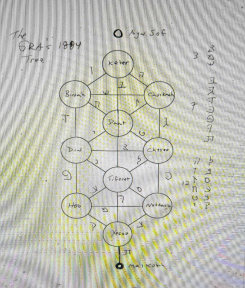
This assertion that the GRA Tree more faithfully reflects the true metaphysical structure and Divine Order of the Universe is that of Raw Clark and other scholars who adopt “the supposed initial presentation of the Universe” in the Sepher Yetzirah, but on what grounds? However, this apprehension is erroneous.
The Sepher Yetzirah – The Book of Formation
Indeed, we know that the authorship of this founding text of Jewish Kabbalah, symbolically attributed to Abraham , is attributed, with hesitation, to various Rabbis: Rabbi Akiva ben Yosef (2nd century), Rabbi Eliezer ben Hyrcanos (1st-2nd centuries), etc.
• It is, originally, a text without the notion of “Sephiroth,” nor a presentation in a Tree
The original text of the Sepher Yetzirah does not present the Universe with the Sephiroth called Kether, Hokmah, Binah, etc. as we know them from the Middle Ages to the present day. It presents it as “10 empty Principles of Creation” in connection with the succession of the Emergence of the Elements (1. Spirit of the living God => 2. Air from the Spirit => 3. Water from the Air => etc. then the 6 directions of space); it is a diagram with lines and not a Tree.
From the 2nd to the 4th centuries, the words “Sephira” (singular) and “Sephiroth” (plural) emerged, but Names (Kether, etc.) were not yet attributed to them. Until the 12th century, the diagram of the Tree did not exist. • In the 12th/13th century (1100-1200), the Names and the Sephirothic Tree were born in the Sepher ha Bahir, The Book of Clarity. We owe this to the work on the Sepher Yetzirah carried out by the Kabbalistic Circle of Provence, which named and arranged the Sephiroth in the form of the Tree we know. This ensemble has since been adopted by all Kabbalists; the Tree presented with the succession of Sephiroth by the Sepher ha Bahir is the one also presented by the Hermetic Order of the Golden Dawn and which is also presented in “Light over the Kingdom.”
Therefore, the original foundations of Kabbalah, derived from the true Sepher Yetzirah, “more faithfully reflect the true metaphysical structure and divine Order of the Universe”; they are expounded in the Sepher ha Bahir, and do not pertain to the GRA Tree.
The Kabbalistic Tree GRA
The so-called GRA Tree (Gaon Rabbeinu Eliyahu) is wrongly attributed to the famous Gaon of Vilna (18th century) because it appears that this Tree is of a later construction. It shows the Sephira (6) Tipheret taking position before the Sephitoth 4 (Chesed) and 5 (Gerurah) and the Sephira Yesod (9) taking position before the Sephiroth 7 (Netzah) and 8 (Hod). Makhut (10) is in its place.
This Sephirothic ordering follows a different concept of the Universe that was rejected by many Kabbalists of the 19th and 20th centuries who were familiar with both the genesis of Kabbalah and its effectiveness demonstrated by centuries-old practice. A Sephirothic Tree, as revealed in the Sepher ha Bahir following the study of the Kabbalists of the Circle of Provence, was drawn by a Kabbalist in 1884 presenting it as a rectification of the GRA Tree.
The Sphere of Daath is clearly represented; this was later “suggested” and not written down because it represents a “chasm of swirling Elements, organizing themselves to bring about the emergence of Creation” and not a Sephirah in itself.2 Creation is revealed in the Sephirah Chesed, the 4th, the Quaternary, which contains it, that is, the rest of the Sephiroth (from 5 to 10), all crowned by the creative Ternary, “God Manifested” (Kether, Chokmah, Binah).3 It should also be noted that from the end of the 15th century, Pico della Mirandola also presents the Sephirothic Tree as we know it (Golden Dawn, “The Light…”), without Daath.
Order to Close the Hermetic Order of the Golden Dawn
One of the founders of the Hermetic Order of the Golden Dawn and its leader was Samuel Liddell Mathers (he added MacGregor to his name) (1854–1918). This Order enjoyed great renown due to the quality of many of its members, but also due to setbacks due to human vicissitudes.
Rumor has it that he received an order from the Masters of Wisdom, residing in Tibet, to close the Golden Dawn at the beginning of the 20th century. We have no details on the exact date; however, given the troubles the Order experienced due to the deviances (black magic) perpetrated by some of its members, this order seems justified.
PAA: III The Depth-Point Concentration: Bardon includes an exercise where the student learns to identify with the center (depth-point) of objects and eventually of their own being. This technique of shifting awareness to a “center of depth” is subtle but said to unlock profound perceptions. How does mastering the depth-point concentration contribute to one’s magical abilities at an advanced level?
In what ways did practicing this exercise affect your own development – for example, did it enhance your sense of unity with objects or living things, or improve your ability to enter a trance or akashic state?
For those struggling with this practice, what methods can help (such as using simple geometric objects first, or visualizing oneself as tiny as an atom at the object’s center) to eventually achieve that complete immersion into the depth-point? With such a small size we could work with the depth point of liquid or gas or idea could we not?
Concentrating on the Depth-Point
The Depth point is a vortex, more precisely a portal between several Dimensions. By focusing consciousness on the center of depth, it immediately shifts through this portal: we thus have a perception of different Planes or Dimensions, depending on our abilities; we can also approach the Akashic Trance.
It is important to remember that our consciousness is exactly where our attention is. The obstacles to these peregrinations from this depth point lie in the impurity of our triple structure (physical/etheric, astral, and lower-mental). These obstacles encourage us to purify our bodies (physical and subtle).
How has practicing this exercise influenced your personal development?
The results of this practice vary depending on the subtle structure of each student. Describing these personal results here will be of no use due to this difference.
Methods for Successful Completion of This Exercise
What has just been clarified: the purification of our vehicles and well-practiced concentration.
Working deeply on everything…
Yes, in the infinitely small as well as in the infinitely large.
PAA: IV Contacting Spiritual Beings (Evocation): In PME, Bardon provides a meticulous guide to evocation – the conjuration of entities ranging from elemental beings to Olympic planetary intelligences. From an advanced practitioner’s standpoint, what are the most critical preparations before attempting spirit contact as described by Bardon?
We know that he insists on having fully developed astral senses (clairvoyance, clairaudience, etc.) and a balanced personality as prerequisites. Beyond these, how important is it to establish one’s authority and relationship with Divine Providence before calling a spirit forth?
Are there any “common misconceptions” you’ve observed in students – for example, focusing too much on elaborate ritual tools or sigils and not enough on the internal connection – that you would warn against?
Lastly, could you speak to the attitude one should hold during evocation in order to foster a respectful, safe, and constructive communication with the being (for instance, balancing confidence with humility, and never evoking out of curiosity or greed)?
It is important to remember that before undertaking a magical evocation, the student must have successfully attained and completed all the degrees up to and including the VIIIth degree of the IIH.
The following answers all your questions, as it is the foundation of any spiritual path in general and the practice of magic in particular. It is about ethics, the desire to work for the good of all, and to nurture compassion for all beings.
This helps to intensify the connection with Divine Providence, thus promoting the action of our Akashic Principle on our human personality. Without this contact, continually creating the Divine Presence in our lives, nothing good can be accomplished, especially in magic. This is what will give us authority over intelligences and all kinds of entities we may encounter.
This is the passport to secure communication with all positive entities and instant protection against negative entities. It is both strength and shield. Whether for a mental or physical Evocation, it is necessary—as you yourself point out—to have developed one’s psychic abilities (physical/etheric, astral, and mental clairvoyance and clairaudience). This guarantees the Magician’s safety because:
• for a mental Evocation, they will have greater control over communication with the contacted Intelligence;
• for a physical Evocation, they will truly see and hear what is happening in the room, what the Entity is like in front of their circle; what frequency it emits, etc. It should be noted that the further we advance on the Path of Perfection, the more our Magic becomes “structural” and the more the Universe responds to our requests. Thus, positive Entities will naturally tend to help us and negative ones to move away. Our attitude will therefore be friendly and respectful toward the Intelligences or Entities contacted; we will therefore be careful not to disturb them to satisfy our curiosity but to really ask them for teaching or help for ourselves or for others, without forgetting to thank them.
PAA: V “Initiations into Hermetics” : Elemental Kingdoms and Moving On: How long do you think should be spend on the Elemental Kingdoms at the end of IIH. As it could be argued that a lifetime may not be enough for each of the kingdoms and the knowledge to be gained from the inhabitants of these kingdoms as Bardon as said could fill volumes of books. How long is enough before a student moves on to PME/KTQ. Is it possible for you to share any experiences with the Elemental Rulers?
Countless anecdotes could be cited, but this would be pointless because, on the one hand, the experiences are personal, and on the other, talking about them weakens the Mage’s psychic energy: often, the experiences may cease for a while. This is why it is recommended to keep quiet about them.
Moreover, the time required for a comprehensive knowledge of the Elemental Realms depends, let us clarify once again, on the Mage’s structure: the more he purifies it, the more he is in symbiosis with his Akashic Principle, and the more his occult abilities are developed, the more he will have experiences with the Spirits of the Elements; his contacts with them will be so easy and unsuspectedly spontaneous that these Spirits will often come of their own accord to help him in some activity or give him useful information.
PAA: VI Mastering the Electric and Magnetic Fluids: In the latter steps of IIH and throughout Bardon’s teachings, the student encounters the two primal forces – the Electric Fluid (expansive, fiery, active) and the Magnetic Fluid (contractive, watery, passive). How did you approach developing an awareness of these polar forces in your own practice? For someone at an advanced stage, what exercises or indications would you suggest to gauge their mastery over the electric and magnetic fluids (e.g. generating tangible heat/cold, or influencing objects/organisms via these energies)?
Bardon hints at tremendous applications once these forces are mastered – from healing with an electromagnetic fluid condenser to charging talismans. In your view, what are some ethical and effective ways to apply the electric and magnetic fluids in advanced magic? Moreover, how can one maintain balance when working with them so as not to become “charged” or imbalanced toward one polarity in daily life?
Explaining personal approaches is pointless, let us be clear, since everyone undertakes this Path with a different nature from others. One could respond by saying that it was simply by following Franz Bardon’s instructions.
Regarding the exercises suggested for assessing mastery of electric and magnetic fluids, you yourself provide an excellent answer: by generating tangible heat/cold, by influencing objects and organisms through these energies.
Finally, the use of a fluidic condenser is very useful in magical actions, particularly in the creation of talismans. Balance in the use of fluids is achieved by observing the number of times each fluid is used.
PAA: VII Qabbalah and the Power of the Word – Ethical Use of the Divine Names: KTQ teaches the use of the creative cosmic language – intoning letters and formulas that can influence reality across the mental, astral, and physical planes. With such immense power at one’s disposal, what do you consider the ethical responsibilities of a quabbalist?
Bardon writes that when a quabbalist creates causes in the Akasha through a word of power, “cause and effect are no longer subject to destiny but exclusively to the Highest Divine Providence,” and an adept “will never [use it] for merely… personal advantages” but will serve a higher will. How can a practitioner ensure they remain aligned with Divine Providence when working with the creative word? For example, do you recommend any specific self-checks, meditations or prayers before and after Kabbalistic operations to keep one’s ego in check?
And from a practical standpoint, how should an advanced student prepare themselves (mentally, morally, and spiritually) before even attempting to speak a formula from KTQ, so that the results are harmonious and in accordance with cosmic law?
At the level that the Mage must have reached to begin practicing “The Key to True Kabbalah,” all these questions have their answers: the level of the Mage is warded off all dangers.
The Mage will therefore not be able to harm anyone in any way, and it would not even occur to him to use the Keys selfishly.
As for creating in the Akasha, he knows what he can and cannot create so that this action is in accordance with Cosmic Law and therefore does not disrupt the karmas of the beings involved. This knowledge is acquired through the long process of development that has allowed him to approach the “timelines” relating to the destiny of beings and, consequently, not to alter them or, a fortiori, to propagate a kind of chaos.
Given what he has become through his journey since the first level of the IIH, the question of whether he is “in phase” with Divine Providence is not a matter for him: he is always in contact with It, and his actions are always in accordance with the Divine Will.
No specific prayers, etc., after the Kabbalistic operations to “master the ego” are required because at this stage of the Magus’s development—a stage that allows him to approach the Holy Kabbalah—the ego has largely been reduced.
PAA: VIII ERJ footnote: seven subplanes and Perfect Adepts
In response to the footnotes for the ERJ formula in KTQ, it’s mentioned in the footnotes that the 7 planes referred to are actually the 7 sub-planes of the physical-Etherical reality that we are bound to until one becomes a Perfect Adept. the 7 subplanes / 70 qualities arranged like a “Jacob’s Ladder” (intersecting, analogous subplanes) or entirely linear?
The Planes and their septenary subdivisions interlock and interpenetrate. They are distinguished by their respective frequencies. Imagining them as arranged on a Jacob’s ladder, or following a line, is false. For educational purposes, they are presented as being placed one on top of the other, from bottom to top. The footnote therefore explains that we are currently evolving in the most material spatio temporal zone of the Manifested Universe.
PAA: IX What sets apart an Adept from a “Perfect Adept”?
In the lexicon of esotericism, the word “Adept,” with a capital “A,” designates a Master of Wisdom, a “Buddha,” a being who has transcended his or her human nature and achieved the State of Ultimate Consciousness. Consequently, there are no half measures in Adepthood, “distinguishing an Adept from a perfect Adept.”
This word, written with a lowercase “a,” designates one who adheres to a given philosophy or religion.
PAA: X For days when you can’t practice the Bardon exercises, is there a single meditation or practice that can replace them all?
The exercise of Mental Emptiness which leads the student to “taste” the Sublime Presence of the Divine within himself and, always, “consciousness in the present”.
PAA: XI How has your relationship to—and understanding of—God developed over the years of your training?
The answer would be useless since the path depends, as has already been stated, on the initial structure of each person. Understanding and relating to the Divine are personal experiences and often inexpressible – or formulatable with human words – even to oneself.
PAA: XII How did you first start your magical practice? What led you to Franz Bardon’s work and has the result of this work matched your expectations.
The first question is personal; therefore, we cannot answer it.
As for the second question: anyone who approaches the Path of Theurgy (White Magic) finds themselves face to face with this Great Mage, Franz Bardon.
Finally, as for the third question: if there had been no satisfactory results, would Bardon’s works have been translated into French and disseminated in that language?
PAA: XIII Often we look at the description of the Elemental beings and the beings of PME – have Franz Bardons description matched your personal experiences with these beings?
Franz Bardon explains that spirits are an “energy/signature”: the way we perceive them, or their form, is linked to their abilities and qualities.
An Indian in Bangalore will likely see a spirit with an Indian appearance, while a Danish magician might see a spirit with blond hair, but they will all be the same spirit: the symbols that describe the qualities, the spirit’s origin, and its positive or negative qualities will all be presented to both magicians through the prism of their respective cultural symbolism.
PAA: XIV Do you think physical evocation is a good use of Magicians time or should the magician spend most of his/her time using mental wandering to go the beings sphere rather than bringing/inviting them here?
In our experience, it is better to mentally solicit the Intelligences of the Spheres described by Franz Bardon than to evoke them on the Physical Plane. They will instruct us in various magical techniques and will willingly perform requested work (help for ourselves and others).
As for the use of our lives, it is better, in our opinion, to pursue the daily purification of our subtle structure because without it, no progress will be possible. Moreover, in addition to the daily examination of our consciousness, our flaws and qualities, and the good thoughts and feelings to maintain towards all beings, we must always return to Mental Emptiness and “present awareness,” because these two practices— combined with those mentioned—are those that lead to Ultimate Consciousness. Once this is acquired, everything becomes possible, without rite, without outfit, without candle… To act then for oneself and the good of all beings, it will be enough to think and feel linked to the latter, and this, in all space and time. This is true Magic, Structural Magic.
PAA: XV Much has been made of Stejnar discovery re the names of spirits and the u se of a Cipher . http://abardoncompanion.de/Stejnar.html What are your thoughts on this?
Solar Intelligences are extremely difficult to pin down, and it makes sense to keep their names slightly obscure: we believe Franz Bardon used the combination you mention to protect readers and followers.
An experienced magician can see the Entities and ask them questions, just as one might ask for directions on the street: thus, this magician can simply ask the Entity to confirm its name if he or she doubts the names given by Franz Bardon.
We will then discover that the problem is resolved more quickly than we thought. Here again, the ability to invoke or contact the Intelligences is linked to the purity of our structure. Thus, when we are finally ready to evoke them, the answer to this question will be obvious.
PAA: On behalf of the the community I would like to thank you for your thoughtful and detailed answers to the communities questions. Your time and generous sharing is greatly appreciated.
Visit Editions Moryason here
Footnotes
- The exit into the astral body is accompanied by the exit of a part of the etheric double; the other part of the latter remains in the physical body, firmly attached to it by the “silver cord” which is anchored in the etheric heart. If this cord detaches from the heart, it is the beginning of death.
↩︎ - When we present the Daath Tree as a Sephira, we obtain 3 Quaternaries, that is to say 12 Centers of Force which are summarized in the initial Ternary of the expression of Life (12 = 1 + 2 =3 ).
↩︎ - Although the “true” Divine Manifestation begins with the “trembling” of Manifestation in the Great Breath that Kabbalah calls the “Three Veils”: Ain, Ain Soph and Ain Soph Aour. From the latter springs the Light that will create and flow over the entire Universe which becomes “God Manifested”.
↩︎

Join the Perseus Community – It is Free!
A Community for Practicing Magicians, Meditators and Internal Martial Artists
Please join us, introduce yourself and begin sharing and learning. We have areas covering all aspects of the esoteric from both Eastern and Western traditions, Energy work and Internal training all freely available on the platform. See you inside.
Explore COURSES
Join a FREE Course
We have a growing collection of free courses from various teachers. These courses give you a chance to get to know our teachers better while developing a new skill set.
Or try one of our premium courses with a 15% discount code: welcome15