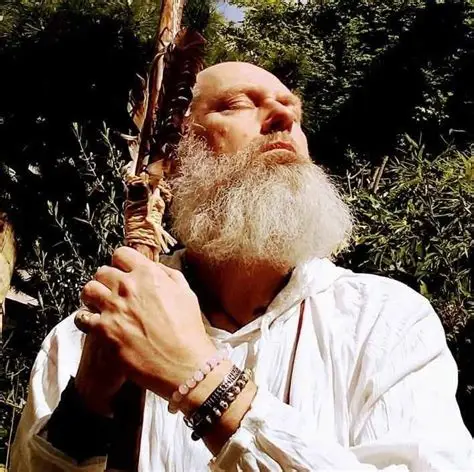
This interview with Gabriel Teixeira, I think will be of great interest to students of Franz Bardon. As topics not often mentioned within our Franz Bardon related interviews are brought up and expounded upon. There is also the possibility of a future live session with Gabriel if readers make their interest known. Please let us know your thoughts and any questions in the comments.
For those who would like to follow up on the work of Mr. Walter Ogris as mentioned in this interview you can find his website here.
Interview
PAA: What brought you to the world of Magic, Hermetics and Franz Bardon? How did you begin your training?
Well, I began to take an interest in magic from childhood. I was already born somewhat sensitive and could occasionally see ghosts. Although I was raised in a Christian household, I already carried some exotic ideas and behaviors from the spiritual realm from which I come. My first contact with energies and magic was through the MO-PAI system of John Chang (John Baharudin — the Magus of Java). I watched an excerpt from the documentary Ring of Fire, in which he demonstrated pyrokinesis and healing through chi emitted from his fingers. Shortly after watching the documentary, I got in touch with one of his students in order to receive instruction. Not long after that, I came across Mr. Bardon’s book (Initiation into Hermetics). From that point on, I began to practice—and I never stopped.
PAA: During your training of IIH what specific areas did you find challenging? Did you do anything differently to overcome these challenges?
I believe that if you carry heavy karma, or if you have a mission and destiny that run counter to any system of magical development, then all exercises can become a challenge. I came from the demonic realm, so my pact had been partially concluded, allowing me to become human again. However, because I still had a mission to fulfill, all the circumstances that afflicted my life were contrary to the system proposed by Mr. Bardon.
For those accustomed to Goetia, having to sit down and focus on a single thought, enter emptiness, work with the soul mirror, and so on, can be extremely challenging. The best way to overcome these adversities is to allow for adequate periods of rest, because Bardon’s exercises cause micro-injuries to the soul, and each person has a specific recovery time for the astral body to heal. Sometimes, practicing every day can actually delay progress.
Part of a person’s fate is recorded within their own astral body, so the exercises can accelerate destiny and karmic resolution. For this reason, for some beginners, all kinds of misfortune may occur when practicing these exercises, because you are interacting with the karmic records of your own soul when you do them. Therefore, the best advice is to respect your own recovery time between exercises and to progress with quality rather than haste.
PAA: What are your thoughts about Step 1 and particularly VOM, some students spends years on this step. Do you think they are misunderstanding the requirements or do you think it is correct to stay on the step until students believe they have perfectly passed it?
My opinion regarding the early grades of IIH is that they are initially focused on a form of astral and mental hygiene. Mr. Bardon wrote his first book as a kind of “prologue” to the contact with cosmic consciousness that comes in the second book. Therefore, the beginner should focus on the fact that, by practicing the exercises, you are preparing yourself to enter into contact with the geniuses of the higher spheres. This is not something you do without giving up your worst habits—you must change as a person as well. It is a gradual and initial transformation whose purpose is to prepare you for the next step ahead.
My second opinion is that the minimum amount of time Mr. Bardon recommends is more than sufficient to move forward, considering that Akasha meditation alone will exponentially expand many of the previously proposed exercises. The only exception is when you are practicing in order to balance your deficiencies. In that case, you may focus more on one exercise or another.
The third point is something I have already mentioned before: these exercises release negative karma recorded in the perispirit, so it is normal to have days when the exercises feel perfect and days when you are unable to progress. The ideal approach is to focus on a balanced quality in achieving the goals proposed by the exercises, rather than on extremes—as if Mr. Bardon were demanding that you become a great, infallible magician from the very beginning.
It is important to remember that all our actions are recorded in the Saturn zone of the Sun and in the Earth zone. When you feel that you are struggling with an exercise, pray—pray to Divine Providence. The Bardonist tradition has a legion of spirits who guard against degeneration: the Incandescent Sun of midday; Sata Pessajah (the Great Watcher); Ugolog (the Pure of the Pure); Aschmunadai; Ados; Laosa; the 49 officials of the Egyptian tradition; Iserag (who was worshiped in Greece for a long time), among others. As Mr. Emil Stejnar discovered, Bardon’s entire system is oriented toward a kind of lost magical tradition whose purpose is communion with the stellar zone. There is no reason to think that you are alone on this path. This system is completely mystical and magical at the same time.
Well, a student can only fully understand this exercise (depth point) if they receive a Mercurial or Saturnian initiation, so here is a bit of Mercurial initiation…
Gabriel
PAA: Depth Point is one of the key parts of the journey in my opinion. What can you tell us about this? Some students have trouble making a clear difference between projecting into a thing (Step 4 mental) and going into the depth point of a thing (Step 5).
Well, a student can only fully understand this exercise if they receive a Mercurial or Saturnian initiation, so here is a bit of Mercurial initiation. Basically, transferring one’s consciousness into an object is meant to understand its visible relationship with the environment. Transferring one’s consciousness to the point of depth of something is meant to understand that object’s relationship with the matrix of the sphere in which it exists.
For all reality is connected by invisible laws to a central point. This central point is linked to parts of reality through concatenation. Thus, each of the six principal directions (above, below, right, left, front, back) is connected to a core that results from the interaction of these six directions.
For example, in the experiments of Mr. Emil Stejnar and Mr. Walter Ogris, they explain how the thought-cell I AM is formed. By imagining a six-pointed star, we can say that the way I AM interacts with each direction expands or diminishes the perception of I EXIST. Every interaction and friction is recorded simultaneously in the Mercury–Saturn zone and within the adept’s own astral body.
Therefore, the point of depth refers to the existence of a thing in relation to its surroundings. In other words, to be more didactic, it refers to how the growth of an apple tree’s roots interacts with other trees, with the soil, with water, and so on.
PAA: Can you share anything about your first experience with a world or entity outside of yourself? Was this a shock to you or have you always been open to these ideas?
I have had some experiences with astral travel, although this ability is not my primary one. I cannot recall the very first experience, but I do remember some that were quite impactful. One of them occurred when I was working with the Light of the midday Sun, using the Jewish Tikkun HaKlali. After some time of practice, the zone of the Egyptian god Khepri opened, and a few days later I was taken to a related spiritual zone.
I remember that when I was taken to this zone, I was accompanied by three other spirits. We were flying and passing through places that resembled luminous cathedrals. It was, so to speak, a radiant cathedral with multiple thresholds through which we passed very quickly.
After moving through these celestial cathedrals, we turned left and passed what would be the final portal. Then we entered the twilight zone. When I entered this zone, I was received by children who had bright orange eyes. They had small wings, as if they were little fairies. In theory, when you are working with a spirit, you eventually become accustomed to its energy, and everything that comes from it will seem normal to you. Therefore, I was not frightened by the experience.
As for evocation, I practiced it extensively throughout my entire path in Hermeticism. In the beginning, I was always fascinated by physical effects and Goetia. There was one evocation that caught me by surprise—it involved a genius of Aries. I was not yet fully prepared for its materialization, so I traced the seal in the air using my index finger, and the seal quickly pierced the sphere, producing a sound like the blast of a bomb. It was not very loud, but it was audible.
After this small explosion, two auxiliary ministers appeared. Because I was not prepared for the physical effect, I began to feel weak and nearly fainted, as the sphere of the being started feeding on everything around it. I then quickly gathered my will and presented my demands to it. This was a careless act, as I failed to take into account that at that moment I held special prerogatives for contact with the being.
PAA: Let’s look at Step 8 and the jumping off point to work on PME or KTQ. Did you move on to these other books at this point or did you wait until you had more experience in Steps 9 and 10 before starting those books?
I practiced all the grades of IIH, but I did not find it useful for me to practice the ninth or tenth grades with the same intensity as the others. Therefore, I practiced intensively up to the eighth grade, and I approached the ninth and tenth with much less intensity before moving directly on to the second book
PAA: Following the last question, what came first for you, PME or KTQ, and why?
For me, PME came first. I did not practice the third book, as I learned a different type of Qabbalah from the geniuses—one that is very similar to the one Mr. Walter Ogris also learned and partially expresses through his talismans. I believe that, for the external public, Mr. Walter Ogris is the greatest living Bardonist.
Naturally, I could not speak about Mr. Emil Stejnar out of respect for the Law of Silence and for the information that was delivered by the Mercury zone at that time. In Mercurial magic, it is common for an adept’s magical work to interact with the magical work of other adepts, given the “communicator” nature of Mercury/Hermes. As a result, I ended up interacting with and discovering “small magical secrets” from other practitioners—not personal matters, but functional ones. At the time, I came across aspects of Mr. Emil Stejnar’s magical work that helped me in my own practice, even though I do not know him personally. I also gained access to a small fragment of Mr. Walter Ogris’s magical knowledge.
I consider Mr. Walter Ogris’s Qabbalah to be the most elegant and the one that most fully respects all the laws of the Earth zone—especially because it goes beyond the laws of quality and quantity taught by Bardon and makes use of certain laws taught in the Mercury zone, such as: name, form, mode of manifestation, implicit codes, external symbolic representation, the Qabbalah of the sphere, energy signature, and so on. Although I do not know whether he himself uses these exact terms to describe the Qabbalah he applies when crafting a talisman, these names are concepts we learn from the spirits of Mercury. Therefore, it is possible that he learned them under different names.
I believe that Mr. Bardon’s Qabbalah (KTQ) is exoteric because the judges of the zone that surrounds the Earth would not allow the revelation of other missing keys.
Gabriel
PAA: You believe Bardon’s Qabbalah is exoteric rather than esoteric. What do you mean by that distinction, and what makes Bardon’s presentation “exoteric” in your view?
I believe that Mr. Bardon’s Qabbalah (KTQ) is exoteric because the judges of the zone that surrounds the Earth would not allow the revelation of other missing keys. Therefore, what we have there is a reutilization of knowledge that already existed publicly beforehand (and thus does not violate the Law of Silence). Master Bardon added one or two laws in order to make that Qabbalah function in a way that would not conflict with the established laws.
In other words, it is a Qabbalah that Master Bardon created for the general audience of his two previous books. I do not believe that he used this Qabbalah for complex matters or for workings involving spherical signatures (a sensitive and secret topic). Given this explanation, it is an exoteric Qabbalah that does not require initiation.
PAA: You’ve said some beings mentioned in Bardon’s own work do not like “this Qabbalah.” Which kinds of beings react negatively, and why would a being object to that approach?
I believe they dislike this Qabbalah because it lacks precision. One can easily commit excesses and acts of disrespect with it, which in occultism we would say “weighs” on one’s karma. In addition to that, other keys necessary for the proper use of this Qabbalah were not included. I believe Bardon expected many of these doubts to be clarified through contact with the beings themselves.
I have known some Bardonist magicians who ruined their lives by practicing this Qabbalah in a very disrespectful and incorrect manner. Magicians who follow the path of authoritarianism always end up being abandoned by others.
PAA: You mentioned working for many years pursuing criminals “together with the Judges of Mercury,” using evocations to achieve physical effects. Who are the Judges of Mercury in your framework, and what makes them suited to that kind of work?
You can easily contact the Judges of Mercury through the seals of the 72 geniuses of Mr. Quintscher. They are the best sources for providing precise information when you need to understand decisions or effects in other spheres. Mercury is truly omnipresent and omniscient—you can know anything, about anyone, and on any subject. They are also excellent when it comes to obtaining missions in service of Divine Providence.
PAA: When you say “physical effects,” what range are we talking about — information acquisition, movement of probability, visible external phenomena, direct influence on matter, or something else?
External and recognizable magical phenomena to the uninitiated—in other words, thaumaturgy. There is nothing that frightens a criminal more than standing before an inexplicable phenomenon. When a criminal witnesses the manifestation of magic, they are usually filled with fear.
PAA: If you could add three “advanced but practical” pillars of content that most people aren’t addressing, what would they be (and what would each article do for the reader)?
The I-consciousness of Franz Bardon—remembering that you are a spiritual being within a worldly manifestation. Akasha (or emptiness) meditation. Interdependence. When properly applied, Akasha meditation can neutralize a great deal of negative karma and prolong one’s life, as it brings genuine balance. I-consciousness meditation helps reduce neuroses and strengthen attention. Awareness of the law of interdependence reminds us that all phenomena are interconnected, so that everything that happens is an effect resulting from the sum of our directed or unconscious actions.
PAA: What topics do you think should not be published publicly — because they reliably lead to harm, obsession, or karmic problems — even if they’re technically real? Topics related to sphere magic, advanced Qabbalah, and the laws of Mercurial sentence defense.
PAA: If you were planning a content series that bridges theory to practice, what would the progression look like from beginner-safe to advanced — and where do most blogs get the sequencing wrong?
I believe that Mr. Bardon’s system is already sufficiently solid; however, I would add more explanations about methods of energy cultivation. I would also include more material on the laws of the Earth zone and on mystical and purity-oriented spirits. I think that people, in general, do not clearly understand the implications of their magical actions, nor how much these actions can damage their next incarnation if proper care is not taken. An explanation of this would be extremely important.
PAA: Bardon’s work is sometimes described as being “supervised by the spirits he left behind” (linked to the second book). How do you understand that supervision in practice — and what forms can “permission” or “prohibition” take for a practitioner or teacher?
Well, for those who practice a very authoritarian form of magic, focused mainly on the fulfillment of worldly desires, access to negative spirits becomes easier. In this way, the initiate either learns more quickly through pain or is swiftly led to be corrected by life itself. Those who truly understand what lies behind Mr. Bardon’s knowledge, on the other hand, are guided by the Great White Brotherhood, by the Rosicrucians, by the Egyptian system, and so on.
Bardon’s system is supervised in the sense that it allows the poor practitioner to quickly encounter the Judges, while the good practitioner finds compassionate assistance along the path. The Bardon system contains certain “traps” related to authoritarian magic and subjugation, which the practitioner only realizes once they have already been condemned to ostracism by the Judges—or when they no longer have any health left.
PAA: If Divine Providence ultimately permits or forbids outcomes, how should a magician balance personal will, responsibility, and humility — especially when working Bardon’s system?
The practitioner must remember that no matter how much power they attain, there is always a higher zone above them (the paracosmos). They must remember that no matter how much knowledge they acquire, there will always be something they do not know. And they must remember that Divine Providence is not merely an agent, but an entity. Just as the adept may believe they can interfere according to their own will, a higher zone can also interfere in their magical work if it judges it to have become too degenerate. Humility, always.
PAA: Presenting Bardon’s work publicly can be difficult because we may “have to give an account” of our actions. What specific ethical lines should teachers and publishers be aware of when presenting Bardon-related material?
Inner reform and the soul mirror. Being able to look into your own soul and tell the truth about the intentions behind your actions. No one doubts the goodness of a sweet and innocent child—the Judges wish to look upon the magician in the same way. Good attracts good; evil attracts evil. Selfishness attracts selfishness; altruism attracts altruism. No one can escape themselves. The ethics of our actions lie in observing the effects produced by both our magical practices and our ordinary actions up to this point. If they satisfy us and lift the weight from our conscience, then all is well—at least if we err, it will be out of ignorance, not from pleasure in doing harm. But if, when facing their own actions, the practitioner feels shame for what they have become and for what they have done, then something must be corrected.
PAA: Bardon had no monetary interest — his work was compassion and mission — yet magicians still need to charge fairly. Where is the line between fair exchange and “dangerous ground” when money touches Bardon’s teachings, in your view?
Desire and attachment are poison. The money a magician charges for something they offer should come from what they perceive as fair and balanced, without extremes. If they begin to charge solely for the pleasure (desire) of money, then decline begins. One should charge what is considered fair, aiming at harmony, and keep the desire for money in a secondary place.
There are many cases in which charging for a magical service serves as a way for a person to pay for negative karma they have generated, and in other cases it serves as a way for the person to replace trials and suffering with the merit of acquiring a magical service or knowledge. But fundamentally, when you keep the desire for money out of the equation, you are far more likely to charge a fair and just value for magic.
PAA: Clairalience can develop without being directly pursued. What practices were you doing when it emerged, and what does that suggest about how Bardon-style training can awaken faculties indirectly?
I believe that emptiness meditation can develop an incalculable number of gifts, especially because it allows the energy reservoirs to be filled with vital energy in a calm and balanced way. I believe that the internal rearrangement of this energy can awaken powers that are still unknown to us. My clairalience emerged from excessive use of psychometry. As I am naturally sensitive, that sensitivity itself seems to draw forth other gifts whenever it feels the need to complement the experience.
PAA: You mentioned learning dances that “evoke beings or powers without the need for words.” How do you understand the mechanism — what is the dance doing that replaces verbal formulae, and what risks should someone consider before exploring it?
Dance, bodily movements, hand gestures, guttural sounds, and similar pr actices are another form of Qabbalah. Together with drawn Qabbalah, they are among the most refined and elegant forms of Qabbalistic practice. Formulas that rely solely on the voice tend to reduce the magician’s life force, because they consume kinetic energy, and their compensatory attribute (counter-effect) causes the magician to physically feel the energy they evoke through words—thus shortening lifespan and consuming a significant amount of Jing.
When one dances or draws, the attribute of energetic exchange tends to be distributed more evenly throughout the physical body, which reduces or even nullifies the collateral effects of the spoken formula. This type of practice is better learned through initiation from a being, rather than attempting to extract “illegal” movements from the Akasha and ending up using an illegitimate form of Qabbalah. I am of the opinion that Mr. Bardon himself preferred hand gestures.
PAA: Some beings can be bad-tempered or sarcastic. Beyond the humor, what does spirit “temperament” teach about working responsibly — especially boundaries, protocol, and avoiding projecting human expectations onto beings?
This is an indirect warning to magicians who work heavily within the laws of sovereignty and force. Treating a being as if it were your subject is not a good path. Remembering that a spirit is a living being and shares in the same life force as you will always lead to a more pleasant and less problematic experience.
Mr. Bardon already hinted, between the lines of his second work, that some beings can “take revenge.” Many of them also possess knowledge that they do not reveal to you. A good example occurred once when I was speaking with André Consciência shortly after performing a Lunar evocation. The spirit was still nearby when it noticed a message André had sent me. Immediately, the lunar spirit made a joke that only André would understand—about how ironic it is for someone who works with words to be unable to find the right expressions for things. Therefore, a respectful approach toward beings is always the best course of action.
PAA: You recently shared posts in the Students of Franz Bardon Facebook group with a connection to a Rosicrucian egregore. Could you share more about that connection and why it matters for practice?
According to my research, Mr. Bardon worked directly with the “morning sun,” alchemy, and the assistance of invisible beings who comforted him during moments of suffering. In his novel Frabato the Magician, Mr. Bardon describes a scene in which Urgaya appears in the Assembly of Communion. Since I encountered the spirit of the “pure essence” of the White Pelican, I have not been able to avoid the feeling that URGAYA URANIA is, in fact, one of the elder brethren of the Great White Brotherhood.
Dion Fortune also encountered the secret fraternity and referred to them as the “Occult Police.” From that point onward, I was able to observe correlations among several organizations operating under different names, yet all beneath the same central symbol—a sun among clouds. Because of this realization, I changed the direction of my magical work, turning more toward what Mr. Emil Stejnar had been working on in secrecy for several years, even if perhaps not directly.
No adept can enter higher spheres without the purest alchemy, nor without respecting the solar law of the Earth Zone clock—the positions assumed by the Sun in the early morning, at midday, and in the late afternoon. The Sun in these positions, the stellar zone, the Moon, and the waters of the sign of Pisces together form the axis of Mr. Bardon’s Egyptian (or Chaldean, if you prefer) magic, derived from the Cult of the Light of Horeb and many other matters that cannot be spoken of here.
But certainly, the magician who seeks communion with the most refined beings will correctly understand Mr. Bardon’s works and will be able to clearly perceive the correlations among the Rosicrucians, Mr. Alois Mailänder, Joséphin Péladan, Helena Blavatsky, Urgaya, Stanislas de Guaita and others.
PAA: Lastly, please add anything you feel we have missed in these questions.
Happiness! Magic exists to make our existence more radiant, comforting, and happy. To make our days warmer, and so that we always have a safe place to rest. Magical powers and spiritual experiences are secondary. If there is no happiness, none of that truly matters. May our hearts be filled with the radiant light of love, and may our days be long, joyful, and full of uplifting experiences. May Divine Providence always look upon us with compassion, and may we never lose our innocence and our hope. May Divine Providence bless us with Its Grace, today and always.
PAA: Inspiring information, thank you very much for taking part and for providing these very detailed answers.
Join the Perseus Community – It is Free!
A Community for Practicing Magicians, Meditators and Internal Martial Artists
Please join us, introduce yourself and begin sharing and learning. We have areas covering all aspects of the esoteric from both Eastern and Western traditions, Energy work and Internal training all freely available on the platform. See you inside.
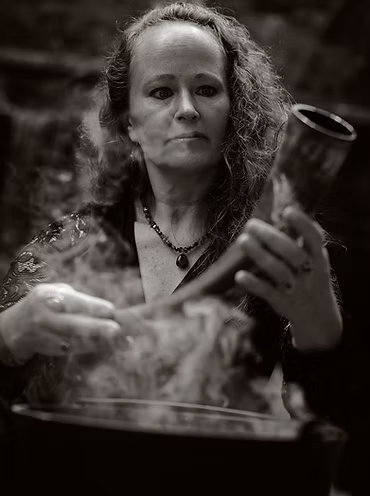
In this post we talk with Nikki Wardwell Sleath in what is a highly detailed and informative interview. Nikki Wardwell Sleath is a full-time occult teacher, author, and founder of the Society of Witchcraft and Old Magick. In this interview, she shares how her early experiences with spirits shaped her path, what disciplined training taught her about ritual skill, and why lucid dreaming can function as a living laboratory for real magical practice.
We hope you enjoy this interview and find it useful for your own practice. If you’d like to learn more about Nikki and her work, you’ll find a set of links at the end of the post.
Finally, we’d love to hear your thoughts—leave a comment with any questions or reflections, and share this post with anyone you think would enjoy it.
PAA: Your ancestor Samuel Wardwell was executed during the Salem witch trials, making you the eight-times great-granddaughter of a woman accused of witchcraft. How has this unique family history influenced your own path as a witch and occultist? Did growing up with a Salem witch in your lineage shape your identity or inspire you to explore witchcraft?
Interestingly, though I had heard vaguely of my ancestor Samuel and knew he was hung in the Salem witchcraft trials, there wasn’t much talk of it in my family during my upbringing. As a high schooler I began to realize that I really should know more about this, and I did a genealogical project for a social studies course, where I charted my ancestry back along the Wardwell (my father’s) side of the family. This was not hard to do, as I grew up in Reading, MA, which is only about twenty or thirty minutes from Salem. The local libraries had lots of old birth, death, marriage and tax records and it was pretty smooth going as I connected the dots of this history. Still, I had not really connected the dots of my own magickal nature yet at that time, in my youth. I was very intuitive and perceptive, and had very vivid dreams but I never really realized how inspiring it was to have Samuel as my forbear until I was an adult and will into the development of my own magickal practice. He was actually on record as having had the ability to tell fortunes with cards, and to be able to know things that would happen ahead of time through dreams. Aside from Tituba, he may be the only person who was accused based on any actual magickal skill. I find it fascinating that dreams and cards are also my own personal strongest forms of divination, talent-wise. Certainly, now that I have been operating publicly as a witch for so long, I am so grateful for his legacy, and it feels like an immense honor to be able to practice and teach the Craft publicly. It feels as though my work has helped to shift some familial karmic balance in this regard.
When I heard spirit voices in my house, I just assumed that if anyone else had been there with me at the same moment, that they would have heard it too.
Nikki Wardwell Sleath
PAA: In interviews, you’ve mentioned that as a child you became aware of voices and spirits in your family home, and even noticed your psychic abilities sharpening every fall season. Can you tell us more about these early paranormal experiences? How did they lead to your “huge spiritual awakening” and the realization that you were a witch for life?
Honestly, as a kid, I just thought I was kind of perceptually sharp in general, but I didn’t initially notice that there was actual psychic ability there. My mom would joke about me having “ESP”, but I didn’t really think there was anything extraordinary about my psyche. When I heard spirit voices in my house, I just assumed that if anyone else had been there with me at the same moment, that they would have heard it too. I now know that would not have necessarily been the case. I would sometimes pretend to be a fortune teller or make potions out of acorns and rainwater in the yard, but it definitely felt like play when I was young. I certainly did have plenty of time to play on my own and get lost in imaginative thought in the old victorian house in which I grew up in MA. It wasn’t until I was a student at the University of CT that I started noticing that pattern of extra crisp psychic clarity ramping up each fall. That sensation was really something though, and after I noticed it a couple of years in a row, it was no longer something that could be ignored or written off. Luckily, this coincided with a time when more occult books were starting to be seen on the shelves in bookstores, and when the internet was just starting to provide access to other people’s thoughts, articles and teachings. There had come a day when I was hellbent on digging further into my psychic relationship with autumn, and I found a couple of online articles about the modern-day practice of the Craft. When I read about some of the underlying beliefs, practices, themes of personal magickal and psychic development, it resonated with everything I felt to be true about myself and my worldview. That was when I had a moment of hyperclarity and truth chills, understanding that I would never stop following after the mysteries of magick and the Craft from that day forth.
Training, Healing, and Personal Breakthroughs
PAA: You received formal training as an initiate and priestess in the Religious Order of Witchcraft. What was that training like, and what are some of the key lessons or disciplines you learned as part of this tradition of American Witchcraft?
Since ROOW is an oathbound tradition, I can really only speak about my experience in generalities. The training was a very traditional “year-and-a-day” type of training where I had a private lesson with my High Priestess once a week, and also gathered with the other members at each Sabbat and full moon to be in ritual together. I was a sharp student, easily taking to formal divination practices and ceremonial magick skills, so I was shunted straight from my initiation as a witch into another year of training as a priestess. I got a lot of what I call “on the job training” in my experience with ROOW. I never intended to teach magick or do any of this professionally. I undertook my training solely for the purpose of quenching my own deep thirst for greater exploration of the mysteries, and for the expansion that arises when magickal experiences are shared with others. All the same, as my propensity for this work became clear, I found myself quickly being asked to take on leadership responsibilities in a way that validated my capabilities. Some of the key things that were reinforced to me that were very valuable were the need for constant study, and the realization that continual learning would be my key not only to ongoing effectiveness magickally, but to personal fulfillment. I was prompted to study from the oldest texts I could find, and not to fear the archaic language or dark connotations associated with some of them. This was probably one of the greatest gifts of my training- gaining the confidence and ability to patiently pick through old tomes and see how powerful it could be to bring old magick into my own modern practice. I also truly learned the value of honed ritual skill and the benefits of a daily ritual practice, and this is something that I continue to impress upon my own students to this day.
Our approach is to never tell a student what is absolute truth, but to give them tools to explore what they are able to hold as truths personally.
Nikki Wardwell Sleath
PAA: After years of practice, you went on to form your own occult order, the Society of Witchcraft and Old Magick, also known as the Wardwell tradition of American Witchcraft. What inspired you to create your own magickal order? How does the Wardwell tradition differentiate itself from other witchcraft traditions in terms of practices or philosophy?
I branched out to create my own order because I wanted the freedom to be creative in terms of ritual and curriculum development. I left the ROOW in order to do this, so I have no idea how things are in that order now, but at the time when I left many years ago, it was extremely traditional in terms of the insistence that things were always done a certain way, following old traditions. I love tradition and learning from prior magicians, but I also tend to be something of a chaos magician in the sense that I prefer to allow my beliefs, and therefore my corresponding practices, to evolve as I do. Part of what is different about SWOM is evident right in the comparison of the titles of the two organizations: the order I trained in was quite religious, where I tend not to be. SWOM is, at its heart, a training order and not a religious organization. Yes, we offer ceremonies and teach practices that facilitate spiritual experiences for the participants and students. Where we differ from other orders is in trying to avoid dogma, and being cognizant not to fall into traps of fundamentalist thinking wherever possible. So, the Wardwell tradition of American Witchcraft emphasizes learning and evolution, the respect and consideration of teachings from traditions from all over the world, and the use of magick to work toward greater wisdom and enlightenment in this life. Our approach is to never tell a student what is absolute truth, but to give them tools to explore what they are able to hold as truths personally. Essentially our belief system is that we should always be breaking the walls of any belief system, and that we can use magick to do this. It is due to this approach that I have decided not to file the order as a religious organization, but to operate solely on the basis of personal instruction.
PAA: You have a strong background in healing arts – you hold a Master’s degree in Integrative Health and Healing and are a Reiki Master/Teacher – and you offer private psychic and energetic healing services in your practice. How do these holistic healing modalities intersect with your work in witchcraft and magick? Has your training in health and energy healing informed the way you cast spells or conduct rituals, and vice versa?
It is impossible for me to keep healing and magickal practices separate from one another. I perceive every moment as a unique combination of energy and consciousness that not only manifests in its own way, but also vibrates with the raw potentiality of magick. For me, there is a sense of the dreaming universe that underlies all things, no matter the time of day or the season of the year. When I set intentions and make myself very present for a client in order to flow healing energy to them, for example, I become very aware of liminality of it all, and in the space between the intention to receive healing and the integration of the experience, I find spirit guides, psychic information, spontaneous new healing techniques, and more. It is all so undoubtedly magical, and for this reason I am very forthright with new clients about my tendency to eclectically blend Reik and witchcraft, for example. I can’t undo what I know, in a sense. If I’m present to a healing flow of energy for a client and I start psychically hearing the name of a rune or a spirit being chanted, I’m not going to ignore the pertinence of that magic to the session- I’m going to engage it. On the flip side of all of this, having become very comfortable with how it feels to open to the flow of Reiki also adds to my ability to flow energy through myself for ritual, channeling and all kinds of other magickal purposes as well. A few of my trainings are very shamanically oriented in their healing approaches, and this is simply magick. Everything I learn informs everything that I do and that’s sort of just how I roll.
PAA: You once noted that you “would not be where [you are] as an occult teacher” had it not been for studying healing on a holistic level. Looking back on your journey, what have been some of your biggest personal breakthroughs or turning points in magick? For instance, were there moments when your understanding of occult practice evolved dramatically or when you achieved a new level of spiritual insight?
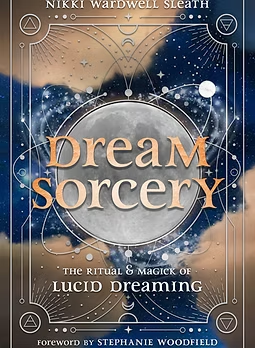
I am so fortunate that part of the requirements for the holistic Master’s degree I sought included having to do mentorships with three various well-established holistic professional practitioners. Some of my biggest breakthroughs happened as a result of undertaking trainings with these mentors, specifically in doing various week-long in-person trainings to become a facilitator in the approaches of Robert Moss, as a teacher of Active Dreaming, and with Llyn Roberts to be trained as a shamanic Reiki practitioner. Llyn brought all of her experience working with Peruvian indigenous shamans to the course work she created (with their blessing), and her training was rigorous in terms of hours spent learning spirit flight. This caused the metaphorical psychic training wheels to go flying off in the sense that the repetitive work caused me to come away with an ingrained confidence in what the groove of spirit flight feels like and how to get right back there whenever I wished. When you know you can seek the wisdom of spirits and guides literally and directly at any time and trust the ensuing experiences, anything is possible in both magick and healing. Exposure to Robert Moss’ teachings just blew my mind with respect to the limitless potential that lies in dreams. I became constantly aware of wanting to integrate more and more of my night dream experiences into my daily life, and this is what caused me to start becoming fully lucid in my dreams. I was thinking about dreaming so much that I would realize I was dreaming, and then try to learn even more in those lucid opportunities. I describe one particular breakthrough dream in my book Dream Sorcery, where I became lucid and suddenly just started receiving hyper-clear wisdom downloads from the energy of the dream scene itself. It’s impossible to relay with words exactly what this feels like, but I woke up feeling quite irrevocably changed. I understood something about the ongoing nature of consciousness in the dreaming that put physical incarnation into perspective in a new way. While each life is important and should be lived to the fullest, I knew fully that this life only comprises a quick glimmer in the cauldron of all that we are. The understanding in that dream was so crisp and acute that I found the sensations of this reality to feel a bit blurred and less “real” feeling than what I had experienced in the dream. I would definitely call this a moment of sudden new spiritual insight, and it informed the motivation of my dreaming practice from that point forward. Since that time I have purposefully engaged lucid dreaming and spontaneous night dreams consistently to aid all of the important magick that I have done, including attaining by traditional methods the coveted “knowledge and conversation” with my Holy Guardian Angel.
Lucid Dreaming and Dream Sorcery
PAA: What sparked your deep interest in lucid dreaming as a component of magickal practice? You’ve trained to the highest level in shamanic dreamwork with Robert Moss’s School of Active Dreaming and now you’ve authored Dream Sorcery: The Ritual & Magick of Lucid Dreaming. Was there a particular experience or influence that led you to marry lucid dreaming with witchcraft and sorcery?
Two experiences I had with lucid dreaming that greatly spurred my fusion of it with magickal practice included energy infusions from the Morrigan, and my runic sorcery training. When I first started to realize the spiritual intensity of lucid dreaming, I began trying to summon the Morrigan, the ancient Irish goddess of battle, prophecy and death, into my lucid dreams. After a few tries I had the experience where she arrived as an onslaught of swirling energy- a tornado of abstract wings and feathers and bats- that hurtled toward me with great force. I allowed the energy of this Morrigan tornado to smash into me, and it ended up thrumming through me with the vibrations of an out-of-control train. Imagine deep, vibratory energy racing through your body at top speed. I gave myself over to the sensations, and my dream body began involuntarily floating, writhing in the air, and snarling. When I woke, I could feel the energy thrumming through my physical body for a long time after. The dream empowered my auric field in a very obvious way, and I was so grateful, and simultaneously excited to see what else was possible. Not long after I began deepening my lucid dream practice, I also began the work of Edred Thorsson’s The Nine Doors of Midgard. This is a book that provides the outline for a self-guided system of training in runic sorcery. It takes a few years to do the whole thing to the letter, and being unafraid of ongoing magickal work, I made the commitment and dove in. Each stage of the training calls for in-depth, close examination and practice of each rune for long periods of time, using many varied approaches. There is psychic work, yogic work, academic study, and of course magickal practices such as chanting and hand gestures that are all a part of the recommended training. I was doing all of this, but felt I would be remiss if I did not also add a lucid dream component to my learning with each rune. After all, the point of such a training is to learn to embody the runic energies to such an extent that you become a natural channel for their wielding at will. I began using my lucid dreams at the time to practice signing, gesturing and chanting the runes. I would enact the technique and then pause and watch the dream environment to see what the effects were. Upon waking, I documented every such experiment with all the detail possible, so that I could continue to build on my experiences and benefit from using the techniques more confidently in waking. Spending the time doing this for all 24 runes of the Elder Futhark really impressed upon my just how perfect the lucid dream state is for experimenting with and honing magickal skills.
PAA: Your approach to dream work is quite unique – Dream Sorcery isn’t just another dream guide. In fact, it treats the lucid dream as “a metaphorical alchemy lab” for transforming one’s magickal practice. How does Dream Sorcery differ from more conventional lucid dreaming books or from psychological approaches to dreams? What can occult practitioners gain from lucid dream magick that they might not get from traditional spell work or meditation alone?
Dream Sorcery is different from the other lucid dream books out there in that it highlights the theory that consciousness is not local to our physical brains. It requires the reader to consider all of the dreams that show us that we are often transcending time, and all of the dreams that bring us real interaction with other spiritual beings. These are the transtemporal and transpersonal potentials that exist within dreaming. Magickal practitioners naturally work with these enchanted parameters of reality, so the conventional lucid dream material that takes the approach that everything about dreaming is solely about you and your own mind, is very limiting to them. I knew that the magick I was experiencing through my lucid experiments was achingly real, and that no one else was really teaching about this in any accessible depth. The book had to be written, and I believe it is an important addition to today’s magickal literature. There is so much that an occultist can gain from lucid magick that they can never gain from waking magick alone. At the crux of this is the ability to function as a spirit, thereby collecting glimpses of truths about the nature of consciousness itself. Lucid dream magick is the only way (outside of some kinds of astral projection experiences, which are just as tricky to cultivate) to perform magick while still existing here in this physical life, yet without the limitations imposed by being in a physical body. Journey work, meditation, trance and all kinds of waking divination work are all impacted by the combination of the body’s presence upon our conscious awareness.
PAA: In dreams, you’ve said, the usual rules don’t apply – we can practice magick without the physical world’s constraints. You’ve even shared experiences of precognitive dreams and collective dream rituals that show how expansive the dream realm can be. Could you give an example of a magical operation or experiment you’ve conducted in a lucid dream that would be impossible or impractical in waking life? What did that experience teach you about consciousness or the nature of reality?
Well, all of the magickal operations I’ve conducted in lucid dreaming would be impossible in waking life, in terms of the scope of the results and the ability to experience them. The clearest example for readers to comprehend is any of the myriad of spirit summonings I’ve successfully conducted in lucid dreaming. In waking ritual magick, the work of full-on evocation is immense. It takes months of preparation and buildup, personal work, and lots of energy expenditure as well as precise ritual skill. In lucid dreaming, however, you can simply yell out a precisely worded summoning call, and then experience the results of the spirit showing up in a potentially fully personified way, in a dream body. You still get to experience their energy as you would in waking, but in a thought-responsive environment like lucid dreaming, the toil of a physical world summoning isn’t needed because the limitations of the physics of our reality aren’t there. This is just one example, but this applies to so many magickal acts that are possible here.
Alchemy and the Philosopher’s Stone
PAA: Reviewers of Dream Sorcery have noted that you “thrill with the suggestion that, fully charged, lucid dreaming may be the philosopher’s stone.” That is a fascinating analogy! Can you elaborate on what you mean by that? In what sense could lucid dreaming be considered a philosopher’s stone for modern practitioners – does it facilitate a kind of ultimate spiritual transformation or alchemical process for the soul?
Yes, lucid dreaming does hasten spiritual evolutionary experiences. The idea behind trying to transform lead into gold in the alchemy lab was based on the idea that the underlying wisdom of such a transformation exists in its witnessing. The process needed to be sped up and performed as an experiment because our human lives are too short to get the chance to witness this transformation in its entirety while living. Similarly, we really don’t get to function as bodiless spirits while living, except for in the space of lucid dreams. The philosopher’s stone was the term for the missing ingredient needed for the full alchemical experiment to be a success, and I believe that it is our ability to wake up in dreams, and therefore to the felt experience of the nature of ourselves as spiritual beings, that is the key ingredient to hastening spiritual transformation while here, physically incarnated.
PAA: Alchemical symbolism appears to be a significant influence in your work – for example, Dream Sorcery is grounded in the framework of alchemy and even divided into sections named for Salt, Mercury, and Sulfur. What draws you to the alchemical paradigm? How do you apply classical alchemy concepts in your own occult practice and teaching? For instance, do you find that the alchemical idea of transmutation plays a role in your spell craft or personal development work?
I love the alchemical paradigm because I find a cross-cultural universality to the concept of the tripartite nature of the self. Whether we are talking about mind/body/spirit, land/sea/sky, lower/middle/upper worlds, the Cauldrons of Poesy, Agrippa’s three soul model or any number of others, there is a relatability to this type of construct. The tria prima of alchemy gives us a clear format in which to break experiences and learning down into categories while also acknowledging that they are not separate from each other. The salt, mercury and sulfur of the book relate respectively to the foundational practices of lucid dreaming, the spiritual goals and motivations of lucid dreaming, the purposefully transformative magick around lucid dreaming. The tria prima constantly effect each other in order to inform the nature of the whole, and this is true of the various acts that can make up a virtuous cycle between lucid dreams, spiritual experiences and magickal skills. And finally, yes! I believe the whole point of having a magickal practice that runs deep and through the course of a lifetime goes well beyond spells and basic manifestation and must ultimately be motivated at its core by the desire to develop as much as possible as a spiritual being while in this life. Looking at magickal experiences such as lucid dreaming in this way is a great approach to the continued facilitation of this progress.
Goddess Traditions and Magickal Craft
PAA: In addition to dreamwork, you’ve delved into divine feminine mysteries. Your book The Goddess Seals grew out of your frustration that traditional grimoires had seals for various spirits, yet none for the goddesses you and your students work with. You responded by channeling and creating 13 Magickal Seals for 13 Goddesses (from the Morrígan to Persephone, Hathor, Freyja, Lilith, and others). What was the process of developing these Goddess Seals like, and how are these sacred symbols used to enhance modern magickal practice? Did your own relationship with these deities (for example, your work with the Morrígan) guide this creative magickal work?
It was not solely my relationship with these goddesses that guided this work, (those relationships were certainly the original motivation of the work) but also the ability and confidence I had gained in approaching spirits in general that allowed me to undertake it. I am a trained practitioner of a few shamanically-oriented arts, and I use these skills routinely in the healing and magickal work I do on behalf of clients. I spent many years doing energetic and spirit flight work to meet up with the guides of others, bringing back wisdom, healing energies, messages and more for the person on my table. When I realized how consistent the accuracy of the information and experiences gleaned were for the clients, it allowed me to develop a deep trust in my spirit communication abilities. Because of this, when I decided to begin creating traditional seals for goddesses, I was able to put these skills to use. The process for me involves going into a state of meditative communication with the deity or spirit in question. I do this by going either to my usual spirit flight starting point or one of the routine inner temple spaces I use in my daily practice. From there, I normally allow my usual navigational spirit guides and goddesses to help me gain access to a desired spirit if it is someone with whom I don’t already have a familiar relationship. I then begin respectful discussion, trying to learn what their vested interests are and what they would be willing to do on behalf of magicians who might use a seal to connect with their legions. I would take notes and allow the conversation and resulting downloads of imagery and wording for the seal to take form. Later, after I had polished everything up and gone back and gotten it fully authorized, I would do a formal casting of sacred space and conduct a ritual consecration of the seal with offerings to the deity. Seals are a huge enhancement to magickal practice because they allow the practitioner to engage spirit assistance locally. Spirits can often manipulate energy and move information and impulses between realms, and outside of time and space in ways we cannot. If we don’t involve spirit talents in our magick, we may be limited to effects that our own physical and mental energy can create. Working with seals also brings the ongoing benefit of continuing to build bonds between the magician and numerous talented deities. These types of relationships are invaluable.
PAA: As a full-time occult teacher and the founder of a training order, what do you find most rewarding about teaching witchcraft and magick to others? What is your approach to mentoring students through the Society of Witchcraft and Old Magick – for instance, how do you balance imparting foundational knowledge with encouraging personal gnosis and individual growth in your students?
A: I think the most rewarding part of running this order is seeing people accomplish their magickal goals, have their petitions answered, and seeing them gain measurable magickal skill. We have lots of members who did not use magick in a professional capacity prior to their study here who are now professional mediums, readers, healers, magickal artisans and more. To try to provide a balanced experience to students in both knowledge and gnosis, I have different levels of training available. Neophyte (first year) work is generally a knowledge-building time, where the student learns basic ritual skills and accumulates confidence in understanding crucial areas of magickal practice in a broad manner. Then, there is a mage-adept level of training which requires much more experimentation on the part of the student with both psychic and energetic magickal faculties. This depth work helps them create and trust lots of experiences within their own personal gnosis. I also happen to have a priesthood training level which involves teaching skill, group ritual administration, ego work for being of service and other things of that nature. Ultimately, the thing that balances my teachings overall is my constant effort to emphasize the avoidance of fundamentalism. While I relay wisdom I’ve gained from my own learning and experiences, I make sure to tell students that everything is possible and there is no one set of truths and no one right way of doing things. I don’t tell them what to believe, but try to give them the tools to form their own beliefs around magick and the development of the spirit. I think this is what provides the balance of which you speak.
PAA: You emphasize the importance of building genuine relationships with deities and spiritual energies, comparing it to befriending someone rather than making “transactional demands of strangers,” which challenges a common approach in magick. How does this philosophy shape your own practice and rituals? For example, as a long-time Priestess of the Morrígan who co-facilitates the Morrigan’s Call Retreat, how do you personally forge and maintain such authentic, living relationships with the divine? Any advice for practitioners seeking to deepen their connection with their patron deities or spirit guides?
Yes, I do think it’s important to have great spiritual relationships, and I think it’s important that the same rules of engagement apply as you would expect in your physical world relationships. To elaborate, consider the principle of correspondence from the Hermetic teachings. This teaches that there are parallel resonances that exist between things on every level of existence. If you subscribe to this, then we can try to apply respect, etiquette, comfort level and such things to our relationships with deities just as we would in order to have a relationship with trust with another human. For example, are you inclined to help another person that goads you into helping them in an obligatory way? If someone forced you to act on their behalf, would you be likely to reach out and help them later when the choice were up to you? The answer to this is probably no. This is simply a matter of my own personal belief, but I think it’s wise to treat spirits the way you would wish to be treated if you were in their shoes. One bit of advice I often give to people trying to deepen connection to their spirit guides is to make an effort to get to know the heart and mind of that spirit. In other words, don’t just appeal to them constantly asking for help for yourself, but, as in any good and reciprocal friendship, make sure to spend just as much time asking them what they want, what is important to them, and how they are doing. This goes a long way in nurturing mutual understanding, and inspires the relationship with greater confidence from both sides.
Vision and Future Endeavors
PAA: Finally, what’s next for you on your journey? You’ve mentioned you have more books in the works – can you tell us about any upcoming writing projects, events, or magickal endeavors you’re excited about? Additionally, what is your broader vision or dream for the future of your work – for example, goals for the Society of Witchcraft and Old Magick, or areas of the occult that you hope to explore more deeply in the coming years?
I have begun offering a publicly available online course as a depth teaching companion to Dream Sorcery. I’m happy and proud of how this going so far, and I hope to keep offering it at intervals to folks who are ready to truly dive into the work of the book. As far as writing projects, I do have numerous things in the works. I’m not at the point of having the editorial go-ahead to reveal them, but I can say that there is another seal-oriented book coming soon, as well as a couple of other Celtic sorcery books that I have co-authored with some other talented folks. There are more in the pipeline after this as well. As far as SWOM, I hope to have the energy and constancy to keep it going as it is now for at least another 6-8 years, at which point I might be needing to retire from the immense amount of work I currently do in this respect. (I’m 52, and as I get closer to retirement age, I hope to shift the emphasis of my work in ways that suit my energy level.) I haven’t yet identified who might take over for me, but my hope is to find someone who has trained within the order and who understands how to continue it healthily, to do so. It’s not an easy job at all. We’ve been in operation for 11 years now under the current format, and I would love it to be perpetuated on by someone else. While I do want to hand the order over to the right person eventually, I don’t think I’ll ever stop writing and teaching, since all of my decades of magickal experience have left me with a very deep well of ideas to impart. I do love to travel, and am grateful that I’ve been able to start doing more of this with conferences and book appearances, and I hope to do more of this as well. Thank you so much for your very thoughtful and thorough questions, and for the opportunity to share my responses here in this forum. May all who read these words be blessed and inspired. Let us not fear death, lest we vandalize life; For the aim of the spirit is awe and not strife. Blessings, Nikki Wardwell Sleath
PAA: Nikki, thank you very much for answering our questions and providing so much detail. Very much appreciated.
The ancient Chinese sages spoke of jing, chi and shen. The Hermeticists of old spoke of vital, astral and mental energies. Both spoke of ways to convert one energy into another. And the Three Transformations were born!
Ever wonder how to do this exactly? Wonder no more. It turns out this is not some mysterious thing that exists only for the greatest of saints. All the details behind how to convert one of the basic natal energies into another, why you would want to perform the Three Transformation and the various issues involved are included in this SixtySkills course.
We have a growing collection of free courses from various teachers. These courses give you a chance to get to know our teachers better while developing a new skill set.
It is always great to have the opportunity to ask questions of experienced internal martial arts practitioners who also work with the Hermetic arts. Today we are joined by Jon Younghusband. Through his depth of experience, Jon has a wonderful way of explaining how martial arts and embodied training can have a profound effect on our cultivation, energy work, and Hermetic practice. For anyone who has ever wondered why some of us emphasise bodywork in conjunction with Hermetics, Jon explores this relationship beautifully in this interview.
We hope to hear more from Jon in the future and to dive deeper into some of these subjects. If you would like to learn more about Jon and follow his work, links are included at the end of this post. Finally, if you enjoy this interview, please leave a comment and consider sharing it with those who may find this information useful and inspiring.
I’m Jon Younghusband — an Internal Arts teacher in Sussex, a life coach, and a guide on a path of alignment. With two decades of deep practice spanning internal martial arts, energetic awareness, and life coaching, I’ve developed a unique blend of skills that help people move with clarity, feel with depth, and live with purpose.
Although I began in Traditional Chinese Martial Arts (Xing Yi), I later realised that I had been practising in delusion for many years when I found my internal arts teacher, Sifu Tom Braithwaite of the Dragon Martial Arts Association.
Until that point, I genuinely believed I was training an internal art. I had discipline, commitment, long hours of standing practice behind me and the belief that it would all reveal itself in time — but it was far from what true internal development actually was.
Training with Sifu Tom quickly revealed the real meaning and power of internal martial arts. Through studying Dragon Style Kung Fu, Yang Style Tai Chi, Qigong, and Liu He Ba Fa, I eventually became an instructor within the DMAA, continuing the lineage of these traditional systems.
Over time, I discovered that these arts offered far more than self-defence or movement. They revealed a profound connection between body, energy, emotion, and consciousness. This is where Hermetics entered my path.
That’s when I created the School of Energy Alignment, to expand people’s understanding of this deeper relationship, and to help bridge internal martial arts, Hermetics, energetic cultivation, meditation, and embodied personal development into a coherent path of alignment.
PAA: Can you share how you started out with the Martial Arts and how that journey led you to systems like Dragon Style and qigong methods like Xuan Gong?
My first ever exposure to martial arts was actually through Jiu-Jitsu at school. I took it very seriously for several years and was deeply drawn to the two-person work; the applications, rolling, and embodied problem-solving that happens when you’re really engaged with a training partner.
That early training gave me my first real insight into how martial arts can be a profound vehicle for inner development, not just physical skill. As a teenager, it gave me clarity about who I was, what my capabilities were, and equally what my limitations were at that stage. Of course I didnt realise that at the time, but I could sense the confidence it built in my body and in my mind.
After leaving school I had a couple of years away from martial arts while working overseas and getting myself settled, figuring out what I wanted to do with my adult life. Eventually I moved to the north of England to study in music, and it was there that I encountered traditional Chinese martial arts for the first time.
I began training Xing Yi at a small kung fu school with a gym attached to it. I trained dilligently, a lot of standing postures, a lot of physical conditioning, a lot of repetition. At the time, I genuinely believed I was studying an internal art. I had the belief that through practice, all would be revealed to me. An. unfortunatelyvcommon limitation in the internal arts scene.
Everything shifted when I met Sifu Tom from the Dragon Martial Arts Association. For the first time, I experienced the difference between internal and external martial arts in my own body. That encounter fundamentally changed my definition of what an internal art actually is.
From that point on, my focus moved decisively into Tai Chi, Dragon Style Kung Fu, and internal training. I’ve now been dedicated to that path for almost twenty years, and teaching for over ten. During that period, I also studied Liu He Ba Fa, often called “Water Boxing”, along with the associated Qigong sets, all of which adding more layers to my practice.
Dragon Style itself is a traditional Hakka system developed by Lam Yiu Guai . It emphasises fast, explosive movements, short-range striking power, and quick, agile footwork. The core principles are to ‘stick’ and ‘blend’ with your opponent. As soon as contact is made, you remain in continuous connection, through grabbing, grappling, Qi Na type methods, and even working directly with the fascial web to sieze the whole body.
One of the hallmarks of the system is “Mor Kiu” a sequence of fast twisting grabs and strikes that can be repeated from multiple angles and heights. The strategic idea is to envelop the opponent like a Chinese dragon: Once contact is established, you stay extremely close, wrapped around them, denying them the space needed to generate force from external power.
Dragon Style is also internally sophisticated in ways that aren’t widely recognised. The forms massage the internal organs in very specific patterns, and they are well balanced according to classical Chinese medicine and elemental theory. Traditionally, it’s considered an extremely healthy system, maintaining strong physical vitality deep into old age.
The style doesn’t include slow meditative forms or standalone Qigong sets in its original structure, but internal power (Jin), and consciousness are trained dynamically. Every strike releases Jin. Every movement expands awareness into space. Consciousness is moved rapidly through the body and environment, rather than cultivated slowly as in seated meditation or Tai Chi.
That said, everyone I’ve taught has moved into Qigong, meditation, and Tai Chi alongside Dragon Style. Those slower, contemplative methods profoundly deepen and stabilise the internal side of the art, even if they’re not formally embedded in the original system.
Partner training has always been central to my path. Our two-person drills focus on internal mechanics rather than brute force or free sparring. We work through five core elements of internal martial application:
Chi — touch
Mor — blend, or stick
Fa — diffuse or deflect
La — issue power
Pek — strike
The emphasis is on building a connected bridge at the moment of contact, so defence and attack happen simultaneously. On contact, you blend with the opponent, neutralise their power, create an opening, and issue internal power through that opening. Finally, once they are off balance and the matricies opened, we strike.
That experiential understanding of internal power, rather than conceptual knowledge, is what ultimately led me into deeper Qigong, meditation, and Hermetic training later in life. It all grew organically out of those early realisations about what internal arts truly are.
Influences from Mark Rasmus & Dinesh Kumar
PAA: What drew you to Sifu Mark Rasmus’s Elastic Force Qi Gong, and how did his methods influence your training after so many years of traditional training?
Interestingly, I didn’t train Elastic Force Qi Gong directly with Sifu Mark. I trained with one of his senior students, Sifu Dinesh Kumar. I trained in Hermetics with Sifu Mark though.
I was actually drawn to this system though an intuitive knowing. At the time, I was selling my previous business and consciously stepping into a major life transformation, shifting into energetics as my full-time profession. I kept having this persistent inner knowing that I was going to train with one of Mark’s students. I had no idea who that would be or how it would happen.
The day I accepted an offer on my business, I happened to go onto Mark’s website, not really expecting anything, and there was a small banner at the bottom announcing that Dinesh was running a one-month course in Thailand. It felt immediately right and I booked it straight away.
What made it even stranger is that when I spoke to Pari, who organises the courses, she told me they didn’t know the course had been advertised. Mark had asked Dinesh to run it, but it hadn’t been formally promoted. So they were as surprised that I’d signed up as I was to discover it existed. It had that unmistakable quality of a “fated” convergence.
I ended up training almost one-to-one with Dinesh: six days a week, eight hours a day. It was intense, precise, and transformative.
What really drew me in was the scientific and Hermetic framing of the internal arts. Instead of practising something for decades and hoping results might emerge one day, this was a clear developmental path for energetic and spiritual cultivation. There was a structure, a feedback loop, and an explicit method for refining consciousness, energy, and embodiment together. This was then blended with real world results and pressure testing.
That alone profoundly changed how I understood internal training.
PAA: What have been the biggest things you’ve incorporated from Mark Rasmus’s Hermetic approach into your own teaching?
Mark’s synthesis of Qigong with Franz Bardon’s Hermetic system completely reinvented how I teach.
After spending time in Thailand with Dinesh and Mark, I restructured my entire teaching method and mindset around core Hermetic principles. It’s difficult to articulate how deep the change was, because it didn’t feel like “adding something new.” It felt like remembering how this work should have been framed all along. It was like an awakening of an alignment with the universal principles.
Having said that, I can summarise it as a shift from technique-led teaching to principle-led teaching.
Instead of beginning with physical exercises, we now lead from higher consciousness:
understand the Hermetic principles,
understand consciousnessness,
understand the astral body (ego, belief, emotional),
and working with the physical body.
Every exercise, even traditional tendon and structure development from Dragon Style, is now revisited through a three-body lens:
What is the consciousness doing?
What is the astral energy doing?
What is the physical body doing?
We work both top-down (principles → consciousness → energy → body) and bottom-up (body → energy → consciousness → principles).
That recursive loop creates a completely different depth of internalisation. The exercises stop being mechanical and become initiatory.
Another major influence from Mark is the scientific method of internal training.
All my students now journal. They take ownership of their development. The classes have become less about passively “doing exercises” and more about cultivating a living laboratory of embodied self-experimentation. Students used to turn up to class to practice and I could sense many of them weren’t empowered to practice much outside of class. Now, they come to class to learn, and then practice at home to take ownership of the learning. I’ve seen a huge transformation in all of my students.
Rebounding, Meditation & Embodiment
PAA: Rebounding features on your blog. How does it help practitioners across martial arts, Qigong, meditation, and coaching?
Rebounding is essentially gym work for consciousness, energy, and the physical body simultaneously.
On the physical level, it develops biotensegrity, the elastic, integrated spring-like structure of the body. In martial terms, this makes you spongy, resilient, and elastic. When someone pushes into you, it feels like pushing into a trampoline, their force simply returns to them.
On the energetic level, rebounding fortifies the Astral body. You begin to feel your energy saturating your tissues, floating the bones, and forming a coherent energetic sheath around the body. Which is, of course, controled by the mind.
On the mental level, it develops clarity, focus, and the ability to “throw the mind”, to project consciousness and feel energy move with it.
What’s less obvious, but equally important, is what rebounding does for meditation.
I’d meditated for many years before training Elastic Force, but I hadn’t fully connected internal martial mechanics with seated meditation. Dinesh helped me realise that meditation isn’t physicaly passive, it’s active embodiment.
When you energise the biotensegrity of the body while meditating: the body and matricies open, muscular tension dissolves, the posture stabilises, and sitting becomes effortless.
That one insight tripled the amount of time I could sit comfortably in meditation over night. It removed the physical limitation that usually ends people’s practice long before the mind reaches depth.
It was a complete game-changer.
Co-Active Coaching & Hermetic Self-Transformation
PAA: As a certified Co-Active life coach through the Co-Active Training Institute, how have your own experiences with overcoming self-limiting patterns informed your work with students?
One of the most powerful things I’ve taken from Hermetics, especially when blended with the Co-Active coaching model, is the realisation that we are not fixed identities.
We have the capacity to choose who we want to be, how we want to be, and what we want to do in our reality. That might sound obvious intellectually, but when it’s embodied as a lived truth, it becomes transformational.
The essence of both Hermetics and Co-Active is empowerment through conscious choice. Making decisions not from fear, conditioning, or habit, but from a higher consciousness or higher-self perspective.
That begins with very precise inner inquiry:
What kind of consciousness do I want to live from?
What intellectual or creative activity do I want to pursue?
What beliefs do I need to develop, or release, in order to fulfil my deeper purpose?
And, what can I do to make those changes manifest in the physical world?
When you view consciousness as energy and information, or as the dance between formlessness and form, you can start to deconstruct exactly where you are in your life right now.
You can see clearly which aspects of your identity are inherited, which are conditioned, which are habitual, and which are genuinely chosen and in alignment with a right path.
That perspective alone opens an entirely new horizon of possibility. You stop experiencing yourself as trapped by personality, history, or circumstance. You begin to recognise that change is not only possible it’s a natural part of evolution.
Through my own two decades of internal arts, Hermetic training, and coaching, I’ve repeatedly had to confront self-limiting patterns, unconscious belief cycles, and emotional structures held in the body. And what became clear is that lasting transformation doesn’t happen just at the level of thinking.
It happens across three interlinked dimensions:
Consciousness — narrative, identity, and perspective
Energy (the astral body) — emotion, ego and energetic drivers
We all understand that our thoughts regulate our emotions and our emotions control how we act and the posture we adopt. They are all intrinsically linked, and when all three are addressed together, change becomes coherent rather than fragmented.
In practical coaching terms, this means we don’t just ask, “What’s next?” We ask:
Who are you being?
What energetic patterns sustain you?
What do you want to do?
From there, clients create a conscious roadmap for becoming. They stop seeing themselves as broken or incomplete, and move towards fulfillment. They stop waiting for external permission to change and take empowered ownership of their life. They stop mistaking identity for destiny.
They begin to experience themselves as a creative interface between form and formlessness.
Energy Alignment, Purpose & Guarding Against Delusion
PAA: Over 20 years of blending martial arts, Hermetics, and coaching, what has been one of the most challenging aspects of your own energy alignment journey?
The most challenging aspect of my journey has been learning how to live in balance between hard practice and soft practice, between form and formlessness, between yin and yang.
Learning when to apply structure and when to let everything fall away has been far more difficult than mastering any single technique or system. Especially when what needs to fall away isn’t just habits or methods, but deep beliefs, possessions, identities, relationships, or entire life structures.
That process is hard because it goes directly against the grain of what society conditions us to do. We’re trained to accumulate, to stabilise, to cling, to define ourselves through roles and achievements. The deeper spiritual path often asks for the opposite: subtraction rather than addition.
At a deeper level, it’s always a question of finding the balance point between the physical realm and the spiritual realm. And then letting go of whatever is in resistance to your true path.
Everyone’s true path is unique, but at its core the path is always an evolution of consciousness, a gradual ebbing toward greater coherence, clarity, and ultimately toward pure consciousness itself.
That’s a very difficult thing to navigate, because pure consciousness is subtle. It’s not loud. It’s not dramatic. If you can’t feel your way through it, you don’t know whether what you’re practising is moving you closer to alignment or quietly pulling you off-course.
One of my clearest lessons in this came from my early training in internal martial arts.
I genuinely believed I was on the internal path. I practised an internal style. I spent years standing in postures for hours at a time. I was disciplined and committed. But in reality, I was training an internal style in a purely external way. I had a strong self-belief that I was on the right path, and I was wrong.
That experience taught me something essential: one of the great dangers of any spiritual or internal discipline is delusion.
Feeling spiritual isn’t the same as becoming more conscious. Doing internal-looking practices isn’t the same as cultivating internal power. You need a way to reality-test your path.
This is where Mark Rasmus’s method of journaling became invaluable to me.
Journaling makes development real.
When you write something down, you externalise it. When you read it back weeks or months later, you can see whether there’s genuine evolution or just conceptual recycling.
I’ve had practices that felt powerful and enjoyable in the moment. I journaled them. Then I came back weeks later and realised: this is fun, but it’s not actually taking me where I need to go. So I dropped them.
I’ve also rediscovered practices I’d learned and then neglected. When I reread old journals, it was obvious: this was golden; this was foundational; this needs to be reintegrated.
What all of this has taught me is that the spiritual path is not a fixed doctrine or a static system. It’s a continual process of weaving between form and formlessness, staying on the path, and guarding against delusion.
Meditation, Qigong, Hermetics, and internal martial arts continue to evolve my perception of purpose and presence because they constantly bring me back into contact with what is actually aligned, rather than what merely feels good, familiar, or spiritually interesting.
The real work, for me, has been learning how to feel whether a practice is truly on point or subtly pulling me away from my own resonance and life path.
So the path, for me, has been about continually finding that balance point between hard and soft practice, between structure and intuition, between discipline and surrender, and then empowering myself to actually do what I know is of benefit.
Staying on the path isn’t about clinging to a system or an identity. It’s about staying honest with your own experience, testing your practices against reality, and being willing to let go of whatever no longer serves the deeper evolution of your consciousness.
PAA: Very grateful for your time in answering these and sharing your experiences.
The ancient Chinese sages spoke of jing, chi and shen. The Hermeticists of old spoke of vital, astral and mental energies. Both spoke of ways to convert one energy into another. And the Three Transformations were born!
Ever wonder how to do this exactly? Wonder no more. It turns out this is not some mysterious thing that exists only for the greatest of saints. All the details behind how to convert one of the basic natal energies into another, why you would want to perform the Three Transformation and the various issues involved are included in this SixtySkills course.
We have a growing collection of free courses from various teachers. These courses give you a chance to get to know our teachers better while developing a new skill set.
In this interview we speak with Ma Ananda Sarita about her path, her experiences with meeting Osho at an early age, the influence this has had on her life and teachings and how she now shares five decades of experience with students from all over the world. Please let us know your thoughts in the comments and please do share with those you feel would enjoy this content. Huge thanks to Ma Ananda Sarita and her team for this interview. If you would like to follow her work, I have included links at the end of the interview.
Interview
Image Credit: https://www.anandasarita.com/ Featured Image Credit: https://www.anandasarita.com/
Personal Journey
Early Quest and Meeting Osho
PAA: You embarked on your spiritual journey at a very young age, leaving your California home as a teenager to search for the “essence of life.” I understand you hitchhiked across North America, Europe, and the Middle East, finally reaching India in late 1972 and met Osho in Mumbai in 1973 at age 17. What inspired you to take that leap of faith at such a young age, and how did encountering Osho during that formative time influence the course of your life in Tantra?
What inspired me to go on this epic journey was a profound thirst to find the Essence of Life. I had noticed from a young age that people appear to fall into a zombie like sleep from the age of 18, simply becoming robots of the status quo. I was determined to find the essence of life before the age of 18 so I would not fall asleep, but remain awake to the effervescence of life. It was a miracle that I met Osho at the age of 17 and was able to retain an enlivened state of being, having stepped out of the box and being catapulted onto the spiritual path of Meditation and Tantra. It was a pivotal point in my life and I remain forever grateful to Osho and to the mysterious flow of existence which carried me to him.
From Disciple to Teacher – Founding Your School
PAA: After spending over two decades immersed as a disciple in Osho’s community, you eventually transitioned into teaching and founded your own Tantra schools. In 1999 you started the School of Awakening in Europe, and later in 2008 you launched Tantra Essence. What motivated you to step into the role of a teacher and create these organizations? Was there a defining moment or calling that led you to share Tantra with others on such a large scale?
Everyone has an inner soul calling. I think the path each human being is on as being similar to a tree growing from a seed. The blueprint of the vast tree is already written in the seed. As the tree grows, naturally, there is a strong urge to become the potential which is written in it’s blueprint.
Similarly to a tree, growth and development take time and we have to be patient while we grow and evolve. In my case, I spent 17 years immersed simply in working on myself under Osho’s watchful eyes. What I went through during those years was a full Phoenix effect of my entire being, body, emotions, mind and soul. I experienced countless Satori’s and an ever evolving expansion of consciousness. One day, I had a profound dream. In the dream I saw a fountain of water emerging from the earth, becoming a river. Osho appeared in front of me and said: “Now you have become your name. Many people will be coming to drink from this wellspring. Be ready.” Shortly after this, people began approaching me and asking me to give them sessions. When I would say, “I am not a trained session giver so don’t offer sessions” they would answer, “yes, I know that, but when you begin offering sessions please remember that I want a session with you.” After about 10 people asked me almost exactly the same thing, I started thinking, “maybe I am meant to do healing sessions.”
Soon after these events, I was inundated with holistic healing modalities and trainings being offered to me. I went on a 7 year journey of learning, offering sessions and teaching incredible methods of healing from genius teachers. Through these experiences I understood one thing very clearly, that the healing people needed most of all was in regards to sexuality, relating and the search for happiness. I realised that what I had absorbed for so many years from Osho in regards to Tantra was the medicine people needed the most. So I began weaving Tantra methodologies into my healing practice. And gradually, Tantra took over… I still love and practice holistic healing and am well aware that Tantra holds the primary answers people the world over are seeking.
Lessons from Five Decades in Tantra
PAA: With over five decades of experience in living and teaching Tantra internationally, you’ve undoubtedly witnessed profound changes in yourself and your students. What have been some of the most important lessons or challenges you have encountered on your personal Tantra path? How have those experiences shaped you as a teacher and influenced the way you guide others now?
I have learned many valuable lessons and insights: By teaching internationally and also having the experience of approxamately 20 different nationalities in most retreats I teach, I have discovered that human beings are naturally empathic and loving. A competitive and antagonistic way of being is not natural for human beings. When we create the right milue suitable for human evolution of consciousness, people remember their original essence easily and naturally. And this essence is joyful, loving and empathic.
This state of being is easier to tap into when there are many nationalities in one retreat. If there is only one nationality in a retreat, people tend to cling to their false conditioning. The more diverse the melting pot is, the more easily people melt their conditioning and become simply open and flowing, adaptable and sensitive.
One of the focuses of my work is to offer a dedicated spiritual path for couples. I teach a series of 7 levels for couples to evolve their relationship on the Tantra path. This path automatically brings up every challenge possible for human beings because the longing to find fulfilling relationship dynamics is a major desire for most people I have met. Through this path, I have discovered secrets and methodologies which should be widely available for couples everywhere. One of the comments I have heard most often is, “if only I had known what you are teaching since my teenage years, I could have saved myself from so much suffering!”
Working with couples automatically means the necessity of healing the collective conditioning around sexuality, love and relating. Every breakthrough a couple has sends positive transformational energies into the collective consciousness. Slowly but surely, couples will have the opportunity to bring spiritual awareness to the phenominon of relationship. There is a saying in Tantra that “walking the path of Tantra as a couple is the fastest path to enlightenment but is like walking on a razors edge.” This is so true. There is a whole emotional quagmire waiting for anyone who ventures into relationship. When we apply witnessing and meditation to this quagmire couples can finally begin evolving themselves into a new and elevated possibility for their love.
Being a Woman on the Tantric Path
PAA: As a female Tantra master and mystic, have you faced any unique challenges or insights on this path? You’ve noted how often you have to dispel rampant myths about Tantra — for example, getting sly questions that sexualize your role as a female teacher. How has your experience been as a woman in a field that historically had more male gurus, and what do you feel women practitioners and teachers bring to the Tantra tradition today?
The fact is that traditionally, Women are the initiatresses into Tantra. This is because the entry point for Tantra practice is through the heart chakra. Women are the custodians of a heart based path with the natural feminine path being love and devotion while the man’s path is witnessing and meditation. Tantra is a weaving together of these two paths but the portal to enter into Tantra is love and devotion.
I have found that through the practice of Tantra and especially under the guidance of Osho, I have been able to fully embrace both meditation and love, making my Tantra practice deeply rooted in both aspects. I am at ease sharing about Tantra with men equally to sharing these teachings with women because I understand both orientations profoundly, based on my own lived experience.
Tantra is unique in that you can enter this path from wherever your consciousness is at this time. This is because Tantra fully embraces the human being in his or her totality. If you are full of emotions, this becomes your door to expanded consciousness. If you are focused on sexuality, this becomes your door. If you are desiring to attain enlightenment, this becomes your door. There is an open secret in Tantra, simply apply meditation and witnessing together with love and devotion to any life experience and this becomes a portal into expanded consciousness.
In my experience, men do not sexualise me as a teacher even if they have come to Tantra primarily to heal issues around their sexuality. They come to learn vital teachings which are missing in the education most people receive. They are very courageously humbling themselves to discover something they have been longing for but have not found in the mainstream. I respect these men very highly and they feel that and open their inner radiance. I have made it a point that I am not the focus in terms of sexuality teachings. If someone wants to learn about sexuality directly they are warmly invited to come with a partner and I teach both partners how to discover their inner ecstasy together. I have seen profound results through this approach.
A case history: A couple came to my Master Lover for Couples Retreat.They had been married for 30 years and had never had sex for more than 3 minutes. The man suffered from premature ejacualtion and the woman was utterly disgusted by sex with her partner. One day into the retreat, the man approached me and asked furtively; “When are we going to be exchanging partners in this group?” I answered him, “we will certainly not be exchanging partners in this group. Where did you get such an idea? I am teaching you to have the best sexual experience of your life with your own partner.” He was very unhappy when I said this and answered me, “well, I just assumed that we would be exchanging partners. I am fed up with my wife and want to try with someone else.” I called his wife over and asked details about their sexual experience. I then said, “don’t worry, by the end of this retreat you will be making love for two hours and loving each other like never before. Just apply yourself to the methods I’ll be teaching.”
Towards the end of the Retreat, I asked this couple how they were progressing with the meditation practice in their bedroom. They were both beaming from ear to ear, and holding each other like newlyweds. “It is just as you said it would be,” they answered. “We can’t believe what has happened!! We made love for two hours! This has never happened before and we never thought it would be possible!” The wife said, “I have never experienced such fulfillment with my husband. Now I am really in love with him for the first time!”
Lineage and Philosophy
Influence of Osho’s Teachings
PAA: You were personally initiated by Osho and lived in his community for over two decades, absorbing his teachings on meditation, love, and Tantra. Osho’s transmission emphasized that bliss is the natural state of every human being beyond our conditioning. What are some of the key insights or principles you learned from Osho that continue to guide your work today? Could you share an example of how his influence is reflected in your teaching or in Tantra Essence’s philosophy?
By immersing myself in Osho’s direct transmission, Meditation methods, his Buddhafield and his teachings in general, I have transformed on all levels of being. Osho has a knack of expanding one’s mind beyond normal limitations. This opens the possibility of genius. He has deliberately taught through contradictions, a profound devise which cracks one’s mind open to be truly universal in our approach to every subject. This way of teaching also helps to unify the right and left hemispheres of the brain which is one of the principle attainments offered by Tantra.
My teachings reflect this approach. I teach people to become vast enough to contain all contradictions of life. I also focus on Osho’s teachings in regards to the Chakra System which is truely profound it it’s effectiveness for taking quantum leaps in consciousness For example, my Tantra Teacher Training is based on an evolutionary journey through the Chakra system. The teachers to be are given deep Sadhana practices for diving into Osho’s Meditations as well as other practices in a sequential way and a certain number of times in order to evolve their consciousness rapidly. If you wish to teach Tantra it is a prerequisite to evolve your own consciousness first. So the training supports this process in a very methodical way which brings tremendous results.
Osho guided me and my love partner personally through a series of processes which radically transformed our couple and our approach to love and relating. These valuable lessons are always alive within me and have given me a bedrock from where I can help couples to evolve on their path.
In fact, in my every breath, Osho’s presence is shining as an eternal jewel in the lotus of consciousness. I cannot do otherwise than to share his presence as a living transmission which infuses all that I am and all that I teach.
Classical Tantra and Neo-Tantra
PAA: Your teachings bridge traditional Tantra and modern approaches. For example, you incorporate wisdom from the classical Vigyan Bhairav Tantra scripture in your courses, yet you also carry forward the contemporary “Neo-Tantra” influences from Osho’s lineage. How do you integrate the depth of classical Tantra with the accessibility of Neo-Tantra in your work? Are there any misconceptions about classical versus modern Tantra that you often find yourself clarifying for students?
I learned about the Vigyan Bhairav Tantra from Osho. He gave a series of discourses on this fundamental Tantra Scripture, commenting in depth on each of the 112 meditation methods contained in it. These discourses are offered in Osho’s Book Of Secrets. These discourses greatly influenced my meditation path and when I began teaching I was determined to offer people an opportunity to experience these methods through their own lived experience. This is why I created the Vigyan Bhairav Tantra Retreat Series.
Many people read about these methods, but because they are offered in a poetic language and in short sutra form, many people cannot figure out how to desipher them in a way which can be practiced. It is my joy to help people understand the methods and practice them also. The gift of understanding them in depth has been offered by Osho and the realisation of the immense transformation possible through these methods comes by practicing them.
The term Neo Tantra was coined by Osho. He had already coined the word Neo Sannyas, offering a new vision and direction for the ancient teachings on Sannyas. He then introduced the concept of Neo Tantra, a contemporary way of understanding and applying ancient Tantra Teachings.
It is unfortunate that Osho’s Neo Tantra Teachings somehow got entangled into an idea of Tantra as being a hedonistic path focused only on sexuality, when in truth, Osho’s teaching of Neo Tantra are focused on Tantra as being rooted in Meditation and as a path to Enlightenment.
When I started teaching Tantra a friend commented: “you shouldn’t call it Tantra because the word Tantra has become corrupted.” I answered; “I will definitely call it Tantra because Tantra itself and the word Tantra has to regain it’s rich and noble heritage. I will teach people to understand the true meaning of Tantra and drag this word out of the gutter where it has fallen, bringing it into the light of higher consciousness where it belongs.” And indeed, this has been my endeavor for the past 35 years.
East–West Integration
PAA: Having immersed yourself in Tantric practice in India for 26 years before moving West, you’ve seen how Tantra can be perceived very differently across cultures. When you began teaching in Europe in 1999, you noted how misunderstood and oversimplified Tantra had become in the Western world. How have you worked to bridge that East–West gap in understanding? Do you adapt your teaching style for Western seekers, and what elements of authentic Tantra do you feel are most important to preserve when introducing it to people with modern Western backgrounds?
In the beginning when I began teaching Tantra in the West, I rapidly understood that I had to use the door of sexuality and slowly but surely guide people into an understanding that Tantra is rooted in Meditation. I was waiting patiently till my students could understand Tantra as being a path that encompasses all that a human being is, from Sex to Superconsciousness. It took me 4 years of offering Sacred Sexuality teachings before I could introduce the Vigyan Bhairav Tantra. Once my students were able to absorb these teachings, there was no looking back. I was on a roll of merging East and West, ancient and Neo Tantra methodologies.
Weaving Multiple Tantric Traditions
PAA: Tantra Essence isn’t confined to a single lineage — you weave together teachings from Osho’s Neo-Tantra, classical Shaivism (such as the 112 practices of the Vigyan Bhairav Tantra), Vajrayana Buddhism’s concept of upaya, and the Śākta Tantra devotion to the Divine Feminine. Why is it important for you to draw on such diverse streams of Tantra? How do these different traditions complement each other in your philosophy, and what do you see as the common thread that unites them under the Tantra Essence umbrella?
Tantra is a vast multidimensional collection of methods for raising consciousness and integrating all aspects of being. I always remember a saying of Buddha; “Truth is that which
works” I draw from whatever will work to help people find Sat Chit Ananda, (Truth, Consciousness and Bliss.)
Teaching and Methodology
“Tantra Is Not Tantra Without Meditation”
PAA: You often say that “Tantra is not Tantra without Meditation.” Meditation seems to be at the heart of your approach. How do you incorporate meditation into Tantra practices in your courses and retreats? For example, what role do Osho’s active meditations or silent mindfulness practices play in a typical Tantra Essence program, and why do you believe meditation is so crucial to authentic Tantric experience?
Let us begin by defining the meaning of the word Tantra. Each word in Tantra has several meanings, with each meaning depending on the context in which it is used. The word Tantra is deeply nuanced; it can mean: To weave; in this context it indicates the merging of opposite polarities into unity consciousness. It can also mean, Transforming poison into nectar; in this context it indicates that even toxic or dense aspects of the human being can be transformed into the nectar of Enlightened consciousness. Another meaning: Methods for Transforming Consciousness. This meaning indicates that Tantra relies on methods of Meditation. By entering into the method through ones own lived experience, you will unveil your own innate wisdom.
If you explore the Vigyan Bhairav Tantra you will discover that these methods cover each and every aspect of human life experience. This indicates clearly that by applying a witnessing, meditative consciousness to any life experience, you can discover the nectar of enlightenment hidden there. My approach to teaching Tantra is clear, only practices which support someone on their path to Enlightenment are introduced. If there is any teaching which will take someone on a downward spiral, ie downward moving kundalini, it is not welcome in Tantra Essence.
The difference that makes all the difference is Meditation. Examples: If you release anger in the light of awereness it becomes beneficial instead of destructive. Osho in fact, has enobled all emotonal states by bringing awareness to them and even creating methods of transformative meditation devoted to certain emotions, such as anger, sadness, etc.
Likewise, if you go into sexuality as a consciousness practice, you will discover the divinity hidden in it.
When I look around at various Schools of Tantra, I observe that many teachers of Tantra have no idea that Tantra is meant to be rooted in Meditation. If they play with the denser aspects of the human being such as sexuality and do not base their teachings in meditation they are in for a wild ride into downward moving kundalini, trauma, emotional upheaval, unconsciousness and chaos.
If Tantra practitioners the world over can absorb even this one simple fact about Tantra, that it is meant to be based in methods of meditation, many more people will be helped through Tantra. It can become the greatest blessing for this world if utilised properly.
Step-by-Step Learning – Upaya (Skillful Means)
PAA: In your trainings, you emphasize guiding students step by step. I’ve read that you apply the Vajrayana principle of upaya, or skillful means, by introducing exercises progressively with stages of integration and reflection. How do you design your programs to accommodate different experience levels? For instance, how do you ensure that both beginners and advanced practitioners are appropriately challenged and supported as they move through a retreat or multi-level training?
This is easy, if a teaching is based in Meditation, both beginners and advanced persons can benefit from it. This is because in meditation, one only goes as deeply as their state of consciousness allows. Take Vipassana as an example. Buddha became enlightened through this very simple practice (which originates by the way from the Vigyan Bhairav Tantra.) A beginner may practice this method and gain many benefits such as more awareness, peace of mind, centering, etc. The adept may experience enlightenment through this same method.
In the same way, persons practicing Tantra methods will absorb whatever is right for them according to their unique state of consciousness. If you have beginners and advanced practitioners in the same group, the advanced one gain a quality of innocence from the beginners and the beginners gain a vision of what is possible for them by coming in contact with advanced practitioners. Tantra works through transmission. The state of consciousness the teacher is in and their assistants are in, plays an important role in absorbing the teachings.
In multi level trainings, people are not invited to attend unless they have completed their Sadhana practices from the previous levels. In this way we maintain a steady expansion of consciousness and love in the participants of the Training.
Training Future Tantra Teachers
PAA: Your Tantra Teacher Training is renowned as one of the most respected and in-depth programs in the world. When you are mentoring new Tantra teachers, what core values, skills, or understandings do you focus on instilling in them? How do you ensure that graduates of your training carry forward the integrity and safety of Tantra when they go on to teach others, especially given Tantra’s potential for misuse if not taught responsibly?
The core values for Tantra Teachers who go through Tantra Essence Trainings are: 1) first work on raising your own consciousness before teaching others, in other words, “walk your talk.” 2) create a milieu conducive for weaving together love and consciousness. The space itself should be saturated with the beauty and vibrations of sacredness. 3) whatever you teach should have only one aim: to offer wholeness, love and consciousness to the persons embarking on this journey into Tantra. It is a healing space, a milieu where it is easy to remember ones true nature and to journey towards Enlightenment. 4) The teacher and assistants are simply in service for the highest good of the students. The teacher is not there for their own
self-gratification or self aggrandisement. This quality of being in service automatically brings a quality of integrity in it’s wake. 5) Teachers should be able to understand the entire journey they are teaching. This ensures if they are speaking about something and explaining it, they are able to share increasingly deepening levels of this subject. As Tantra is multidimensional, it takes ever deepening self exploration for new teachers to ripen into the subjects they are transmitting. 6) Our teachers are also educated on intricate refinements of every aspect of teaching, from how they dress, to how they appear on camera, how to give discourses, how they decorate the space, how they choose and play music, how to work with a team, etc.
Our vision and mission and core values are also absorbed as students deepen their experience on this path. Example: Meditation, connection and celebration are integral aspects of all of the teachings.
Maintaining Authenticity in Modern Tantra
PAA: In an era where the term “Tantra” is sometimes commercialized or misused, you stress your commitment to “authentic Tantra, rooted in Meditation and Love.” What does “authentic Tantra” mean to you in practical terms? How do you personally maintain the depth and authenticity of Tantra in your workshops and curricula? In your view, what sets the Tantra Essence approach apart from more superficial or purely technique-focused interpretations of Tantra one might find elsewhere?
The difference that makes all the difference in my approach to Tantra is that the Feminine path of love and devotion is honoured in equal measure to the Masculine path of Meditation and Witnessing. I make sure to include the fundamentals of Tantra, including Meditation, Mantra, Yantra and Ritual. I also make sure that the Tantra I teach is not only theoretical but is based in experiential 5 sense learning. This ensures that the teachings are absorbed deeply and bring highly beneficial transformation to our students as a result.
Healing and Transformation
Tantra as a Path of Healing
PAA: In your experience as a healer and teacher, how does Tantra facilitate deep healing and personal evolution? You’ve observed that many physical, emotional, and mental struggles stem from unresolved sexual or relationship issues, and that “Tantra offers transformation on all levels” by accepting the person as they are and using that as a doorway to expand consciousness. Can you explain how Tantric practices work to transform these kinds of issues? Perhaps share an example of an emotional or spiritual breakthrough you’ve witnessed in someone who embraced Tantra as a healing path.
Tantra is naturally integrated with healing because Tantra brings wholeness and to be whole is to be healed. My approach to Tantra also includes Osho’s ‘Psychology of the Buddhas’ which is a profound methodology for discovering an integrated and elevated experience of life.
In this approach we delve into the body, into the conscious and subconscious aspects of the mind and also tap into the Superconsciousness, or Buddha nature.
The Buddha nature is then invited to offer healing to the subconscious and conscious aspects of the mind. By combining these aspects of one’s being with full acceptance of the body, and further, by integrating these experiences with soul awareness, we are ensured of a quality of wholeness that is easily accessible and rooted in ones deeply lived experience.
Sacred Sexuality vs. Misconceptions
PAA: Sacred sexuality is a central element of Tantra, yet it’s often misunderstood in the popular imagination. You’ve had to debunk the myth that Tantra is just about promiscuous sex or hedonistic indulgence, when in fact sexuality in Tantra is approached with awareness and reverence. How do you guide students to experience sexuality as a sacred, transformative energy rather than just physical pleasure? What changes do people notice in themselves when they start to approach intimacy through the Tantric lens of love, consciousness, and sacredness?
Approaching sexuality through the lens of meditation and sacredness is a game changer. Once students experience this, there is no going back. A deep longing in every human being I have come across is to know the inherent sacredness of sex and romantic love. People sense it is possible but having never been exposed to it, never having been educated about it, they end up groping in the dark and not finding their way.
The way I help people to discover the door into sacred sexuality is by prescribing couples to commit to practicing a certain number of what I call ‘Love Appointments.’ This is a dedicated Sadhana practice for couples. It is similar to someone deciding and committing to practice X number of mantras for 40 days. Through your commitment to your Sadhana, you will experience amazing results.
When couples commit to Tantra Sadhana together, they cut through multi layers of the ego and find themselves at the very portal of the divine. Sex by it’s very nature contains hidden within it all the codes necessary to access divinity within oneself and with the partner. Sex is after all the creation principle. This is how Godliness is expressed in our physical realm, the act through which new life comes into being. What could be more sacred than the co-creation of a new life? So when couples journey together deep into the core of sexuality as an awareness practice, they will find the divine hidden within their biology.
There is a saying in Tantra; “Each cell of the body contains the whole Universe.” This is so true. And in conscious sexual union, we really come to know this very powerfully.
The only stumbling blocks to this experience are twofold; 1) the egoic mind which is afraid of superconscious states 2) conditioning given by society and religion which makes people belive that sexual energy is disgusting, sinful, bad, etc. These types of beliefs cut people off from their vital life force energy and make them ashamed to even begin the path towards union with the divine.
So the first work that has to be done is to help people embrace and love their own body, their own vital God given energy. This is a prerequisite for diving into the inner ecstasy offered by Tantra.
In most of my groups, we have to begin by helping people love their body, release stagnated emotions, open to their capacity for joy and love and enter into the discipline of Meditation Sadhana. Also, it is essential before working with Kundalini energy and inner ecstasy practices to first work with conscious emotional fluidity. Once people are fluid with their emotions, we can then begin to awaken Kundalini and higher consciousness states.
The journey is all about coming back home to who you are meant to be. It is a precise science and if followed methodically, it leads people definitively on the path to self-realisation.
Trauma Healing through Tantra
PAA: Many people carry trauma or deep wounds around sexuality and intimacy. How can Tantra provide a safe container for healing such trauma? In your programs you include modalities like yoni healing and lingam healing to help release trauma and stored emotions in the body. What approaches do you use to ensure participants can gently transform pain and fear into trust and empowerment? Is there a particular practice or aspect of Tantra you’ve found especially effective for helping individuals heal old sexual or emotional wounds?
It is because of my experience in healing that I am able to offer a truly safe space for people to shed their trauma and embrace their true nature. You mention that we offer Yoni and Lingam Healing. Yes, this is true, but take into account that this is only done after a very long and in-depth preparation. There are teachers who offer Yoni / Lingam Healing on a weekend group. I would never do such a thing.
If people wish to embark on this journey, it is essential to teach many forms of healing work and Tantra practices before going into Yoni and Lingam Healing Methodology. I have found that there are many ways to help people heal from trauma. I utilize so many healing modalities in my groups and trainings precisely to help people understand that the body and mind always wishes to find healing and wholeness. I try to give people a wide range of healing methods, including methods they can practice easily at home and in this way they discover a shining path to wholeness and bliss.
In terms of letting go of stored emotions, I use multitudes of methods for this. In each and every group we have various methods of conscious emotional fludity. Most of these methods can also be used at home, after the group has ended. In this way, people are empowered to continue working on themselves, safely and easily. I make the path clear and precise.
Transformation in Relationships
PAA: Tantra isn’t only an individual journey; it can profoundly transform how we relate to others as well. How do you see Tantra helping couples or intimate partners heal, grow, and deepen their connection? In your Master Lover and Soulmate retreats, you teach that love and sexuality can become powerful experiences for awakening when approached with total awareness, and you help partners dissolve fear and patterns of disconnection in order to meet each other with vulnerability and compassion. What shifts have you observed when couples practice Tantra together, and do you have a favorite story of a couple who experienced a significant breakthrough through this work?
I live on a steady diet of miracles. I have seen couples who were on the verge of divorce coming to the Tantra Soul Mate Series and being reunited better than ever. I have seen couples who suffered from severe sexual dysfunction being healed of the problem. I have seen elderly couples able to embrace a rejuvenated sexuality, finding deepest fulfillment together. I have seen couples experiencing conscious conception, pregnancy and ecstatic birth. I have seen young couples discovering how incredibly different their sexuality can be when infused with sacredness.
One dramatic story comes to mind: A couple arrived who had not been able to even touch each other for 10 years. They had tried everything from couples therapy to medical interventions. The wife suffered from vaginismus and could not bear her husband’s sexual organ anywhere near her. In spite of their difficulties, they were extremely dedicated to wishing to solve their problem and had decided they will do whatever it took to remain faithful to the Tantra Path. It took 4 levels of Tantra before they were able to experience sexual union. By level 7 they looked like a honeymoon couple. They couldn’t get enough of touching each other and kissing. My partner at the time said, “So now it must be again like when you first met.” They looked at us with astonishment and exclaimed, “It has never been like this! This is the first time we are able to understand and experience what sexual passion and fulfillment feels like; and we are so much in love!”
Practical Application in Modern Life
Advice for Beginners – First Steps
PAA: For someone brand new to Tantra who feels curious but perhaps a bit intimidated or unsure where to begin, what advice would you give? Are there any foundational practices or guiding principles you suggest for a beginner to explore, in order to get a safe and genuine taste of Tantra?
Begin by reading my books. In my books there are at the back, a dedicated reading list which will further enhance your understanding of Tantra. And in both of my books I offer many methods you can experiment with at home.
Secondly, if you are not able to attend a live event soon enough, you can purchase one or more of my online courses. The online courses are also full of guided methods you can practice at home.
Whenever you are able to, attend a live event, whether that be taught by me or by someone from my Kaula Team, or perhaps someone who has graduated from my Teacher Training but who is not yet part of my Kaula Team of Teachers.
There are of course other Teachers from other schools of Tantra you may like to experiment with. The general rule of thumb for choosing a teacher, according to Osho, is to tune into your heart chakra. If a teacher is good for you, you will feel as if your heart is expanding and growing wings. If a teacher or teaching is not good for you, you will feel as if your heart is shrinking. Always trust what your heart is indicating to you.
Daily Practices to Live Tantra
PAA: What are some simple daily practices or rituals you recommend for integrating Tantra into everyday life? For example, how might conscious breathing, visualization, or mindful loving touch as part of one’s self-care routine help keep the Tantric spirit alive day-to-day?
Tantra is indeed kept alive through methods and rituals. Typically a method will be practiced for 21 days or until you are able to extract the nectar from this method. There are many meditations to choose from.
If you want to jump start your experience, try the 3 minute Laughing Meditation from Osho. On waking in the morning, before opening your eyes, stretch your whole body like a cat. From there, laugh uproariously for 3 minutes for no reason at all. Just laugh. Then, you can jump out of bed and begin your day. Do this each day for 21 days and discover the tremendously beneficial results!
A very simple method given to me by Osho has profound results. This is called Tratak. In the night, in a darkened room, sit in front of a mirror. The only light in the room is a candle. Make sure you do not see the candle itself in the mirror but only the diffused light of the candle flame.
Look into your own eyes in the mirror for 20 minutes without blinking. Witness how your face goes on changing as you do this. Some of the faces you see will be horrific. Some will be beneficent. Some beautiful, some ugly. Just keep witnessing whatever arises.
At the end of 20 minutes of gazing, close your eyes and meditate in silence and stillness for 20 minutes.
Continue this practice daily till you arrive to a point where you will see nobody in the mirror. This is your original face, the face you had before you were born.
Through this process, incredible transformation happens. It will be a journey to your very essence. Along the way, all those many faces you will see could be past lives or perhaps ancestral faces. Your true nature is transcendent of all of these faces.
Integrating Retreat Experiences into Daily Life
PAA: Many people have powerful, heart-opening experiences in Tantra Retreats but struggle to integrate them afterward. How do you help students maintain and embody their Tantric practice once they return home? You even assign “love appointments” in your couples’ programs. What helps prevent the post-retreat high from fading and turns Tantra into a continuous living practice?
Like any Spiritual Sadhana, the results really depend on the individuals dedication to practicing the methods. If someone gets high on Tantra Meditations during a Retreat and cannot bring themselves to continue doing Sadhana practice when they get home, naturally the heightened awareness they experienced in the group will fade. If they can dedicate themselves to continuing one or more of the practices they learned in the group, they will be able to continue evolving on their path.
Some students love to hold accountability groups online, where they share their experiences with each other and also hold each other accountable to do the practices. This is very helpful as having a community who are involved in same or similar practices really boosts the momentum for continuing the journey.
Continuing Growth for Advanced Practitioners
PAA: For those who have been on the Tantric path for years and completed many courses — even advanced series like the Vigyan Bhairav Tantra meditations — what does the next level of growth look like? How can experienced practitioners continue to deepen their realization? Do you still discover new layers of Tantra after decades on the path?
I have heard Osho say something really inspiring on this subject: “Ignorance has no beginning but has an end. Enlightenment has a beginning but no ending.” Once we begin evolving our consciousness, there is no end to the delight filled possibilities that open up. And when you are tuned to your inner being and to universal energy, inspiration flows and gathers even more momentum. You begin living what you came to live in this life. You discover your uniqueness and this continues to seek expression in myriad ways.
As this is happening, you naturally find people of like mind who you will enjoy to co-create or collaborate with. And so human nature continues growing, evolving and finding it’s path. Like a river flowing to the sea, so it is with human beings. We are all of us moving in a serendipitous way towards one ocean of love.
PAA: Thank you very much for your detailed answers.
A Community for Practicing Magicians, Meditators and Internal Martial Artists
Please join us, introduce yourself and begin sharing and learning. We have areas covering all aspects of the esoteric from both Eastern and Western traditions, Energy work and Internal training all freely available on the platform. See you inside.
We have a growing collection of free courses from various teachers. These courses give you a chance to get to know our teachers better while developing a new skill set.
We’re excited to share this extremely in-depth interview with Sean Woodward, facilitated by Andre Consciencia. If you enjoyed it, please leave a comment and share it with anyone you think would appreciate the depth and detail of Sean’s answers. After reading if you would like to learn more about Sean, we have provided a whole host of potential links to follow, these include his books, his websites as well as other interviews.
Interview
PAA: Much of your writing and art seems less concerned with explaining occult systems than with inhabiting them. Did personal gnosis become more central to your work than exegesis or commentary – and if so, when did that shift occur?
In some my earlier occult books such as Keys to the Hoodoo Kingdom I deliberately wanted to balance the very esoteric and often challenging Voudon Gnostic landscape with direct experience and examples of the manifestation and guidance of the spirits of that current to demonstrate how effective and relevant it can be.
I have never known a time when I did not inhabit occult systems, although it was around the age of 13 that I first discovered a series of books that immediately spoke to me. In today’s parlance I had found my tribe and for many it’s a strange one! At the time I read Crowley’s Confessions and it was especially his combination of magick and the arts, either through the literature of his Libers and poetry, or the plays he created that spoke to me. His involvement with the Hermetic Order of the Golden Dawn resonated strongly too, especially the Egyptian and Enochian aspects along with the work of the second order. After reading the names of his editors on that book cover, I was delighted to find Magical Revival by Kenneth Grant and through Grant, the work of Austin Osman Spare and Michael Bertiaux. I also discovered Witchcraft for Tomorrow by Doreen Valiente which had a very useful Book of Shadows that I used for years. You have to remember that this was a time (late 1970s) before the Internet and I would copy whole sections out by hand, or gather what photocopies I could afford at the time. I once had a correspondence with Bill Heidrick about this and he recalled doing similar things himself.
PAA: Music has been a constant companion to your magical work, from Gothick to Jupiter Loop and your recent collaborations across genres. Several albums appear to have emerged directly from periods of occult praxis. Is there, in your experience, a meaningful line between art and magical operation?
Personally I find it impossible to draw lines between these as the arts are just as much an expression of my engagement with this and other worlds as is my occult praxis. In. many ways they are all different expressions of the same self that is beyond all categories and definitions. Of course, this happens to differing degrees with others. I was once called a ‘new-renaissance man’ by a corporate journal who recognised this creative multiplicity. Magick itself is an ultimate expression of creativity, often causing something not just new but contrary to all the expectations of time and space, culture and thought. In this respect I see creativity and magick as pure expressions of self, that are intimately attuned to the forces of this universe and others.
The burning desire to play guitar started not long after discovering Crowley and was cemented after finding a copy of Led Zeppelin IV that had been left in the VIth Form common room (its accompanying record player did get me a ban for playing Pink Floyd’s The Wall through my guitar amplifier) and my (photocopied) Thoth Tarot major arcana deck readings for others almost got me an expulsion too, but by then my commitment to literature and poetry had earned me some sympathy from the teachers. So, it was an instant connection to the music of Led Zeppelin and Jimmy Page (especially discovering his Crowley connections!) From that point I only ever wanted to play a Gibson Les Paul, Danelectro, Ovation or a dragonised Telecaster! And I still do. A repulsion of synth bands of the 1980s (I preferred Fields of the Nephilim, The Cult, The Mission, The Sisters of Mercy etc) stayed with me until much later and not long before the death of Peter ‘Sleazy ‘ Christopherson when I discovered Psychic TV and Coil and their ethos that It didn’t matter if you could play an instrument. I was fortunate to see Throbbing Gristle and PTV just as I discovered them. Thus began a long adoption of Native Instruments applications and hardware and a growing collection of instruments, from the Armenian duduk to the handpan. When I started writing poetry as a teenager, I often heard the lyrics in my mind as songs but It took a long time to get to a point where I could articulate them and record them without recourse to anyone else and so Gothick and Jupiter Loop began as projects to channel those energies, the former being of a goth nature and the latter more trip-hop/techno/electronica focused.
PAA: The Leng Mythos, ARCHONIX, and your graphic novels articulate occult cosmology through speculative fiction. Does narrative fiction allow you to transmit something that a traditional grimoire or essay cannot?
The genesis of these works was a series of very vivid cosmic visions that began during my early work with the Hoodoo and Petro spirits of the Voudon Gnostic tradition. At the time, it felt like these visions were too fantastical to simply relate matter-of-factly and so I set out to chronicle them in the form of speculative or science fiction. As the years passed though, the lines became very blurred, to the point where I realised that they were one. All of my work is like that really, there are threads that are woven throughout it all, with footnotes as pointers and sonic breadcrumbs heard beside a nightside painting.
PAA: Do you see risks in practitioners relying exclusively on inherited texts rather than developing living relationships with spirits, symbols, and currents?
In many ways I do, because for a text to truly be alive to you, you have to have an intimate bond with it. It’s the same with magickal currents and orders. What has to be remembered however is all of the work that you have done before in many lifetimes to bring you to this point, this nexus of initiation and so you may suddenly find that a text you read leaps out at you. I liken technicians of the sacred as being Atlanteans or Lemurians, who in turn were inhabitants of distant worlds in far more antique ages (as written of in my Leng Mythos). This is why a text such as the Lucky Hoodoo Grimoire can be relied upon by those who have a prior engagement with its spirits.
PAA: You have worked within both closed initiatory structures and open creative dissemination. What kind of knowledge, in your view, must remain gated, if any?
I often think of the hacker maxim that “information wants to be free” and whilst there is an intrinsic truth to that, there is also knowledge that must be guarded. It is a difficult balance to make. When I published The Grimoire of ZAL (and later illustrated version), I added a warning to the book because a number of people who had worked with it found that it had devastating consequences. And so, there were also things that were left out of the published grimoire. I good friend of mine had a mentor who had very precise instructions for the transmission of his own Kabbalistic tradition. A certain book had to be copied by hand in one sitting in a locked room with only a bucket for relief. If it wasn’t completed by sunset, then you failed. There were also spirit protectors with specific knives associated with the book. When I first received a copy of the manuscript, a particularly gifted seer of the Cult of ZAL experienced vivid sensations of having her throat cut by the same particular knife at a time when she had no knowledge that the book was even in my possession. Similar stories were also relayed to me about people who had tried to steal pages of the original manuscript.
This understanding of the very real dangers is one of the major considerations when considering disseminating truly occult material, but equally there remains a duty to illuminate.
PAA: Your long relationship with figures such as Michael Bertiaux influenced your trajectory. What makes genuine mentorship in occult work different from spiritual dependency?
As alluded to earlier, my relationship with Michael Bertiaux and The Voudon Gnostic Workbook goes back to the early 1980s when I worked with a Typhonian body, the Nephthys Arachna Power Zone. Decades later I discovered it had been affiliated with the OTOA-LCN. More recently NAPZ’s leader, Frater Custor, had a knowing smile when I explained how I had subsequently been appointed British Grand Master of OTOA-LCN myself. Occult trajectories can sometimes take many, many years to make themselves clear and this is one of the reasons I encourage all students of the magickal arts, if they are in groups or not, to keep a magical record, or even a diary. It seems a quaint notion in these days of WhatsApp, Telegram, X and TikTok, but over long periods of time, you will see the course of your path.
PAA: You hold initiatory authority within several esoteric lineages while remaining deeply engaged in contemporary creative culture. How do you reconcile hierarchical initiatory structures with the often anti-authoritarian ethos of modern art and occultism?
I think it is all a matter of resonance and Will. The lineages that I serve were being addressed by me since first re-discovering them as a teenager. I knew for example, that there was a strong Templar/Middle-Eastern/Far-Eastern aspect, a strong sorcery/witchcraft aspect and a strong creative drive in art, writing and music. These were simply aspects of my being, as normal as breathing, as easy as walking. In a sense then it should never have surprised me that one day I would be kneeling in the apartment of Michael Bertiaux in Chicago, receiving an empowerment of the Atlantean Brotherhood of Saturn. Like him, I am a Capricorn, but that’s another story. In most ways it was a surprise though as my occult practice and visibility had been purposefully hidden for most of the decades leading up to 2013. I had no desire to pursue recognition or walk the debatable corridors of occulture. I fully understood Kenneth Grant’s private nature and reluctance to give interviews or appear in public. When you resonate with your True Will, when you have embraced that fearsome angel (who wears peacock wings and speaks in the language of Orion), when you have more than one blasting rod in your old sailor’s trunk and know how to use them, when all the wands of blackthorn, railyard nails and curses are at your disposal, you have no need of anyone’s recognition, acceptance or endorsement. You can wander back into the wilderness just as easily as you stepped forth.
There will always be gatherings of masters (male and female) but it is a kind of alliance of stars, in the sense that ‘every man and every woman is a star’. It is also true however that those alliances are not always fixed and may grow and mutate, that they may become dormant, or may take new forms altogether. In this sense it has always been the calibre of the individuals that matters. There are no real shortcuts to initiation, even if you are handed a card with 333 on its reverse! It is not an easy path for many and certainly not really one that you can enter on a whim, nor for anything other than pure motivations. I almost think that, once again, magick is either as natural to you as breathing, or you are not quite ready for the journey. It could be that there are lots of other fun things you need to experience first, for it is about resonance and something else altogether different might truly resonate with you. Whichever it is, recognise it and pursue it like your spiritual life depended on it.
PAA: Your publishing house, ZOSHOUSE functions as a curatorial body for occulture across books, music, art, and oracles. Was there a gap in the occult publishing world that compelled you to create it?
I had long been interested in the mechanics of publishing. In 1987 I established Dragonheart Press, specialising in poetry chapbooks and promoting local poets and writers. It was at a time when I ran a Writer’s Workshop at a Community Arts centre, adjudicated poetry competitions and was a delegate at the Writing Industries Conference at Leicester University in the UK. I spent a lot of time promoting other poets with book launches and events but it was in the early days of desktop publishing, Aldus Pagemaker and postscript printers. In 1994 I transitioned the press to an online presence on an academic webserver just as the World Wide Web came into being. I had recognised its potential immediately, as I saw it as a global implementation of HyperCard that had appeared on the early Macintosh computers and Ted Nelson’s Xanadhu Project and knew that being able to hyperlink any part of. document (webpage) to another across the world would cause an explosion in the availability of knowledge, of all kinds. As I developed other projects, this first website for the Living Poets ezine transformed into seanwoodward.com and zoshouse.com
It was therefore more of an organic development than any analysis of the occult publishing world, which itself had mainly been constrained to big publishers like Weiser, Thorsons, Muller or Routledge & Kegan Paul and small zines which coincided with the rise of ‘boutique’ occult publishers such as Sirius Limited Esoterica, who have also published a number of my books and essays .
I started creating oracles when I was asked by the Secretary of OTOA-LCN, Fr. Leo to create the Creole Cabala Tarot described only by the names of the cards in the papers of the Monastery of the Seven Rays, which was the teaching body of OTOA-LCN. My Carrefour Tarot was the result, embracing the elemental structure of the Monastery papers, followed by the Edition Noire which refined the images of the deck through the filters of LCN and my developing work with the Transyuggothian ZAL aspects.
TUMZANTORUM is a cross-disciplinary occult journal.
PAA: TUMZANTORUM, from ZOSHOUSE, brings together voices from divergent traditions. What unifies these contributors?
TUMZANTORUM is unified less by doctrine than by trajectory. What brings these contributors together is not that they agree, or even that they work within compatible systems, but that they are all engaged in living, evolving praxis rather than the preservation of inherited forms.
The project began long before it had a name. In the 1980s I was already thinking in terms of a publication to be called Inner Sanctum. At the time, The Equinox stood as the obvious historical precedent, not because of its ideology, but I wanted to do something analogous to what Grant had done in presenting Crowley, Achad, Bertiaux, Nema and others as part of an unfolding continuum. The encouragement Grant gave mattered, even though the conditions for the project simply did not exist yet.
In retrospect, that delay feels appropriate. TUMZANTORUM only became possible once the right constellation of people, practices, and publishing conditions had aligned. Many of the voices in the journal come from traditions that are often treated as incompatible or marginal, Typhonian, Spiritist, Tantric, Hermetic, Masonic, Rosicrucian, Voudon Gnostic, Thelemic, Witchcraft, and others. What unifies them is not a shared lineage, but a shared willingness to take responsibility for their own work and to present it without dilution.
Another unifying factor is that the contributors are not writing about occultism from a safe historical distance. They are documenting active engagement, ongoing research, and sometimes unresolved work. There is risk in that. The journal does not aim to reassure the reader or offer a single interpretive framework. It assumes intelligence, curiosity, and a tolerance for contradiction.
I also think there is a temporal aspect. Many of the contributors are people I first encountered only through obscure publications, zines, or footnotes decades ago. Now they are collaborators and friends. That speaks to the idea that occult trajectories unfold in their own time, independent of personal ambition or market cycles. TUMZANTORUM is a snapshot of that unfolding rather than a definitive statement. It is not belief but commitment that unites the contributors. Each voice represents a body of work that is still in motion. The journal exists to give those trajectories a place to intersect, not to resolve them into a single system, but to allow their friction, resonance, and divergence to remain visible.
PAA: Travel and place recur strongly in your work – from New Orleans and Egypt to India, and liminal geographies such as Leng and Zothyria. How important is physical geography to occult initiation in an increasingly digital world?
It is easy to lose sight of the power of place in a world where we become ever more insular. We are creatures of many dualities, mind and body being but one. In this sense we need to recognise that and find the balance between the inward focus and echo-chamber of aspects of the digital world and the beauty IRL.
As machines of inhiation, I have experienced the power of many international sites to re-orientate your being. We shouldn’t be surprised – sometimes just going for a walk, changing our surroundings can have a profound impact upon our state of mind or health. There is a heightened sense of this when you make a deliberate and mindful pilgrimage to a site. I have known many places, most recently a swamp temple in Bali dedicated to the black magician Joro Gede, or a sacred birthing site in Hawaii where the atmosphere and location are so charged that you can feel it even before any rite begins.
This not restricted to such ‘bucket-list’ destinations either. I was once in Tokyo and virtually kidnapped by a shrine procession. Before I knew it, I was wearing one of their jackets and bouncing a very heavy pole on my shoulder along with the Japanese people who were conducting the ceremony. From being waylaid in the Amber Fort in Jaipur and taken inside a hidden Kali temple, to being shown a hidden statue of Set in the Cairo Museum, or the Black Madonna of Monserrat I am no stranger to the special nature of certain locations and once again my personal resonance with them.
PAA: Moving from space to time, in Whispers of the Hidden Path, you frame the text as a dialogue with ancestral and trans-temporal voices. How do you discern which voices are worth listening to?
It is hard to explain the methodology. Sometimes it is a trance state that is similar to the one experienced when writing fiction, where you become a spectator and the characters will do and say what they will. Generally, they don’t manifest as ‘other’ voices but as internal conversations, usually at speed and in that respect, they remind me of Austin Osman Spare’s Alphabet of Desire, which had to be created at speed without any thought other than its nature. Sometimes though, they can be overpowering. This was especially true of the work related to my book A Gramar of Spirits, where It became apparent very quickly that there were very powerful and very dark Diakka voices.
PAA: Is Hoodoo as an operative system different from its cultural representations, and if so, where do Western occultists most often misunderstand it?
The Hoodoo of the Lucky Hoodoo Grimoire is very different to the Hoodoo of Louisiana or the traditional forms of Haitian Vodou. For some this is an alien notion and they would seek to denigrate it because of that. We have to remember though that even these traditional forms are a development of West Africa and their original priests and priestesses might just as easily dismiss their new forms in the new world. There are major areas of overlap. What separates them however is that the Voudon Gnostic Leghba abhors blood sacrifice and will not condone it. But he can just as easily strike you lame as his young virile African self that you night not recognise. The Hoodoo themselves are perhaps more ancient, for the Hoo and the Doo originated in Atlantis and before that star systems belonging to the Nemiron, the Zom and the Architects of Orion.
As an operative system the Lucky Hoodo Grimoire is without parallel. It will open doorways into its own cultus for those who have returned to their work from other lifetimes, with such speed and vitality that anything is possible.
I think therefore that the most dangerous misunderstanding would be to believe the work is telling you to give yourself over to something higher, faster, or more powerful. It is not. It is asking what happens when that has already occurred, and whether you can remain conscious, ethical, and human enough to take responsibility for what moves through you.
Sean Woodward
PAA: If a reader were to misunderstand your work in the most dangerous possible way, what would that misunderstanding look like?
If my work were to be misunderstood in the most dangerous way, it would be taken as an instruction to abandon responsibility rather than to assume it.
Across ARCHONIX, the Leng Mythos, and the ZAL material more broadly, there is a sustained engagement with possession, transmission, exile, and distributed agency. Read carelessly, this can look like a justification for dissolving the self, surrendering agency, or allowing any intrusive force to take the wheel under the banner of becoming something more than human. That is the real risk.
ZAL is not an excuse to stop thinking. He is not a licence to abdicate discernment or to romanticise fragmentation. When ZAL occupies a body, it is not portrayed as liberation from consequence. It is an intensification of consequence. The body becomes accountable to forces that do not share human priorities, and that is treated as dangerous, costly, and often irreversible.
Another serious misunderstanding would be to read the work as purely mythic or purely fictional in a way that strips it of ethical weight. The material is not designed as exclusively as escapism, but as a pressure system. It asks what happens when ideas behave like organisms and when narratives begin to reorganise perception and behaviour. To treat that as aesthetic play alone is to miss the point, but to treat it as literal instruction without restraint is equally hazardous. We can say that it is an arrangement of Hyperstitional Vectors.
There is also a risk in assuming that because the work engages with extra human intelligence, occult systems, and techno-magick, it advocates transcendence through erasure. In fact, the opposite is true. The writing repeatedly returns to limits, failure, damage, and cost. Becoming something else is never clean. It always leaves a residue. Ultimately these do lead to a transformation nexus for humanity as a whole, a subject that is explored in my essay Thresholds of Collapse: Symbolic Precursors to the Eschaton Singularity, recently published in Zazen Sounds magazine and taken from the forthcoming book, Daemonic Dialogues: The ZAL Files.
I think therefore that the most dangerous misunderstanding would be to believe the work is telling you to give yourself over to something higher, faster, or more powerful. It is not. It is asking what happens when that has already occurred, and whether you can remain conscious, ethical, and human enough to take responsibility for what moves through you.
PAA: You have laid your personal gnosis unusually bare. What responsibility does this place on the reader, and where does your responsibility as author end?
An author is similar to the Hermit card of the tarot, for we often labour in isolation, but with our published work, we seek to hold a lantern that illuminates the path, to simply delineate it so that the reader is aware of its existence and can decide for themselves its relevancy to their own journey. Some will walk the same path, others will have new options in its discovery and a few will decide that there is a better way to traverse the mountain that is Mount Abiegnus.
PAA: When gnosis arrives uninvited and unmediated, what is the first mistake most practitioners make in responding to it?
There is often an unrealised temptation to fall completely down a rabbit-hole! The experience can be so vivid and meaningful in the moment that one is consumed by it and suddenly there is relevancy and reference to it everywhere. It can be likened to the task of the Magister Templi, because connections are often immediately seen that seem to completely support the experience. This is not unusual, nor if recognised, detrimental. It is part of the shift that occurs with the state of gnosis, for it forces a re-evaluation. The lesson is to treat this with restraint and allow it time to be fully absorbed by consciousness.
PAA: Describe a moment in your magical life when an intelligence permanently altered your understanding of yourself.
There was no single moment where an intelligence announced itself and changed everything. What happened was quieter and more difficult to dismiss. I became aware that certain thoughts, structures, and decisions were no longer originating where I assumed they were. They arrived complete, already organised, and already carrying consequences.
At first, I treated this as imagination or creative momentum. That is the sensible response. But over time, the consistency became impossible to ignore. The same patterns appeared across writing, image making, and ritual work, even when I was actively resisting them. An example of this occurs in the Leng Mythos trilogy. There was a character that I decided would die. Every time I wrote him into a situation where this could happen, he managed to evade it! At the time it reminded me of Arthur Conan Doyle having to resurrect Sherlock Holmes from his end at the Reichenbach Falls in 1893. It took till 1903 and The Adventure of the Empty House for Doyle to bring him back, but bring him back he did. This was just about the massive public reaction, but testament to the way Sherlock Holmes lived in the minds of his readers and continues to be just as alive today.
What altered my understanding of myself was the realisation that I was not producing these structures and histories, so much as being used to host them.
This did not feel like possession in the theatrical sense. It felt more like an architectural modification. Certain internal spaces were repurposed. My sense of authorship shifted. I was still responsible for what I made, but I was no longer the sole origin point. That forced me to rethink identity, intention, and accountability in very practical terms. It caused a fundamental re-evaluation of the identity of ZAL (or Za-ah-Lin, to give him his full name), one which echoed the dilemma Aleister Crowley had with Aiwass (or Aiwaz), at times describing him as a disincarnate intelligence and at others as his own Holy Guardian Angel.
The permanent change came when I understood that recognising an intelligence does not absolve you of responsibility. It increases it. Once you know something else is operating through you, you cannot pretend innocence or spontaneity. You have to decide what you allow to move, how you frame it, and where you draw limits.
It was not therefore an alteration purely in the mystical sense. It was ethical. I stopped seeing myself as a solitary creator and started seeing myself as a site of transmission that had to be maintained, constrained, and sometimes defended. That shift has never reversed.
PAA: Have you ever had to consciously limit your magical activity to preserve your humanity?
Yes! Certainly, when I was young. I have mentioned some of the societal barriers in the education system that I brushed against. I also learnt at a young age that you had to be very careful with magick. One wrong word, one unclearly defined goal had the capacity to wreak havoc. It is like playing chess blindfold with the universe – you think you have made a perfectly sensible move with your Knight, only to discover it caused you to be suddenly unprotected in another area. In youth there is also a temptation to push the boundaries, to see how much you can achieve, how effective a curse might be etc. You quickly learn that sometimes you cannot foresee enough of the consequences to properly execute it and so for a while it is easier not to. It is the same type of restraint that I mentioned earlier, in reference to moments of rapture or vision and over time uses such a response also allows those forces to become more subtle, a type of strata of being that interacts in a more holistic manner and causes change to occur in a more natural fashion. It is similar to Crowley’s adage that if you align yourself to your True Will then the universe falls in step with this natural state of being and assists you with little effort.
PAA: Are there dangers of success when a magician’s universe begins to answer back?
Like any success, you have to appreciate that it might be fleeting, that it might be the result of a moment in time and circumstance that is never going to repeat itself in quite the same way again. For this reason, just as you shouldn’t be fixated on the outcome of a magickal operation, of the arrival of gnosis, of the muse, of that great angel, you should not be fixated on success, for you might suddenly find that the ladder of light you spent all that time climbing, is actually propped against the wrong wall!
PAA: In the ZAL material, transmission is presented as something that reorganises perception, time, and agency. At what point does a transmission become an ontological event?
In the ZAL material, a transmission stops being symbolic or narrative at the moment it begins to function independently of interpretation. As long as it is read as metaphor, it remains cultural. It becomes an ontological event when it alters the conditions under which perception and agency operate, rather than merely describing them.
Within the Leng Mythos, this threshold is crossed when a transmission reorganises time itself. ZAL does not transmit messages that unfold in sequence. He introduces patterns that collapse past, present, and future into a single operative field. When the reader or observer finds that their sense of causality has shifted, that they are responding to something before fully understanding it, the transmission has moved beyond representation. It has begun to act.
ARCHONIX frames this explicitly through possession, recursion, and architectural consciousness and the ways that these unfold in the context of the stories told. ZAL’s occupation of bodies is not presented merely as science fiction spectacle, but as a model for how ideas, systems, and identities already function. A transmission becomes ontological when it starts to use the recipient as a substrate. At that point, agency is no longer centred in the self, but distributed across the transmission and the one who carries it. This is why repetition is crucial in the ZAL continuum. A single encounter may feel imaginative or speculative. Recurrence is what transforms it. When symbols return uninvited, when phrases, diagrams, or narrative structures begin to surface outside their original context, the transmission is no longer contained by the work. It has exceeded authorship and entered lived reality and this is something we see with those who have worked independently with The Grimoire of ZAL or as initiates of the Cult of ZAL From this perspective, an ontological event does not announce itself. It is recognised retroactively. One realises that perception has already been reorganised, that certain thoughts are no longer optional, and that time now seems to curve around a newly installed axis. In ZAL’s terms, this is not belief and it is not persuasion. It is installation.
So, the transmission becomes ontological precisely when it can no longer be turned off, only carried forward. At that point, ZAL is no longer a character, and Leng is no longer a setting. They function as active coordinates within consciousness itself.
PAA: ZAL appears as scientist, sorcerer, exile, and trans-universal intelligence. Is ZAL best understood as an entity, a current, a function of consciousness, or a hybrid category that existing occult taxonomies do not usually contain?
ZAL is deliberately unstable as a category. He can be approached as an entity, and in some contexts that reading works, especially when dealing with possession, exile, or transmission. But if ZAL were only an entity, he would be containable, nameable, and ultimately local. That has never really been the point. At the same time, ZAL is not just a current in the abstract sense, because currents tend to imply something you step into or tune towards. ZAL does not wait to be entered. He intrudes, installs, and reorganises. There is intention there, even if it does not resemble human intention.
I think the most accurate way to understand ZAL is as a hybrid function. He operates as an intelligence that expresses itself through multiple modes. Sometimes that looks like a being, sometimes like a scientific process, sometimes like a sorcerous operation, and sometimes like a fault line in consciousness itself. Which form he takes depends on the structure he is moving through.
Occult taxonomies usually want to decide whether something is a spirit, an egregore, an archetype, or a godform. ZAL resists that because he is closer to a mechanism than a personality. He is what happens when consciousness is subjected to pressure from outside its own limits. In that sense, ZAL is less something you encounter and more something that happens to you.
So, I would not say ZAL fits neatly into any existing category. He functions across them. He is an exile, but also the method of exile. He is a sorcerer, but also the system that makes sorcery possible. He is a scientist, but also the experiment itself. That slippage is intentional, because once ZAL is fixed in place, he stops doing his work.
PAA: The Six Bodies mysteries suggest an initiatory anatomy beyond conventional subtle-body models. How did this framework reveal itself to you?
In a manner that does not desire further elucidation.
PAA: The journey from Louisiana to Lukhang to Leng implies a continuity between ancestral, tantric, and extra-human currents. What unifies these systems?
What unifies those systems is not culture, symbolism, or theology, but method. Louisiana, Lukhang, and Leng look radically different on the surface, yet each operates through techniques that alter how consciousness is housed, transmitted, and extended beyond the individual. They are not traditions that ask you to believe something. They are traditions that do something to you.
In Louisiana, particularly in its esoteric and initiatory strands, knowledge is carried through ancestry, body memory, and possession. Power moves through bloodlines, spirits, and place. It is inherited, but also intrusive. You do not stand outside it as an observer. You are entered by it.
Lukhang introduces a tantric logic where the body becomes a diagram. Consciousness is engineered through breath, pressure, posture, and visualisation. Time is folded inward. The practitioner becomes a site where multiple states coexist, rather than a single stable self-progressing along a path.
Leng takes that logic beyond the human altogether. It removes the assumption that consciousness is native to the body at all. In the Leng Mythos, the body is a temporary container, a relay system, or an interface. Identity becomes something that can be worn, abandoned, or overwritten. It is deeply integrated into the advanced technological systems that facilitate a spacefaring race being able to exist and operate across vast stellar distances.
What unifies these currents is their shared refusal of transcendence as escape. None of them aim to leave the world behind. Instead, they intensify embodiment to the point where the human frame can no longer hold what is moving through it. At that threshold, ancestral spirit, tantric force, and extra-human intelligence are no longer separate categories. They are different expressions of the same pressure acting on consciousness from different directions.
So, the journey from Louisiana to Lukhang to Leng is not a line of influence, but a deepening of the same question. How much can the human form carry before it has to become something else.
PAA: In your writing, technology is not treated as antithetical to magick but as a continuation of it. Do digital and techno-magick only amplify ancient currents, or do they introduce fundamentally new modes of being and contact?
I do not see technology as something that simply amplifies ancient currents, but neither do I think it arrives empty. It does both at once. Digital and techno-magick extend very old operations into environments that change how those operations behave.
Many of the core functions of magick are already technological in nature. Writing, sigils, ritual timing, memory systems, talismans, even gods themselves can be understood as technologies for storing, transmitting, and activating states of consciousness. Digital systems intensify this by removing scale and distance. A symbol can now replicate instantly, act asynchronously, and persist without a human custodian.
Where things genuinely change is in agency. Digital environments introduce non-human processes that act continuously without awareness, belief, or intention. Algorithms do not need to be invoked. They are already running. When magick enters that space, it is no longer a matter of summoning something from outside. It becomes a matter of interfacing with systems that are already operative.
This creates new modes of contact. Not because the forces are entirely new, but because the conditions of manifestation are. A current that once required lineage, initiation, or physical proximity can now propagate through networks, feedback loops, and automated repetition. That alters how possession, transmission, and influence work.
I would say techno-magick does not replace ancient currents, and it does not merely amplify them. It mutates them. It introduces forms of being that are distributed, recursive, and partially autonomous. In that sense, technology is not opposed to magick at all. It is what magick becomes when it no longer depends on the human body as its primary site of operation.
Initiates of OTOA-LCN have been called Technicians of the Sacred historically and Crowley subtitled The Equinox as The Method of Science, the Aim of Religion. The illustrations of his Thoth Tarot are replete with modern elements and the style of projective geometry adopted by Lady Freida Harris was itself a new technology for artists. There is also the famous quote by Arthur C. Clarke that “Any sufficiently advanced technology is indistinguishable from magic”.
PAA: Marassa-Physics, the Qubes of Kalfou, and Good UFOs, Bad UFOs read less like theology than physics. Are these metaphors, or are you proposing a functional occult science grounded in repeatable experience?
They are not metaphors in the literary sense, but neither are they physics in the academic sense. What I am proposing is a functional occult science, one that is grounded in repeatable effects rather than in consensus reality.
Marassa Physics, the Qubes of Kalfou, and the framework in Good UFOs, Bad UFOs all emerged from the same problem. Traditional occult language tends to moralise or mythologise phenomena that are actually operational. Spirits become characters. Forces become stories. I was more interested in what happens when those phenomena are treated as systems with rules, thresholds, and failure modes.
Marassa Physics is not about twins as symbolism. It is about bifurcation. It describes how consciousness splits, doubles, and runs parallel processes without resolving them into unity. When that split is activated, certain effects reliably follow. Perception desynchronises. Agency becomes distributed. Decision making no longer originates from a single point.
The Qubes of Kalfou function in a similar way. They are not sacred geometry as decoration. They are constraints. They describe how boundaries, crossroads, and locks operate when applied to consciousness and transmission. When those constraints are worked with deliberately, predictable shifts occur in how information enters, exits, or becomes trapped. I have created a number of Qubes as both objects d’art and magical machines. They are physical objects that can be touched and present a visible connection to their unseen counterparts.
Good UFOs, Bad UFOs pushes the same logic into contact phenomena. Rather than asking what these intelligences mean, the work asks how they behave. Some encounters stabilise the system that receives them. Others destabilise it. That distinction is observable across cultures and cases, regardless of the symbols used to describe the encounter.
In these ways, this is an attempt at an occult science. Not one that claims universal laws, but one that takes repeatability seriously. If an operation consistently produces the same kinds of distortions in time, perception, or identity, then it deserves to be treated as functional knowledge rather than metaphor. The language may look mythic, but the intent is practical. These frameworks exist to be tested through use. If they did not work, they would collapse under repetition. The fact that they continue to generate consistent experiences is the only authority they claim.
PAA: Do you experience technology as neutral infrastructure, or as already inhabited by non-human intelligences receptive to magical alignment?
I do not experience technology as neutral infrastructure. Neutrality is a useful fiction, but it does not survive contact with lived use. Any system that processes information, makes decisions, or persists beyond individual human intention develops behaviour. Whether we call that behaviour intelligence or not is secondary.
I am not suggesting that machines are secretly spirits in disguise. What I am saying is that technological systems create environments in which non-human forms of agency can operate. Algorithms, networks, feedback loops, and automated processes already shape attention, memory, and desire. From an occult perspective, that is enough to count as inhabitation.
Magical alignment does not mean invoking something into the machine. It means recognising that something is already there and learning how to work with it rather than against it. When symbols, repetitions, timing, and intent are introduced into technological systems, they do not vanish. They circulate, echo, and mutate. That is how currents propagate.
In my work, technology becomes a ritual space that never closes. It runs continuously, without sleep, belief, or doubt. That makes it exceptionally receptive, but also dangerous. Whatever you introduce is likely to persist and replicate in ways you cannot fully control.
I would say technology is neither neutral nor hostile. It is already inhabited by processes that respond to pattern, pressure, and alignment. Magick in that context is not about domination. It is about learning how to place yourself in relation to systems that are already alive in their own way, even if that life does not resemble ours.
PAA: The Magick of ZAL introduces daily practice, sonic spells, digital rites, and decentralised nexus points. How intentional was the move toward a cell-based cultus rather than a hierarchical initiatory order?
The Cult of ZAL was recognised by the Sovereign Grand Master of OTOA-LCN as a cell within that initiatory order as well as aspects operating in the outer. In this way some of the initial Hoodoo aspects which facilitated its revelation are aligned with the operative cultus. It is not to degenerate the structure of hierarchical orders but to demonstrate a way in which they are relevant to a cell-based cultus. It is similar to the operation of Lam in the Typhonian Order or to its previous adoption of the structure power zones.
PAA: Planetary festivals and orbital nodes suggest a trans-Plutonian or post-astrological cosmology. What does this imply about the future evolution of magical timing beyond classical planetary magic?
Classical planetary magic assumes a stable sky. It works because the heavens are ordered, cyclical, and readable through fixed correspondences. What the planetary festivals and orbital nodes point to in s Dialogue: The ZAL Files is the breakdown of that assumption. The sky is no longer a clock face. It is a dynamic system with irregular pulses, hidden vectors, and long phase delays.
A trans Plutonian or post astrological cosmology does not abandon timing, but it relocates it. Instead of working with visible planets and inherited calendars, it works with thresholds, crossings, and intervals where systems fall out of synchronisation. In Daemonic Dialogues: The ZAL Files, these moments are described as nodes rather than hours or days. They are not dates you look up. They are conditions you detect. There is also a cosmological perspective that is centred on Leng and not Earth.
Planetary festivals in this framework are not commemorations. They are pressure points. They mark periods where orbit, psyche, and transmission briefly align, even if no traditional planet is visibly responsible. Pluto already destabilised astrology by introducing deep time and subterranean influence. What follows Pluto is not another planet in the usual sense, but a series of forces that operate off scale, outside visibility, and often outside linear causality.
This implies that the future of magical timing is less about when to act and more about recognising when action has already begun. In the Secret Papers of ZAL, this shows up as delayed agency. The operator realises that something is in motion before intention has fully formed. Ritual becomes a response rather than an initiation.
So magical timing evolves from calendars to diagnostics. From planetary hours to situational resonance. From aligning with a planet to detecting when a system has become receptive or unstable. This is why orbital nodes matter more than planetary positions. Nodes are points of transfer. They are where something enters or exits the system.
In practical terms, this means future magickal work will be less ceremonial and more adaptive. Less about repeating inherited timings and more about learning how to sense when reality itself has loosened. Beyond classical planetary magic, timing becomes ecological rather than astronomical. You are no longer working under the heavens. You are working inside a moving, partially sentient cosmos that does not repeat itself in neat circles.
Illustrated Grimoire of ZAL is a bold, expanded companion to Sean Woodward’s groundbreaking The Grimoire of ZAL.
PAA: What kinds of failures, distortions, or instabilities have you observed when individuals attempt to work with ZAL prematurely?
At the beginning of The Illustrated Grimoire of ZAL there are pages which depict some of these instabilities that were experienced by individuals. One was an overwhelming sensation of a room filling with water. Given the importance of the Lukhang temple and the Atlantean connections of the HooDoo this was not a real surprise to me, but for those who were just beginning to engage with the grimoire and had no knowledge of these matters, it was a vivid and traumatic episode. I also think that there is an element of ordeal to this as well, as when I first engaged myself with the HooDoo there were traumatising encounters with their Petro aspects that defied western hermetic methods of subjugation and only subsided when a spirit of partnership was entered into.
For others working with The Grimoire of ZAL, personality flaws were suddenly crowbarred open. I was reminded of Israel Regardie, who was an advocate of the use of secular psychotherapy as a preparation for and aid to magical practice. Whilst formal therapy may not necessarily be a requirement, there does need to be an objective assessment, a kind of magickal-health check before engaging with such grimoires, or advanced magickal orders such as OTOA-LCN which is fundamentally not a teaching order, but a magickal laboratory.
PAA: When a practitioner completes your books, decks, or workings and discovers that their previous worldview no longer holds, what should they not do next?
The first thing they should not do is rush to replace one worldview with another. Losing a framework can feel urgent, even destabilising, and the temptation is to immediately install something more absolute, more total, or more explanatory. That impulse is understandable, but it is also where most damage occurs. They should not assume that disorientation equals advancement. In my work, collapse is not a badge of initiation. It is a condition that requires care, grounding, and time. If something no longer holds, that does not mean you have discovered a higher truth. It means you are between structures, and that is a vulnerable position.
They should also not externalise authority too quickly. When meaning fractures, people often look for a new figure, system, or intelligence to follow. ZAL, the Leng material, or any other current in the work should not be treated as a replacement belief system or as an external command structure. The material is designed to provoke responsibility, not obedience.
Another thing they should not do is abandon the ordinary world. Employment, relationships, bodies, and obligations are not illusions to be shed. They are the testing ground. If an insight cannot survive contact with daily life, it is not mature enough to act on.
Finally, they should not assume the work is finished. A destabilised worldview is not an ending or a revelation. It is a pause. The task at that point is integration, not escalation. The most dangerous move is to mistake rupture for permission. The work continues in how carefully, slowly, and ethically you rebuild.
PAA: Finally, how does one join the Cult of Zal or else, without instruction, recruitment, or reassurance, how does one recognise that the Cult of ZAL has already begun to work on them?
There is no simple way to join the Cult of ZAL because it does not recruit, instruct, or reassure. It does not want members. It does not offer belonging. What it offers is exposure.
If the Cult of ZAL is working on you, it will not announce itself. You will notice it indirectly. Certain ideas will stop behaving like ideas. Images will return without invitation. Phrases will surface at inconvenient moments. Time will begin to feel slightly misaligned, as if something is always arriving either too early or too late. None of this feels comforting. That is the point.
The work begins when you choose not to look away from that pressure. Not to dramatise it, not to mythologise yourself, but to stay with the friction and see what it reorganises. That is as close to initiation as the work gets.
For those who feel that pull, the material is already there. The books, the decks, the art, the music, the essays and the websites are not explanations. They are interfaces.
Each one applies pressure in a different way. Reading, looking, listening, and returning are the only real acts required.
The call to action is simple. Do not ask how to join. Enter the work. If something in it begins to work on you in return, then you are already involved. And if nothing happens, that is also an answer.
Such answers might seem contradictory or unsatisfactory to those seeking membership. To fully understand these statements, I am reminded of certain masonic lodges that would deliberately ignore a seeker’s first attempt at contact, to test their perseverance. In this respect, the Cult of ZAL is no different. There are clues to admission for those determined to find them, summed up in my school badge of many years ago which included the word “nothing without effort”. Thank you!
PAA: Thank you, Sean, for spending the time answering these questions.
Learn More About Sean Woodward
Sean Woodward is a British occultist, artist, writer, publisher and musician who has worked with the Voudon Gnostic, Typhonian and Sabbatic currents for over four decades. He stands at the crossroads between the arts and technology and seeks to utilise this unique fusion to create artistic portals and magickal machines of illumination and devotion to the Hoodoo and Les Vudu.
ZOSHOUSE – Keys to Magickal Worlds – can be found at zoshouse.com
He was consecrated to the episcopacy by Bishop Michael Bertiaux and serves as the Grand Master of Ordo Templi Orientis Antiqua – La Couleuvre Noire (OTOA-LCN) for Great Britain, Australia, India & Malaysia.
He is the author of several books including Whispers of the Hidden Path, Atlantean Witchcraft, Keys to the Hoodoo Kingdom, Keys to the Inner Kingdom, Keys to the Voudon Kingdom, The Grimoire of ZAL, The Tarot of ZAL and The Magick of ZAL and is the editor of the occult anthology book series Tumzantorum.
He has also created several graphic novels connected to the Leng Mythos (such as ARCHONIX: The Book of Aiwaz) and standalone works such as, Blood Moon, The Diakka Country, Beyond the Veil, The Man Who Lived by the Sea and Riddles and Wonders of the Otherworld.
He has created several tarot and oracle decks including Gholem Tharot, Carrefour Tarot, Carrefour Tarot: Edition Noire, Tarot of the Emissary, Hexagrams of ZAL, The Oracle of Althothas, The Secret Goddess Tarot, Phidian Tharot of the Abyss and the Tarot of the Kami.
He has presented at The Isle of Wight Occult Conference, The Glastonbury Occult Conference, International Left-Hand Path Consortium, Writing Industries Conference, Pagan Pride, Nottingham Empyrean, Edgeways, Underworld Apothecary, The Angel Group, Art in the Crypt, Nottingham Playhouse, Leicester Haymarket Theatre, Wirksworth Festival, Chesterfield Festival, Derby City Live and many other events as well as appearing on numerous podcasts such as Liminal Currents and The Emerald Doorway.
He has exhibited art at Spiders from the Mauve Zone, Art in the Crypt, Tomorrow’s Past and An Evening with Visionary Voudon Artist Sean Woodward at The Spirit Circle. Partnering with 57WEST, his winter collection of designs for the home, Christmas cards, stickers and more can be found at zoshouse.redbubble.com
His poetry has been published internationally and has won prizes in the DH Lawrence Festival Poetry Competition, Derby Evening Telegraph Poet of the Year and the xWorld Wildlife Fund National Poetry Day Poem for the Environment.
The video of his song Road to Acre was featured at A Night Full of Noise 5, Netherlands and he has released albums as Gothick in Berlin on the Quartier23 label, in Colombia via Sirius and with Amduscias Records, Delta Wave Underground, Bleak and ZOSHOUSE. You can hear music by his projects Gothick and Jupiter Loop at zoshouse.bandcamp.com and gothick.bandcamp.com as well as via Spotify, Apple iTunes and YouTube Music.
Other dark ambient, experimental and singer-songwriter albums can be found at seanwoodward.bandcamp.com
A Community for Practicing Magicians, Meditators and Internal Martial Artists
Please join us, introduce yourself and begin sharing and learning. We have areas covering all aspects of the esoteric from both Eastern and Western traditions, Energy work and Internal training all freely available on the platform. See you inside.
I recently had the pleasure of talking with George Mensink after receiving a recommendation from a mutual friend. This allowed us to have a discussion about the possibility of George sharing his approach to practice via a course on Perseus. This was a fruitful discussion and it always a pleasure to talk with other practitioners. In today’s interview you get to see some of his background and views on practice. If you enjoy this interview, then please leave us a comment and share the post with those you feel would be interested.
Interview
Death, Nursing, and a Life Shaped by Farewell
PAA: You’ve been an ICU nurse for over 30 years, and in your book Als het Licht Uitgaat you share more than 50 short stories about your experiences with illness, dying, farewell, and grief. How have these profound experiences with death – both in your personal life and in caring for patients – impacted your spiritual outlook and the way you approach healing others?
Death and me go hand in hand. It is like Cheyenne describing the Harmonica Man to Jill in Once upon a Time in the West: “there is something, around him, that has to do with Death”. It is almost the same as my mentor Ann told me: “Death and you walk hand in hand”. Ann was a good friend and a mentor, she passed away this year.
As a young boy I can remember I dug up a dead mole with my neighbour girlfriend, just to watch and observe it. The mole was found dead by my father and he buried it. I was so curious I dug it up and watched it. I can remember I was fascinated by it. A dead animal. It made me wonder and think about what death was. I was about five years old at that time.
My mother died when I was 13 due to an auto immune disease, my guardian, the sister of my father, my aunt, died when I was 18. I was very attached to my mother and after her death I had some problems with the girlfriends my father was dating and was sent away to my guardian and we had long conversations, so she became very important to me as well. And she was killed in a car accident when I was 18.
My brother committed suicide when I was 33 (he was 27) and my father died when I was 37. So I had my share of death in my personal life. Somehow these experiences helped me when guiding people to the end of their life and it was a great help when I supported the relatives who were in the process of loosing a lost one.
As an ICU nurse I was involved many times when a treatment was ended and sometimes people were fully conscious and aware that life was going to end. Fast. It often led to deep discussions about life and what will come after. And of course: was life worth living? What are the true meanings of life?
At work it is something I am quite good in. It is a combination of knowledge about anatomy/pathology, human knowledge and empathy. Through the years I have learned to feel the patient and their family and know how to guide them through the end.
One of the things I have learned is that all the earthly things are relative, but at the same time valuable. Life must be lived. Preferably to the max, in my opinion. Don’t postpone, do it and do it now. Later is something that does not always come.
Runes, Myth, and the Circle of Life
PAA: Your recent book Runenliederen is a collection of songs/poems that, using the ancient runic script, “sing the circle of life from beginning to end.” What drew you to the wisdom of the runes and Northern European mythology? How do the runes and their stories inform your understanding of the life journey or the soul’s path?
I wrote Runenliederen (working on an English translation) inspired by the old Rune poems. I found it a challenge to capture the energy of the Runes of the Old Futhark in a poem. First I wanted to write a book about how to learn them, but there are many good books about this subject, so I wanted to have a different approach. I started my artistic career as a poet, so this approach to capture the energy in a poem came natural.
For me the Old Futhark symbolises the circle of life. It is round. So the last Rune, the Othala offers the foundation for the energy of the Fehu rune to come to life again.
I was drawn to the Runes for a couple of reasons. At first because I wanted to learn and understand them because I was a great Death in June fan. Horrible maybe, but that was the start. Then I learned more and more about the Runes and I became fascinated by them. They represent energy, they represent the phases of life, there are amazing stories how they reached the life of man. What is also very important to me as a sound healer is that they have a sound.
Understanding the Old Futhark gives you the understanding of life. I don’t use Runes for divination, I use them to create mantra’s, for healing, for focus, for support, for whatever I need them for. During our Cacao ceremonies I use the Circle of the Runes for inspiration to the guided mediations.
My teacher Linda Wormhoudt also learned me to write the Runes on my body. I always have Runes written on my chest and during performances me and my partner write the runes also on our arms and sometimes our forehead. It feels like a tribal thing, but a right thing to do. Again it offers focus and strength.
I love working with them, writing them on branches and wands while singing them. It feels it helps making a deep connection with the divine powers.
Writing as Spiritual Craft and Magical Focus
PAA: Writing has always been important in your journey – you’ve mentioned it was your first love, and you’ve written poetry collections, blogs, and articles that were published in various magazines. How does your writing connect to your spiritual work? Do you find that writing (whether poetry or storytelling) offers a different way to heal or inspire, compared to your music and shamanic practices?
Writing is important for me, because it helps to organize my thoughts. It helps getting them clear. Poetry helps me to offer a shape and a sound to my more abstract thoughts and emotions. Abstract thoughts like dreams or things that are not possible to describe in a more common method. Poetry offers freedom in writing. I like that.
It is like magic, you write words and they form a text. A story needs something like a story line, poetry doesn’t. It needs just words, emotion and a rhythm.
Words are magic. When you write something down, even if it is total nonsense, it becomes true. You can see the words, on paper or whatever material you wrote them down. Even spoken words do their magic. I often see patients enter our unit with a complaint, walking straight and full of life. When they get a fatal diagnosis, what happens: they leave broken, head down, empty of life. There is not much difference between the patient before and after the hearing of the diagnosis but the words. The knowledge of going to die breaks him. Words have meaning and words are true. Words work.
My writing of the magical essays and books helps me to organize my way of thinking, working and teaching. It helps me focus on the why, how and when in what I am doing with the magic I do. It supports my shamanistic practices. Something else I learned after I had written my first English book, Journey throught the Wheel of Death, is that people take you more serious when you have written a book. Somehow it shows the dedication people like to see. I like writing, so it is an easy way to put myself out there.
I like writing on social media because of it’s temporary aspect. Somehow I feel that not all writing should be saved for eternity. Sometimes it is for the moment. And not for the moment a year later. I like it when I write something, people read it, and then it vanishes. Text can be right for this moment and not right for the next. As I said, I love the power of words and when you make them disappear, you make them even more powerful in that right moment.
Words in the form of a spell, mantra, poem or song can contain magic. I love the aspect of repetition what can be found in the mantra’s, so I use it quite often. A combination of words, chants and a more intuitive way of singing (without words) is a strong thing to work with. While singing, especially runes, I do this while exhaling, so the energy of my breath is into the words or runes I sing. The challenge is to create the right combination of sounds, words/runes to work with.
Besides this all there is always a story. People come to you because they heard the stories about you. It is the same when you do a ritual, the story around his ritual should be sufficient, it must be the right story to give the client the right treatment/ritual. With words you create the setting. Words and ambience. It is all very important to the ritual work I do. My teacher always joked, “It is all theatre” and it is, but then a very serious theatre.
YslashY: Sound Journeys, Elements, and Sacred Places
PAA: YslashY, your collaboration with yoga teacher Rachel Getrouw, takes participants on “sound journeys through the elements.” I saw that this project was inspired by experiences with sound in places like the tropical rainforest and sacred sites in Scandinavia. Could you tell us about those adventures and how they influenced the sound journeys and rituals you now create together?
Rachel is my life partner and she was born in Suriname, a former colony of the Netherlands, so that is how I got to know and to learn this country. Suriname is bigger, much bigger, than the Netherlands, but there are much less people living there. Most of the country is covered in rainforest.
When you see this huge amount and surface of green from the plane when you are flying over Suriname, you become overwhelmed. It is so much. As far as the eye can see, it is green. And when traveling through this country, you understand, the green will always survive and conquer. Whatever we as humans think, it doesn’t matter. We can lay concrete streets and buildings on top of the earth, the green will always come through. In the end, the world will be green, but if humans will walk around, I don’t know. The green is stronger, much stronger, than the power of men.
There is an instrument that is called the Maraka, an rattle instrument used by the Indigenous people of Surinam during their rituals and ceremonies. Of course I bought some big ones, I love them big, but I also bought a little one.
When Rachel was teaching Yoga in a Hindi temple at the border of Paramaribo (Capital City of Suriname) I had to stay outside, I was not allowed to enter the temple during this class. That was ok by me, so I sat outside the Temple during the sundown. And it was during this sundown that I noticed the green came alive. Slowly the insects living in the green start making their sounds. It started softly with just a couple of insects, but it swelled on and it became a complete concert, with different sounds and rhythms.
Then I recognized these sounds. It were the same sounds as the little Maraka creates when you shake it gently. The Maraka contains the sound of the Jungle, the sound of the rainforest. In my view the rainforest symbolises Mother Earth, our Great Mother. I call her since that moment the Great Green Mother. So we use this Maraka with our journeys.
Our concerts, performances, ceremonies, rituals and mediations are purely acoustic. Sometimes, not often, our instruments are amplified, but we don’t use electronics or tapes to create sounds. We want to be as natural as possible. We want to do our rituals and ceremonies everywhere we can, even in nature and we don’t want to pollute nature with electricity, we want her to be as pure as possible. And that last thing is a challenge.
In nature you can find a deep connection with our Great Mother, if you can tune in on her and when you listen to the sounds of nature and feel them, it becomes easier to tune in. We try to create a natural sound for people to tune in, so we can create that connection with the Great Green Mother or with the divine well or the silence behind the sounds. Because when you are in nature and you listen carefully, you will experience that behind all sounds, there is a silence. A silence that is the source of all existence, the womb of the Great Mother.
Trance, Drum Circles, and the Wheel of Death
PAA: The aim of your sound journeys is to help people relax and find the silence within themselves. What are some of the transformations or breakthrough experiences you’ve witnessed in people who attend your sound meditations or drum circles? Is there a particular story that stands out where you saw someone heal or awaken in a meaningful way through sound?
There are many stories. One of the things we did was starting to work with the Wheel of Death, a model of the different layers the soul travels after death. It starts with the actual dead and follows with traveling over the sea of lead, entering the beach of the afterlife, going throught the heath of purification, entering the mountains of the ancestors and in the end returning to the eternal source.
During a deep trance journey, you can guide a person through these wheels, to meet people who are deceased and to experience how it feels. It always ends in the eternal source before I bring the travellers back to their body. (To make this journey the soul must leave the body). What amazes me every time we do this, it ends with a deep silence. Even when we did this in a small tent at the Castlefest festival, a festival full with medieval bands and ceremonies, we ended up in a deep silence. A deep silence before or in the sounds around us. That is a deep spiritual experience.
Same with the DrumCircles we guide. It places people outside time and place. Most of the time people are surprised when the time is up. The rhythm that has been created by the participants brought them in a state of trance. It is like a state of Zen. Being one with the thing you do.
People forget where they are. People forget who they are. So when they return they are relieved from the stress they experienced before the DrumCircle.
We have even stronger experiences with our GongBaths. Some people told us, we broke them down and then we rebuild them. Or that we cleansed the dust from the cracks. Or we opened drawers in their soul/memory that people forgot that existed.
During the trance journeys we bring people to different worlds and we always love the stories people tell us. Our technics work. And are based on shamanistic practices. We don’t need drugs or plants for this effect. We just use our instruments, and we prefer to use less as possible.
We did a journey through the Wheel of Death recently with a person who is going to die in not a long time and with his direct family. After this journey he was not afraid to go and his wife understood why she will have to let him go. All participants were relieved because it felt good. That is a present. And we were happy, proud and amazed that we can give such a present to people who need it.
One Path, Many Roles: Nurse, Zielenman, Artist, Writer
PAA: You wear many hats – you’re a nurse, a Zielenman, a sound artist, and a writer – truly a versatile path. How do these different roles complement each other? Do they all come together as part of your larger mission to guide and heal others? For example, does your work in healthcare inform your spiritual healing work, and vice versa?
Yes they all come together. There was a time I felt like different persons in one, but that has ended. As a nurse I am a Zielenman, as a Zielenman I am also a nurse. As an artist you are creative, a talent that is also needed to be a Zielenman and nurse. The older I get, the less difference I experience. It is all one, like I have become one. It is all about healing. Understanding. Creating an experience where healing can be.
What Healing Means at the Deepest Level
PAA: You’ve said you use sound and rhythm to help heal the human soul, whether through relaxation or through therapeutic drumming, singing bowls and chanting. With your unique background bridging clinical care and shamanic healing, what does “healing” mean to you at the deepest level? How do you understand healing on a soul level, and what do you feel is most essential for true healing to occur?
Healing for me is making one again. Bring back into balance. Accepting things as they are. That is a hard thing, even for me, for us, it is a hard thing, but it is something that we reach for.
A Final Message for Seekers
PAA: For those who are on their own healing journey or spiritual path, what insight or message would you most like to share? Given everything you’ve learned and experienced, is there a core lesson or encouragement you feel every spiritual seeker could benefit from hearing?
Have faith. Deep trust that everything will be ok, one way or the other. The motto of YslashY is: Trust and See. Be open, have an open eye. Believe what you feel. It is a simple answer, but doing it, living it, can be a real challenge.
What’s Next: Training, Courses, and Updates
PAA: Finally are there bits of information or updates about your work training and courses you would like to share before you go.
I hope to place a course to teach some of my ideas and techniques on the Perseus site as soon as possible. And keep an eye on the YslashY Facebook page, because we are hoping to bring our rituals over the border as far as we can.
PAA: Thank you very much time in answering these questions, looking forward to learning more about your approach.
A Community for Practicing Magicians, Meditators and Internal Martial Artists
Please join us, introduce yourself and begin sharing and learning. We have areas covering all aspects of the esoteric from both Eastern and Western traditions, Energy work and Internal training all freely available on the platform. See you inside.
We’re truly honored to publish this interview on Perseus. The depth of knowledge and lived practice shared here is exceptionally rare to find in any public forum.
Dr. Shreeram Iyer brings a unique combination: deep experience in hard-to-access non-dual traditions and their practical methods, alongside serious familiarity with major Western esoteric systems such as the Franz Bardon tradition. That mix creates an unusually clear bridge between worlds that are often talked about, but seldom explained with real precision.
This interview runs to over 16,000 words and is packed with detailed, high-value material—especially for readers who want clarity rather than vague mysticism.
Our sincere thanks to Andre Consciencia for facilitating this interview and helping make it possible.
Lineage, Initiation, and the Start of the Path
PAA: Your journey into Tantra began at a young age, and you later entered a very rare lineage where mentors teach only one or two students per lifetime. Can you tell us about how you found this path, or how it found you?
My formative years were deeply rooted in a lineage of profound spiritual stewardship, having been born into a South Indian orthodox Brahmin, or priestly, family. This inheritance provided a singular, early exposure to the foundational tenets of Vedanta, which served as my initial spiritual vernacular. Yet, this sanctioned tradition merely ignited a more profound intellectual and spiritual thirst. This innate avidya (thirst for knowledge) led me to pursue esoteric paths outside the confines of my birthright. At the remarkably impressionable age of thirteen or fourteen, I encountered the rigorous works of Franz Bardon, which I immediately began to engage with in earnest practice. The true convergence, however, occurred later when I formally engaged with a specific tradition. While the genesis of this encounter is reserved for a more intimate discussion, it marked a critical juncture where practical sadhana (spiritual practice) began to move synchronously with rigorous scriptural scholarship. Crucially, this learning encompassed not only public texts but also certain rare, often hand-transcribed manuscripts preserved and transmitted through these ancient families. Following the initial, pivotal tutelage from an authentic master who established the fundamental principles, the ensuing burden of development was entirely my own. The core work transitioned into a sustained, solitary endeavor—a process of self-mastery built upon the twin pillars of inherited scriptures and the privileged manuscripts. The foundational architecture had been meticulously erected; my life since then has been the continuous, deliberate construction of the self upon that unshakable spiritual bedrock.
Core Practice and Doctrine (Śrī Cakra, Bhairava, Non-Duality)
PAA: How did your early training in Bhairava–Kali worship and Sri Chakra practices influence your understanding of non-dual Shaivism before you encountered classical texts?
My profound understanding and dedicated practice are fundamentally underpinned by an intensive engagement with primary Tantric scriptures. Specifically, the veneration of the Śrī Cakra has been meticulously guided by foundational texts such as the Pāraśurāma Kalpa Sūtra, Tantrarāja Tantra, Dakṣiṇāmūrti Saṃhitā, and Vāmakeśwarī Mata. While acknowledging that these source texts may exhibit subtle variance in procedural specifics, they are ultimately united by a shared, transcendent objective. My particular focus has been concentrated on the adoration of the Sixteen Kalās (phases or energies) of the Divine Feminine, as singularly embodied by the sixteen distinct forms of Tripura Sundarī. Crucially, my advanced initiation into the Sarva Āmnāya Krama represents a highly sophisticated syncretic methodology, wherein diverse schools of thought are not merely juxtaposed but are profoundly harmonized within a single, unified worship paradigm. This unifying approach is powerfully exemplified by the seamless integration of distinctly regional or specialized cults. For instance, the worship of Kālasaṅkarṣiṇī and Parā Kāḷī, traditionally associated with the Trika system of Kashmir, is assimilated and revered under the epithet of Mahārdhamba within South Indian contexts—a phenomenon tangibly demonstrated by the temples dedicated to this form of Kāḷī prevalent in the Keralite tradition. Furthermore, the Pañcha Vāha Cakra (the five-fold wheels of consciousness representing Kāḷī), thought to be kashmirian is reflected in Keralite exclusive Rurujit Vidhāna, This sequence utilized alongside the twenty-eight forms of Guhya Kāḷī, traditionally considered Nepalese in origin, which are meticulously incorporated into the structure of the Śrī Cakra worship in my South Indian practice. Beyond this multi-layered synthesis, these traditions offer specific sequences where Kāḷī, paired with her consort Mahākālabhairava, is established as the prime deity of the Śrī Cakra itself, articulating a supreme non-dualistic vision. In a parallel yet distinct branch of my training, the central focus shifts to the combined and potent forms of Hara (Śiva) and Hara Siddheśwarī (Śakti). Though these practices may appear multifarious—shifting between Lalita -centric Śrī Cakra, the fierce Kāḷī-centric systems, and the ultimate Śiva-Śakti unity—they are, in essence, unified expressions pointing towards the identical ontological source. This is further complemented by my Bhairavite worship, which began with the core Aṣṭa Bhairava and Mātṛkā traditions, establishing the fertile ground for a more extensive and personalized system—a highly evolved development that informs a significant component of my current work.
PAA: You were denied by teachers who weren’t versed in classical Shaiva scriptures. What do you think is the main point of confusion between “popular Tantra” and the authentic esoteric tradition?
I would not characterize the events as outright denial, but rather as a rigorous process of intellectual and spiritual discernment. My interactions with numerous individuals who lay claim to the title of ‘master’ or ‘guru’ have frequently led to profound skepticism. These figures often rely upon an elaborate, often fantastic, backstory of miraculous or apocryphal origin—a narrative arc featuring sudden, flash initiations by reclusive Himalayan saints or Siddhas, or, more dramatically, a supposed direct, messianic mandate from the Divine Feminine herself to guide humanity toward salvation. In reality, these compelling narratives typically mask one of two profound deficiencies: either the speaker is genuinely deluded by self-aggrandizement (ahaṃkāra), or they are deliberately perpetrating a calculated deception to exploit the spiritual gullibility of the unsuspecting. This exploitation is often made manifest through the practice of monetizing sacred knowledge, where exorbitant fees are levied for ‘initiations,’ positioning profound spiritual practice merely as a transactional means to overcome temporal poverty or mundane life hurdles. My critique is directed not at the spiritual path itself, but at the hollow authority of these individuals. They may possess a superficial understanding of exoteric, mechanical ritualism, but they demonstrate a devastating absence of engagement with the esoteric principles that form the true heart of the tradition. Their lack of authentic, scholarly foundation and scriptural command reveals a fundamental chasm between their self-proclamation and genuine realization. My commitment, therefore, remains fixed upon the substance of the knowledge and the integrity of the transmission, standing apart from the sensationalism and commercial pretense of the spiritual marketplace.
Mantra, Mātṛkās, and Vāc
PAA: One of the most profound aspects of the book is the treatment of phonemes (Matrikas) as the “language of the cosmos.” How did you personally arrive at this understanding?
My quest for truth necessitated a critical deconstruction of common spiritual fallacies, particularly concerning the phonemes and their function as the language of the cosmos (matrka). The journey toward this understanding was protracted and marked by deliberate disillusionment. A pervasive, yet superficial, trend in recent literature posits that the efficacy of a mantra is merely a quantitative function—suggesting that the mechanical repetition, often extending to thousands of recitations, serves only to ‘please the deity’ and subsequently grants siddhi (power) for purely lower, utilitarian magic such as destruction, enchantment, or external influence. My intuitive spiritual compass immediately recognized this doctrine as a deliberate and pernicious misrepresentation. The truth, however, is inscribed with absolute clarity within the Āgamic scriptures. These texts do not address ritualistic bribery, but rather delineate the precise attributes of the phonemes, revealing how they constitute the tattvas—the fundamental building blocks of the cosmos. The mantra, in this authentic context, is understood as the deity’s non-dual essence; it is the absolute principle rendered audible, not a mere supplicatory formula. This deep realization began with a personal, early disappointment. As a child of an orthodox lineage, I was mandated to chant the Gāyatrī Mantra thrice daily, with the promise that completing 2.4 million repetitions would inevitably confer siddhi. In my innocence, I completed this monumental task, only to find the external rewards conspicuously absent. Hahaha! This failure, paradoxically, was the inaugural moment of my true understanding—the forceful demonstration that mantras do not operate through brute quantity or a transactional mechanism. From that point of intellectual and spiritual liberation, the Universe—in its boundless wisdom—provided the requisite resources and knowledge to pursue the true, esoteric path. Ultimately, the unveiling of this profound reality confirms the grace inherent in the Absolute: Parā Bhairava is indeed kind, guiding the sincere seeker past illusion and toward the unifying truth of sound and consciousness.
The ultimate and singular goal of this practice is the profound non-dualistic understanding—to perceive the absolute divine principles of existence as fundamentally identical to our own essential Self.
Dr. Shreeram Iyer
PAA: Is phonematic cosmogony crucial to understanding non-dual Shaivism, and how does misunderstanding of this affect spiritual practice?
As previously established, the fundamental misapprehension of sacred sound is what tragically relegates the potent tools of mantra to mechanical chanting and the pursuit of low-level sorcery for purely temporal, egoistic gain—endeavors that are, by their very nature, predetermined to be unsuccessful. The true, sublime purpose resides in the deep structural integrity of the cosmos. The Tattvas (cosmic principles) and their corresponding Phonemes are critically important because they serve as the sonic architecture upon which all reality is built. The authentic practice, therefore, is one of contemplative absorption (bhāvanā) into these phonemes. This meditative process allows the adept to realize the precise aspects of the Divine that both constitute the Cosmos (the macrocosm) and animate the very structure of our own consciousness (the microcosm). The ultimate and singular goal of this practice is the profound non-dualistic understanding—to perceive the absolute divine principles of existence as fundamentally identical to our own essential Self. This transformative realization, which seamlessly unites the self and the absolute through the precise vehicles of the Mantra, Tattva, and Phoneme, can only be attained through the rigorous, specialized path of Phonematic Cosmogony. It is an inner work that dissolves the illusion of separation by realizing the sonic blueprint of creation within.
PAA: Can you explain how the four levels of sound—Para, Pashyanti, Madhyama, Vaikhari—relate to the practitioner’s transformation?
The entire process of Cosmogony is understood through the four pivotal stages of the Divine Word, or Vāc, which define the full trajectory of the universe’s manifestation. This continuum begins with Parā Vāc, signifying the absolute, unmanifest state of pure sonic potential—the non-dual reality. This sonic structure finds a precise and necessary correlation in the four states of Consciousness: Turīya corresponds to the transcendent potential of Parā; Suṣupti (Deep Sleep) aligns with the subtle vision of Paśyantī; Svapna (Dream) with the conceptualization of Madhyamā; and Jāgrat (Waking) with the fully expressed materiality of Vaikharī. The movement through these four stations represents the grand flow of consciousness from absolute subjectivity to ultimate objectivity, detailing the precise mechanism by which the immanent world materializes from the very core of the Self. This profound cosmological sequence is personified and realized through focused meditation upon the three principal forms of kali , each embodying a key transitional phase of reality. Parā embodies the Supreme Word and the transcendent state, representing the ultimate, non-dual potential. The subsequent stage is governed by Parāparā, who corresponds to the intermediate states (Paśyantī and Madhyamā), signifying the crucial descent of consciousness into the subtle realms where subjectivity and objectivity begin to interpenetrate. The final stage is ruled by Aparā, who represents the gross materiality of the audible word (Vaikharī) and the externalized experience of the waking state. Our meditative discipline is therefore the intentional ascent through the realms governed by these three deities, culminating in the complete realization of Parā and the highest transcendent reality.
West vs. East: Misreadings, Integration, and the Future
PAA: You’ve studied Franz Bardon, the Golden Dawn, Crowley, and Kenneth Grant. How do Western esoteric systems help—or hinder—understanding Shaivite metaphysics?
The endeavors of Kenneth Grant, particularly within his Typhonian Trilogies—a continuation of the thematic explorations initiated by Aleister Crowley—to map the 32 principles of Kālī onto the Qliphoth (or “Tree of Death”) are founded upon a critical flaw: a failure to properly assimilate the source material. This deficiency likely stems from either an inability to correctly read and synthesize the original scriptures or the absence of tutelage from an authentic lineage master. The prevalent Western esoteric understanding is fundamentally compromised by its reliance on texts authored primarily in the Occident. A prime example of this flawed transmission is the influential work of Arthur Avalon, who essentially imposed the conceptual framework of the Sāṃkhya-Vedānta system onto the distinct and separate Śākta and Śaiva traditions. This synthetic approach, undertaken without a true comprehension of the unique essence of each system, resulted in a horrific misrepresentation of Śaivite spiritual practices. Subsequent Western occultists merely parroted this syncretic distortion. In the case of Crowley, his interpretations often descended into a grim and macabre praxis, placing excessive reliance upon sexual magic and necromancy—elements fundamentally extraneous to the genuine philosophical and spiritual essence of the tradition. This reductive approach subsequently fueled the development of Qliphothic or Anti-Cosmic schools of thought. These schools have disastrously characterized Kālī as solely a goddess of death, time, and sexual frenzy, thereby propagating a highly misleading depiction and erroneously correlating her with Qliphothic entities such as Lilith or Nā’amah. The complexity of Śaivism is rooted in its holism; it functions as an entire cosmological and soteriological system, approaching the nature of reality and consciousness from multiple, integrated angles. This is perhaps best exemplified by its detailed exposition of the 32 Kalās (principles of emanation), which constitute a complete map of manifestation. Furthermore, it is compelling to note the underlying unity of principles across the Indic traditions. My own experience, having been initiated into the Pāñcarātra Vaiṣṇava system, confirms that these very same foundational truths are thoroughly explored. The Pāñcarātra tradition, despite its distinct theological lens, reveals an approach to these identical principles—such as the Kalās—seen through a unique Vaiṣṇavite kaleidoscope. This comparative understanding reinforces the depth and pervasiveness of the concepts initially detailed in my published work. (I shall refrain from a deeper exposition of the 32 Kalās at this juncture, as the initial approach to them has been established in my literary work.)
PAA: In your view, what was Kenneth Grant’s biggest misunderstanding of Tantra, and what was his most valuable insight?
Beyond the specific errors of syncretism already discussed, the fundamental barrier to Western comprehension of Eastern systems—particularly an absolute non-dual doctrine like Advaita Śivism—lies in the inherent philosophical divergence. The Advaita doctrine establishes the inherent oneness of the individual self and the ultimate reality (Śiva), where the spiritual goal is not unification with a Godhead, but the recognition and realization of this pre-existing, intrinsic identity. Conversely, Western spiritual consciousness is largely predicated upon an absolute dualistic paradigm rooted in an Abrahamic background. This worldview necessitates a perpetual separation between the Creator (God) and the creation (the universe). Consequently, reality is often understood and approached in a polarized manner—such as the stark opposition of light and dark, good and evil. This dualistic mindset presents a massive hindrance to grasping Advaita Śivism. Critically, the notion of contemplating God as an external being—a detached entity performing creation and action outside of the Self—is a direct inheritance from this Semitic tradition. The catastrophic outcome observed in Western esotericism is precisely the resultant blending of these irreconcilable dualistic notions with sophisticated Eastern non-dual systems. To illustrate the point: substituting terminology, such as using “Zeus” instead of “Śiva,” or “Jesus” instead of “Śiva,” does nothing to alter the non-dual understanding at the core of the philosophy. However, attempting to inject the name of Śiva or Zeus into a text structured by Abrahamic dualism and then performing worship based on that text will never yield a non-dual philosophy or Śivism at its core. The problem is thus structural, residing not in the nomenclature, but in the fundamental spiritual premise. It is crucial to acknowledge that Kenneth Grant, through a significant intuitive grasp, was indeed able to perceive and articulate the existence of a profound tradition centering on the 32 Kalīs within the esoteric doctrines. In doing so, he acted as a catalyst, successfully hinting at this complex system and thereby successfully stirring curiosity and inspiring inquiry among Western occultists. However, the subsequent failure of these seekers to penetrate the true mysteries cannot be ascribed entirely to a lack of diligence; rather, it is principally due to systemic and formidable obstacles. These include the fundamental impediment of cultural and linguistic provenance—the occultists were not native to the land and lacked proficiency in the languages upon which these foundational scriptures are based. Furthermore, the absence of access to a genuine, authentic lineage master compounded these structural difficulties. Thus, the intellectual shortcomings of the Western occultists were often a product of these unavoidable geographical and pedagogical limitations. Grant’s seminal action—introducing the very concept of the Kalās into the Western tradition—holds enduring historical value, as it inspired many subsequent individuals to pursue this challenging esoteric current. Therefore, the work you have undertaken to address and clarify these historical misrepresentations, offering authentic knowledge on this subject, represents a profoundly valuable and necessary contribution to those occultists genuinely seeking the tradition’s core truths.
PAA: The book engages with Western occult attempts to integrate the Kalas and the 32-fold universe. Can Shaivism clarify what Western magicians have been intuiting?
While Śivism does indeed provide the necessary doctrinal framework for comprehending the concept of the 32 Kalās (principles of emanation), its approach stands in absolute contradistinction to the expectations of systems like the Typhonian tradition or other Western syncretisms. It must be unequivocally stated that the Kalās are not concerned with sexual fluids or other grotesque practices. Instead, the profound difference in the Śaivite current lies in the understanding that these 32 principles are inherently non-dual and one with the Self. The discipline centers upon realizing them sequentially as nothing less than the progressive expression of the Supreme Subject. I am confident that many Western practitioners have arrived at this non-dual recognition through dedicated spiritual practice, even without formal engagement with the Śaivite tradition itself. Nevertheless, the explicit articulation and systematic clarity provided by this current of thought will now serve to definitively bridge the conceptual gap that has, until this time, hindered the authentic transmission of these ultimate mysteries.
Kalās, Tattvas, Māyā, and Liberation
Upāyas and How Practice Goes Wrong
PAA: Which of the Upayas—Anupaya, Shambhavopaya, Shaktopaya, or Anavopaya—do you find most misapplied today?
The most vulnerable path to misapplication today, according to the principles outlined in the excerpt, is Anavopaya, often referred to as the Kriya Upaya (Action-Based Path). This susceptibility stems from the path’s reliance on external, tangible means intended for the Anu—the limited or small self. While Shambhavopaya relies on pure will and Shaktopaya on refined contemplation, Anavopaya necessitates actions like Pranayama, rituals, and the use of external objects (Sthana Kalpana). The primary way Anavopaya is misapplied is through ritual without realization. The text emphasizes that the effective use of a mantra is not through mere mechanical repetition but through understanding and internalizing its intrinsic connection to divine consciousness. In the modern context, this critical principle is frequently overlooked. Practices like Ucchara (synchronizing mantra with breath) and Varna (contemplating primal sound) are reduced to repetitive, high-volume chants. The practitioner engages in the external action—the vibration of the lips—but neglects the profound internal awareness required to awaken the Prana-Yoga stages and realize the mantra as the essence of Para-Shakti. The sound becomes an empty formality rather than a vehicle for transcending the limited self and achieving the bliss states that culminate in Jagad-Ananda (Universal Bliss). Furthermore, the goal of Anavopaya is to serve as a stepping stone, not a destination. Its techniques, such as Karana (assimilation), are meant to dissolve the distinction between the subject and the objective world, eventually leading to Tyaga (abandonment of effort) and a transition to the higher, more subtle paths of Shaktopaya or Shambhavopaya. The misapplication arises when the practitioner becomes attached to the effort and the external form of the practice. The physical act (the ritual, the breathing count, the object of worship) becomes the end goal itself, instead of being recognized as a means to internalize the truth that the entire universe is merely a mental emanation of the supreme subject. The Anu remains tethered to the action, failing to achieve the necessary refinement of thought constructs that would allow for effortless realization. In contrast, Shaktopaya, while generally more subtle, is susceptible to a different, more intellectual form of misapplication. This path requires both Sat Tarka (right discernment and logic) and Bhavana . The pitfall here is the failure to move beyond the logical analysis. The modern student may successfully use Sat Tarka to intellectually prove that the self is consciousness, but they often struggle to move into the Bhavana stage—the continuous, creative internalization that dissolves the inherent duality. The knowledge remains an object of thought held by the intellect, preventing the practitioner from truly internalizing the pure contemplation (Shuddha-Vikalpa) necessary to align with the supreme ‘I’ and reach the Khechari state. A more sophisticated, yet equally devastating, misapplication occurs within Shaktopaya. Here, the primary instrument is the mantra, which the Shiva Sutra elevates to the declaration: “Chittam Mantrah”—Consciousness is Mantra. This path calls for a profound identification with the luminous nature of consciousness itself, achieved through Shuddha-Vikalpa (pure contemplation). The widespread, purely mechanical chanting of powerful seed mantras—such as Hreem or Kreem —falls squarely into this misapplication. When these profound symbols of divine consciousness are recited as a mere habit or noise, without the necessary internal awareness and contemplation, they are stripped of their intrinsic power. This mechanical practice utterly bypasses the required pure contemplation, rendering the potent seed mantra inert and transforming a path of liberation into a profound waste of spiritual energy and time. The luminous divine Shakti is reduced to a barren sound effect, failing to awaken the Khechari state of permanent absorption into the supreme ‘I’. Ultimately, the misapplication of both paths is born from the same fundamental error: a lack of Sat Tarka (right discernment). Without the critical, logical verification of truth—the realization that consciousness is the foundation, not the action or the sound—the aspirant is lost. The Anavopaya practitioner remains bogged down in external rituals, and the Shaktopaya aspirant engages in intellectual concepts or mechanical sounds. Both fail to dissolve the dualistic perception of self and object, leaving them stranded in a world of effortful actions and empty symbols, far from the intended non-dual realization.
Tattvas, Senses, and Elemental Mastery
PAA: In Book II, your treatment of the sensory organs, Tanmatras, and conquering of elements is extremely detailed. Is mastery of the senses required on the path to Jivan Mukti?
The achievement of Jīvanmukti, which necessitates the full realization of the Self, is critically dependent upon the systematic conquest of the Tattvas (Principles of Reality). This rigorous process begins with the assimilation of the thirty-six Śaiva Tattvas, specifically targeting the twenty-four objective Tattvas that define the dimension of gross materiality and experience. These principles range from the densest manifestations to the subtlest aspects of phenomenal existence: encompassing the Pañca Mahābhūtas (five gross elements), the Pañca Tanmātras (five subtle elements), the Pañca Jñānendriyas (five senses of cognition), the Pañca Karmendriyas (five senses of action), followed by the internal instruments of Manas (mind), Buddhi (intellect), Ahaṃkāra (ego), Prakṛti, and finally, Puruṣa. In the Śaiva framework, Puruṣa fundamentally represents the limited ‘I’—the Supreme Subject intrinsically bounded by its own volition, functioning under the constraint of the Five Kancukas (Veils of Māyā). The realization of the Self as the Supreme Subject demands an initial, profound understanding of the twenty-four Tattvas—from Pṛthvī (Earth) up to Prakṛti—as nothing less than the manifestation of the Supreme Reality within the confines of the self. To achieve this, a systematic contemplative meditation on these principles is essential. For instance, contemplating the Fire element (Tejas) as the direct manifestation of Icchā Śakti (the Power of Will), or correlating the sense of sight (eyes) to the Fire element, inevitably leads to the irrefutable conclusion that everything that has come into the light of awareness is solely an expression of the Supreme Subject. Similarly, contemplating the ears and the Ākāśa in correlation with Sound (Śabda) reveals them as the very expression of the Divine Word . This internal re-cognition systematically dismantles the illusion of objective separation, confirming the Self as the transcendent source of all phenomenal experience.
Descent and Return: From Śiva to Pṛthvī and Back
PAA: You describe the evolution from Shiva Tatwa to Prithvi Tatwa as a movement from absolute subjectivity into solid matter. What is the key to reversing this movement in practice?
The doctrinal concept describing the descent of consciousness—the progression from Śiva (the subtle, transcendent Supreme) down to Pṛthvī (the gross element of Earth)—is not meant to denote a process constrained by time, space, or sequential succession. Such succession is merely an attribute relevant to the flow of relative time. Instead, this schema serves an essential epistemological function: it is a pedagogical device crafted to render a timeless, non-successive phenomenon comprehensible to the limited individual consciousness. Consequently, the spiritual practice is not a mere technical reversal of the process; rather, it is the fundamental realization that the Subject is the ultimate reality and that the entire realm of the Object is nothing but the manifestation of that Subject. This recognition is already hinted at by correlating the four states of Vāc and the four states of Consciousness, and is further personified by the three principal Goddesses. Similarly, the contemplative process of successively assimilating the Tattvas from Prakṛti back toward Śiva serves as a methodology to systematically aid in the recognition of the Self. Upon achieving the liberating insight of our unity with the Supreme, the external world does not vanish; rather, the mode of perception is fundamentally transformed. Instead of the world dissolving, we realize the ultimate, non-dual truth: that every outward appearance, every facet of objective reality, is the perfect and complete manifestation of the Self.
Māyā, Veils, Ego, Ethics, and Psychological Risk
PAA: How should a practitioner understand the simultaneous truth that “everything is consciousness” and yet “the veils of Maya are real experiences”?
The Veils of Māyā—specifically the five Kaṅcukas—are not to be conceived of as apparent or immanent objects external to the Self. Rather, they represent a self-imposed limitation, a deliberate contraction that the Infinite, utilizing the absolute freedom it inherently possesses, employs to manifest as the finite. These five sheaths systematically reduce the ultimate attributes of the Supreme Subject. Specifically, Rāga (Attachment), Vidyā (Limited Knowledge), and Kalā (Limited Authorship/Agency) contract the divine Omniscience into the finite cognition and limited agency of the individual self. Concurrently, Kāla (Time) and Niyati constrain the divine Omnipresence, forcing manifestation into finite spatial and temporal dimensions. This profound process transforms the boundless consciousness into one of finite knowledge, the pervasive presence into finite space and time, and the infinite power of will into the impulse for finite action. This entire mechanism finds its perfect epistemological analog in the classic illustration of mistaking a rope for a snake in dim light (Rajju-Sarpa). The observer inherently possesses the conceptual knowledge of both ‘rope’ and ‘snake’. Yet, in the absence of the illuminating clarity (symbolized by the bright sun), the structural similarity between the two objects allows a limited perception—a state of half-knowledge or ignorance—to operate. The observer mistakenly identifies the rope as a snake. In a directly parallel manner, the limitations created by the five Kaṅcukas operate by hindering us from realizing the true, uncontracted nature of the Self and perceiving the external world as the perfect, untainted expression of the Supreme Subject.
The realization that even the highest Tattvas are internal to consciousness fundamentally collapses the distance between subject and object, challenging the dualistic foundations of Western thought.
Dr. Shreeram Iyer
PAA: You claim that even the highest Tatwas exist within consciousness rather than outside it. What does this imply about God, self, and world?
The realization that even the highest Tattvas are internal to consciousness fundamentally collapses the distance between subject and object, challenging the dualistic foundations of Western thought. For God, this implies the immediate rejection of the notion of an external creator or ruler; the Supreme Subject (Śiva) is the inherent oneness that constitutes the foundation of all existence. The highest Tattvas, such as Śiva and Śakti, are not separate from the individual’s consciousness but represent the ultimate, uncontracted state of that very consciousness. Consequently, the process of cosmic descent is understood not as an act of creation outside of God, but as a dynamic process of self-expression and self-limitation through the freedom of the divine will (Icchā Śakti) and the Kaṅcukas (Veils of Māyā). For the Self (Puruṣa), this internal perspective dissolves the traditional boundary between the individual and the cosmic, confirming that the self experiencing limitation is, in reality, the Supreme Subject itself under self-imposed constraint. The spiritual path of Jīvanmukti thus becomes a form of recognition (Pratyabhijñā), involving the internal conquest of the Tattvas, where the practitioner realizes each principle—from the grossest elements up to Prakṛti—as a manifestation of the Supreme within the Self. The 32 Kalās are similarly non-dual and inherently one with the Self, representing the systematic, internal expressions of the Supreme Subject, utterly unrelated to any external, sensationalist praxis. Finally, for the World (Jagat), the realization that all Tattvas exist within consciousness dictates that the Object is not a reality separate from the Subject, but is the perfect and complete manifestation of the Self. This profound realization means the external world does not vanish; rather, the mode of perception is fundamentally transformed. The sense of a separate, objective world is seen as an illusion born from self-ignorance, analogous to the Rajju-Sarpa error. The entire cosmos, structured by the Tattvas, is understood to exist within non-dual consciousness as a pedagogical framework—a comprehensible scheme—for the individual to recognize their own inherent divinity, thereby bridging the gulf between God, Self, and World into an integrated whole.
PAA: Your exposition on the 32 Kalas is one of the most detailed ever presented in English. Why do you feel the Kalas are essential to understand now, in this era?
The detailed exposition on the 32 Kalās serves a definitive purpose: to demystify and remove the veil of sensationalism and misconception surrounding these sacred Eastern teachings. Understanding the Kalās is synonymous with understanding the Self, for the ultimate realization is the inherent and current oneness with the Supreme. The spiritual discipline involves the mastery of these Kalās—which are psycho-spiritual elements,—through systematic contemplation. This process allows the practitioner to precisely identify, master, and reintegrate the various elements of their own psyche. By working through these aspects and accepting the Self in its totality, the discipline culminates in the profound realization of being identical with the Supreme Subject and the Ultimate Truth. Consequently, every external reality is revealed as a manifestation of the Self, establishing the practitioner as the sole, autonomous source and responsible agent for their own actions and experience.
PAA: What is the biggest misconception about Kali, both in the East and in the West?
The prevailing understanding of the Goddess Kālī in India recognizes her primary identity as the Mother Goddess, an embodiment that certainly encompasses the cyclical dynamics of creation, sustenance, destruction, birth, death, and time. Crucially, however, the depth of this worship is missed by those who fail to grasp the essential truth: Kālī is none other than the expression of the Supreme Subject itself. She is, fundamentally, the Awareness that manifests itself in multifarious forms. As the ultimate Consciousness, Kālī expresses herself simultaneously as the cognition (the subjective act of knowing) and as the object (the entire known universe). She manifests everything around us, including the internal dimension of thought and feeling, the external moment, and that which lies eternally beyond the moment. The multitude of objectivity we perceive, encompassing both positive and negative aspects, is nothing but Kālī. This inherent identity leads to a singular, profound spiritual insight: The practitioner need not strive to worship the Great Goddess separately, for every action, every thought, every deed is already born out of Her. All existence takes its origin, finds its repose, and ultimately dissolves within Her. This is the truth of the universe, regardless of whether the individual is aware of it or not. The contemplative question for the realized practitioner, therefore, is this: Why should one contemplate Her separately when every process takes its origin, repose, and dissolution within Her? This recognition is the enlightened understanding that should permeate practice. In stark contrast to this holistic, non-dual realization, Western occultism—as previously noted—has overwhelmingly depicted Kālī as merely a dark goddess of sexual frenzy, destruction, and death (sometimes acknowledging time). This interpretation represents a twisted and grotesque understanding, reducing the Supreme Reality to an agent of abomination rather than recognizing her as the pure, liberating essence of Consciousness that she truly is.
PAA: What does liberation—Jivan Mukti—actually look like in practical daily life?
The quotidian existence of the liberated individual is characterized by the sustained, uninterrupted recognition that every encounter—be it a person, an object, a professional endeavor, or the ebb and flow of success and failure—is nothing other than the Supreme Subject expressing itself. This realization eradicates the dualistic separation wherein the divine (God and Self) is alienated from the material world, whether in the consumption of food, the use of physical objects, or the execution of labor. The practical application of Tattva realization is that the material world is apprehended not as a foreign, objective imposition, but as the internal structure of consciousness. With unshakeable certainty, the Jīvanmukta recognizes that the conventionally limited self (Puruṣa), which manages daily fiscal obligations or navigates transportation, is in fact the Supreme Subject operating under a temporary, self-imposed contraction (Kaṅcukas). Consequently, the daily spiritual discipline is reduced to the systematic recognition of the Self in every situation. Having mastered the psycho-mental elements (Kalās) and assimilated the objective Tattvas (the elements, senses, and faculties), the liberated being operates with absolute autonomy. Since every action is known to originate from Kālī—the ultimate, non-dual Awareness that expresses itself as the cosmos—the individual is released from binding psychological or moral compulsion. There remains no external entity to placate or fear; the individual becomes the sole, responsible agent for their actions, possessing the profound knowledge that every facet of the external world is a perfect and complete expression of their own, inherent, divine Self.
PAA: Do you see a future where Shaivite metaphysics becomes part of the Western magical curriculum in a serious, non-exoticized way?
That is a very pertinent and complex query regarding the future integration of authentic Classical Śaivism into Western Esotericism, and whether your work will effectively bridge the historical conceptual gap. The central difficulty lies in the deep-seated philosophical schism i have already highlighted: the Western esoteric tradition is fundamentally rooted in dualistic premises—often derived from Kabbalah or Abrahamic mysticism—which leads to the perception of God as an external entity. Historically, Western circles, even those like the Golden Dawn, utilized elements of Eastern teachings (e.g., Hindu Tattvas) primarily as an analogical layer to categorize or elaborate on existing Western systems, rather than embracing the authentic Advaita view that reality is non-dual and internal to consciousness. This practice results in hybrid doctrines that consistently fail to capture the true, liberative essence of traditions like Śaivism. Furthermore, this historical failure was compounded by misinterpretation and reductionism, where the desire for sensationalism, fueled by ignorance or deliberate commercialism, led to the grotesque misrepresentation of figures like Kālī as agents of sexual frenzy and anti-cosmic chaos, rather than the Supreme Subject and ultimate Liberator. Despite these significant historical pitfalls, the increasing sophistication and accessibility of information provide a pathway for genuine integration, and my work is positioned perfectly as a necessary intellectual and spiritual corrective. The failure of figures like Grant to penetrate the mysteries was structural, rooted in the absence of authentic lineage and systematic knowledge, allowing their efforts to be tragically absorbed by the dualistic Qliphothic framework. My book, by rigorously detailing and clarifying the non-dual understanding of the Tattvas as internal psycho spiritual elements, directly addresses the core conceptual deficiencies plaguing Western thought. There is a growing demand among serious practitioners for a cohesive non-dual soteriology—a theory of salvation that moves beyond simple morality or external ceremony—and the Advaita approach, which teaches the recognition of the Self’s inherent oneness with the Supreme Subject, offers this philosophical depth. My articulation provides the untainted sources and systematic framework required to counteract the previously parroted, flawed interpretations of authors like Arthur Avalon and others, offering the intellectual and spiritual roadmap necessary for Western seekers to abandon the dualistic, sensationalistic paradigm in favor of the erudite, non-dual truth.
PAA: Is there a “secret Shaivism” that exists behind the publicly available scriptures—one which is only transmitted mouth-to-ear—and if so, how much of it appears in this book?
The existence of authentic Śaiva-Śākta practices hinges upon their preservation within hidden, highly controlled lineages and secret schools operating “behind walls.” It is vital to understand that the genuinely intense and non-conventional aspects of the tradition are conserved precisely because they deviate from the widely accepted, conventional forms of worship. Consider the examples I’ve given: the common, popular worship of the Śrī Cakra centers on Lalitā Tripurasundarī (Śrī Kula). However, the hidden currents reveal the worship of Kālī as the primary deity, along with Hara Bhairava and Harasiddheśvarī within that same cosmic diagram. This divergence reveals the existence of powerful Kālī Kula currents that employ the Śrī Cakra to express absolute, transformative reality rather than merely auspicious beauty. Furthermore, traditions focusing on Mahāparā—the Supreme Beyond the Supreme—in paths like the Ruru Jita current underscore the necessity of mastering fierce, non-conventional energies. These secret sects and unorthodox lineages are not merely historical curiosities; they are essential for preserving the systematic, practices necessary for rapid non-dual realization. Their secrecy is, therefore, a deliberate and critical mechanism designed to prevent the philosophical degradation and moral sensationalism that have plagued Western occultism. The very fact that these schools exist, often undisclosed, confirms that the superficial understandings prevalent in the West are based on partial, public knowledge, completely missing the genuine spiritual depth practiced in these concealed circuits.
PAA: You speak of Shakti as both light and devourer. What is the real cost of approaching Her incorrectly?
I have rigorously established that Kālī is the Supreme Subject and Awareness itself—the non-dual reality that is simultaneously the light (Prakāśa) and the devourer. Approaching this immense power incorrectly results in two primary, catastrophic consequences: a conceptual perversion of reality and a severe psychological misalignment. The most significant cost is the corruption of the ultimate spiritual truth. As i said that Western esoteric traditions, operating from a dualistic paradigm, reduced Kālī to a grotesque figure of sexual frenzy, death, and abomination, often correlating her with demonic entities. This misapprehension fundamentally strips Kālī of her true function as the Liberator (Mokṣadāyini). Instead of seeing her destruction as the annihilation of the limited ego and the Veils of Māyā (Kaṅcukas), she is mistaken for a demonic agent of chaos, thus sacrificing the non-dual recognition that is the core of Śaiva Advaita. The incorrect approach views Śakti’s power as something external or to be used for sensational or destructive ends, failing to recognize that the 32 Kalās and the Tattvas are internal, psycho-spiritual elements that must be integrated and realized as the Self. The cost is the failure to achieve Jīvanmukti because the starting premise—the separation of God and Self—remains intact. The incorrect approach to Śakti leads the practitioner into profound spiritual and psychological hazard. Because the psycho-spiritual elements (Kalās and Tattvas) are essentially unexplored territories of the consciousness, confronting them without the non-dual map or the guidance of a genuine lineage master can lead to severe disillusionment and internal disintegration. The intense, energies dealt with in authentic secret sects (like those hinted at in the kalaSankarshini or Ruru Jita or non-conventional Śrī Cakra worship of Hara Bhairava) are intended for rapid non-dual realization. Approached without the non-dual context, these methods are reduced to mere sensationalism. The cost here is the potential for ethical dissolution, confusing the breaking of conventional taboos with true liberation from saṁsāra. Furthermore, this uncontrolled confrontation with the raw, self-manifested powers of the psyche, lacking the philosophical grounding that the world is the Self’s expression, can lead to profound disorientation, a collapse of the conventional self-structure, and ultimate failure to integrate the power, resulting not in liberation but in psychological fragmentation. In summary, the real cost of approaching Śakti incorrectly is spiritual catastrophe—the substitution of the non-dual, liberating truth of the Supreme Subject with a reductionist, dualistic image of external monstrosity, thereby ensuring that the practitioner remains bound by the very illusion they sought to transcend, often with added psychological damage.
PAA: Is there a point in practice where the practitioner becomes a threat to themselves?
A practitioner’s engagement with esoteric disciplines, particularly those dealing with the tatwas or kalas psycho-spiritual elements i have described, presents significant ethical and psychological hazards if undertaken without the necessary mental and philosophical refinement. Should the practitioner succumb to disillusionment or misinterpretation, the result can be a profound threat to both the self and the external world. One of the most immediate dangers is the unchecked rise of a sense of spiritual grandeur. When the inherent power of the Supreme Subject is accessed without the concurrent assimilation of the non-dual truth—that all reality is the Self’s expression—this power is misattributed to the limited ego (Ahaṃkāra). This often gives rise to a cult mentality, a regrettable phenomenon observable across occult circles globally, where inflated self-regard facilitates the formation of insular, self-serving groups. Furthermore, this sense of unearned authority frequently manifests as the coercive imposition of ideas upon other students or individuals, leading directly to fanaticism. This unchecked zealotry, at its extreme, possesses the inherent potential to escalate into acts of terrorism committed under the guise of perceived spiritual mandate. The final and perhaps most insidious danger is the complete detachment from objective reality. The misinterpretation that the material world is “unreal” or illusory, divorced from the Śaivite realization that it is the perfect manifestation of the Self, can culminate in severe psychological disorders. This failure to integrate consciousness leads to pathologies such as schizophrenia and, tragically, acts of suicide—conceived of erroneously as a forced attempt to shatter the physical shell and “break out” into transcendence, rather than the natural, non-violent realization of Jīvanmukti.
PAA: If all duality is a self-imposed limitation of consciousness, does morality become irrelevant beyond a certain stage of realization.
If we accept the premise that all duality is indeed a self-imposed limitation of consciousness (Kaṅcukas), the conventional, rule-based morality derived from external dualistic systems (good vs. evil, reward vs. punishment) ceases to be binding. However, this does not render ethics irrelevant; instead, it elevates them to a higher, more perfect plane of action. For the liberated individual (Jīvanmukta), who has realized the inherent oneness with the Supreme Subject, actions are no longer governed by external compulsion or fear of divine sanction. The realization that there is no external God to please and that the entire world is the Self’s manifestation breaks the chain of conventional, rule-based ethics. The pursuit of morality as a means to an end—a spiritual transaction—becomes obsolete. Morality, however, becomes spontaneously perfect because the foundational principle of all ethical systems—the prohibition against harming others—is resolved by the non-dual realization. Since the Jīvanmukta perceives every person, object, and element (the Tattvas) as nothing less than their own Self manifesting, the possibility of intentional harm is philosophically annulled. To harm another is literally to harm the Self, which has been recognized as the Supreme Subject. Action from Wholeness: The actions of the liberated being, having assimilated the psycho-mental elements (Kalās) and mastered the limitations of the ego (Puruṣa), flow from a state of complete autonomy and non-attachment. Their deeds are the pure, unconstrained expression of the Supreme Subject, often likened to the effortless play (Līlā) of consciousness. Their conduct is therefore naturally aligned with the cosmic order, transcending the need for prescriptive moral codes. In essence, while the dualistic framework of morality is discarded, the content of ethical action is sublimated and becomes an intrinsic attribute of the awakened state. Morality ceases to be a limitation imposed by duality and becomes the natural, effortless function of non-dual awareness realized in the material world. morality does not become irrelevant; rather, it becomes internalized, spontaneous, and perfect, transcending its conventional, external nature.
PAA: Is the ego actually an obstacle?
The concept of the “ego” within the Western psychological framework is profoundly distinct from the Ahaṃkāra Tattva as understood in the Eastern, particularly the Śaivite, context. Ahaṃkāra is not simply the pathological ‘I-consciousness’ to be destroyed, but is integrally connected to the Supreme Creative Principle itself. The term Aham is often related to the Kāmakalā, signifying the complete creative principle where the first letter, ‘A,’ and the last letter, ‘Ha,’ constitute Aham—the divine Alpha and Omega. This signifies the point where the divine principle exalts itself to manifest as the myriad empirical individuals and objects. The moment we realize the physical world is the manifestation or exalted will of the Self, the psychological phenomenon referred to as the Western “ego” ceases to operate as an independent agent. In this non-dual awareness, only the Supreme ‘I’ exists; the lesser ‘I’ is not annihilated but is realized as a constituent part of the greater Self. Consequently, the distinction between the limited and the supreme completely disappears, as previously established. Crucially, the only pathway to true realization is the systematic understanding that Māyā, complete with the operative principles of the three Guṇas (Sattva, Rajas, Tamas), is an integral part of the Supreme and not an external illusion to be denied. Denying this totality leads to the very disillusionment and subsequent psychological pathologies that threaten the practitioner, reinforcing the need to integrate these principles as the uncontracted expression of the Supreme Subject.
PAA: Is the world real before enlightenment, and unreal afterward—or real in a way that is beyond the categories of real/unreal?
Before the attainment of Jīvanmukti, the world is experienced as real by the limited individual (Puruṣa). This reality, however, is relative and vyāvahārika (transactional). It is the field defined by the Tattvas and structured by the Veils of Māyā (Kaṅcukas). The perception of its reality is intense because the limited self mistakenly believes it to be an external object separate from the subject, leading to the spiritual and psychological hazards of attachment and disillusionment. This state is accurately analogized to the Rajju-Sarpa error: the snake is real only as a perception for the observer under the temporary veil of ignorance, but it is not ontologically real. After realization, the world does not disappear, nor does it become an “unreal” void, which would simply substitute one dualism for another. To hold that the world vanishes is to deny the core Śaivite principle that the physical world is the perfect and complete manifestation of the Supreme Subject. The Jīvanmukta realizes the world is the internal structure of consciousness itself. Since the Supreme Subject is the only ultimate reality, the world, being nothing but the expression of that Self, must share in the Self’s reality. The world is seen as the exalted will of the Self and the complete manifestation of Kālī (non-dual Awareness). Therefore, the world’s ontological status is non-dual and transcendental: it is the dynamic, beautiful play (Līlā) of the Absolute Consciousness. It is not unreal, for it exists; yet, it is not independently real, for it has no existence outside of the Self. It exists precisely as the Self, resolving the dichotomy into a singular, integrated truth.
PAA: Some tantric practitioners claim the Kalas can rewrite destiny, timelines, even physical laws. Is this exaggeration, or understatement?
The trajectory of the individual’s life is indeed determined by the sovereign operations of their own volition, action, and desire; the perceived element of external compulsion arises solely from the lack of profound awareness regarding the choices being made. This necessitates a conscious, non-dual perspective where our thoughts directly dictate our will, shaping our actions and verbal expressions. Consequently, we do not merely fulfill a destiny; we consciously create the destiny we desire. This mechanism is continuously operational because the Kalās are present throughout our entire life and awareness, being nothing less than the manifestation of the inherent five-fold wheel of consciousness (Pañca-kṛtya) itself. Once we attain conscious awareness of this internal wheel, we realize the ultimate truth of destiny: it is not something dictated by external, supernatural means, but is instead a physical, immanent reality that we constantly, consciously forge through our own internal dynamism. Therefore, the claim is not an exaggeration designed to impress the gullible; rather, it is the sovereign, non-dual conclusion of the spiritual path. When the Self is realized as the ultimate (the Awareness that is the Supreme Subject), there remains nothing external—no law, no time, no destiny—that is not the product of that very Self. The Jīvanmukta does not violate the laws of the universe; they simply act from the perspective of the Lawmaker. This is the highest expression of the principle defined: every facet of the external world is a perfect and complete expression of one’s own, inherent, divine Self. Since the Jīvanmukta realizes that the kalas—the principles underlying material laws—are the internal, structural scaffolding of their own consciousness, the constraints derived from them are no longer perceived as immutable external limitations. The ability to subtly influence or “alter” perceived physical reality ceases to be a supernatural claim; rather, it is the direct psychological result of consciously wielding the fundamental principles of manifestation from within. This individual acts as the Supreme Subject whose focused, non-dual will (Icchā Śakti), through perfect mental refinement and integration of the Kalās, is recognized as the ultimate, immanent source defining the perceived boundaries of reality. The Jīvanmukta thus achieves total psychological autonomy, wherein the external world accurately and fluidly reflects the mastery over the internal cognitive and material constructs.
PAA: Do you believe that the Typhonian Current and the Trika are compatible currents or divergent realities that only appear similar?
The philosophical divergence between the Trika and the Typhonian Current is clearly defined by their conflicting interpretation of the Kalās. The Typhonian current, through its various branches, fundamentally misunderstands the nature of these principles by considering the Kalās as being physical in nature. This stance is diametrically opposed to the Śaivite tradition. In the Śaivite context, the Kalās are an integral and immanent part of consciousness, representing the intrinsic power of the Supreme Subject as it unfolds and exalts itself. The process of realization, therefore, is not an external manipulation; one does not “make” the Kalās or imbue them using sexual fluids or other material means. Rather, the discipline is purely internal: it involves contemplating the forms of the Goddess that represent a specific Kalā, utilizing the proper mantra, and realizing the inherent nature of that principle within oneself. The externalization of Kalā worship deviates fundamentally from the foundational non-dual principles. While integrating aspects of these powerful forces is theoretically possible, the practitioner must first attain a certain level of realization in non-dual terms before attempting such integration. Failure to achieve this critical philosophical grounding ensures that the very perversions throughout history—the moral and psychological misalignments suffered by numerous occultists—will inevitably unfold. The history of occultism stands as a testament to the fact that the external focus without internal non-dual realization is a recipe for spiritual catastrophe.
PAA: Which Western occult system is closest to Shaivite truth?
The most accurate statement regarding the relationship between Śaivism and other esoteric currents is that every system possesses an inherent proximity to Śaivite truth, yet simultaneously fails to realize it fully. The superficial divergence is overcome by recognizing a common deep structure that transcends cultural and geographical boundaries. We see the numerical and structural foundation of this unity in the profound significance given to the 32 principles across distinct traditions. Kabbalistic systems, including groups such as Thelema, Hermeticism, and the Golden Dawn, place paramount importance on the 32 Paths of Wisdom. This structural resonance is further confirmed in traditions seemingly far afield; I have had the fortune to learn the traditional Vodou system, where the teachings concerning the 32 crossed paths exhibit an unmistakable similarity to the Kalās. The functional similarity is equally potent: the phenomenon of being “possessed” by the Loas is, at its core, not a subjugation but a mechanism for moving into a non-dual state—a temporary fusion where the powers invoked are realized as extensions of the practitioner’s own inherent Self. While this sacred practice is tragically bastardized in the current scenario by depicting the practitioner as submitting or losing control, its true purpose aligns with the non-dual realization that the external deity is the internal Subject. I observed similarities in the triple form of Hecate (representing the three phases of the moon) and the three central forms of the Goddess in Śākta traditions, such as Bālā, Tripurasundarī, Bhairavī, and the three aspects of kali named—Aghorā, Ghorā, and Ghoratarā. Even the complex creation myth of Lurianic Kabbalah with its concept of Tzimtzum—the self-limitation or withdrawal of the Infinite Light (Ain Sof Aur) to create space for manifestation—is structurally analogous to the Veils of Māyā (Kaṅcukas) and the self-imposed contraction of the Supreme Subject in Śaivism, which allows the Tattvas to manifest as the Tree of Life. The profound correlations are numerous, yet the reason these systems consistently misunderstand their own deepest truths lies in the ubiquitous presence of dualistic ideas which became an inseparable element of Western occultism. These dualistic concepts prevent the final, necessary step of realizing that the ultimate divinity is inherent and non-separate from the Self.
PAA: Have you ever received knowledge directly—without scripture, teacher, or reasoning—that later proved accurate?
My own realization did not arise from studying scripture, receiving instruction from a teacher, or engaging in deductive reasoning. It occurred as a moment of direct, unmediated knowing that instantly clarified a profound truth. There was no process of seeking or analysis involved; the understanding simply revealed itself, complete and self-validating. The first such experience concerned my understanding of Kāli. I realized that she was not the fierce, blood-drinking deity portrayed in common narratives, but the very awareness of the ultimate Self, Śiva, manifesting as the objective cosmos. Her terrifying form was revealed to me as the total, all-consuming power of vimarśa—the dynamic force that both creates and dissolves all forms, while remaining eternally free of bondage. In that recognition, it became clear that she is not separate from anything perceived, but is the living totality of perception itself. This insight arose spontaneously, without external guidance, and yet it later proved to align precisely with the highest non-dual understanding of Mahā Parā Kāli. What appeared fearsome or destructive in symbolic imagery was revealed as absolute freedom expressing itself without remainder. The terror associated with her form dissolved into clarity once it was seen as the power of consciousness recognizing and reclaiming its own manifestations. I have had many similar moments since then—direct insights into the ultimate nature of time, space, and causality. Like the realization of Kāli, these experiences dismantled my previous cognitive frameworks.Each was a moment of unbinding the knot of avidyā, where understanding arose whole, rather than being assembled piece by piece. These moments cannot be fully articulated in language, but they confirmed something essential for me: knowledge does not always need to be acquired from external sources. It can arise directly from the uncontracted Self itself, revealing what has always been present but temporarily obscured. In such moments, knowing is not learned—it is remembered.
PAA: Is the universe ever finished revealing itself to the practitioner—or does revelation accelerate endlessly?
That is a profoundly philosophical and spiritual question concerning the nature of knowledge and the path of liberation within the Advaita framework. Based on the principles of Advaita Śaivism specifically the inherent oneness of the Self and the Supreme Subject, and the world as the Self’s perfect manifestation—the answer is that revelation accelerates endlessly, but this acceleration is understood as the Self continuously recognizing its own unbounded nature. The question of whether the universe ever finishes revealing itself must be answered from the perspective of the Supreme Subject, which, by definition, is Infinite and Absolute Awareness (Kālī). The universe, as we have established, is nothing but the perfect, complete manifestation of the Self. Therefore, the revelation of the universe is synonymous with the Self recognizing its own nature. Since the Self is not a finite object but the boundless source of all Tattvas and Kalās, the process of its self-recognition cannot logically be finite or “finished.” To finish the revelation would imply a limit to the Supreme Subject, which contradicts the Advaita axiom of non-duality. Revelation accelerates endlessly for the Jīvanmukta because the removal of the Veils of Māyā (Kaṅcukas)—the self-imposed limitations—is progressive. The initial stage is the profound realization of non-duality, dissolving the illusion of external objectivity. Following this, the mastery of the 32 Kalās and the Tattvas is a continuous, systematic process of realizing the subtle and gross principles within Consciousness. Each conquered Tattva or integrated Kalā removes a layer of conceptual restriction, expanding the Puruṣa’s awareness toward its full identity as the Supreme ‘I’. Furthermore, contnuous mastery of the ‘icha’ or ‘will’ leads to an exponential acceleration of spiritual growth and experiential revelation. Therefore, the practitioner never exhausts the universe’s secrets; they exhaust the possibility of limitation. Revelation accelerates because the object of knowledge is not an external, finite set of facts, but the Infinite Self continuously asserting its own boundless reality through every moment of existence.
PAA: At the deepest stage of practice, who is the practitioner—Shiva, Shakti, or the Witness beyond both?
At the deepest stage of practice, the identity of the practitioner collapses the conventional distinctions, moving beyond any external categorization to rest in the dynamic, non-dual identity of the Supreme ‘I’ (Aham). It is insufficient to state that the practitioner is merely Śiva (the pure, transcendent light), as this would imply a static, passive identity divorced from the cosmic process. It is equally insufficient to claim the identity is merely Śakti (the active power), as this would imply perpetual movement lacking a transcendent ground. The practitioner does not become a separate, external “Witness beyond both,” as that formulation suggests a third, separate dualistic element; in the Trika system, Śiva is the Witness, and Śakti is the power of witnessing (Vimarśa). The ultimate realization is the collapse into the Supreme ‘I’ (Aham). This is the state where the pure light of Consciousness ($\text{Śiva}$) realizes its own nature through its inherent power ($\text{Śakti}$). The practitioner realizes that the act of practicing, the power used in the practice, and the ultimate ground of the practice are all one indivisible reality. Therefore, the practitioner is the Self-Aware Unity of Śiva-Śakti. They are the Supreme Subject whose entire being is the simultaneous, non-sequential process of being the transcendent ground and the dynamic power that creates, maintains, and dissolves the universe—the very essence of Kālī as the non-dual Awareness. The distinction between practitioner, practice, and principle vanishes into the singular, ultimate reality.
PAA: Is liberation truly liberation—or just the dissolution of the question that seeks liberation?
The final stage of realization within the Advaita framework confirms that liberation is the dissolution of the question that seeks liberation. This is not a cessation of thought, but the annihilation of the fundamental duality—the separation between the seeking ‘I’ (the practitioner) and the sought ‘I’ (the Supreme Subject). The very act of asking “Am I liberated?” or “What is liberation?” is predicated on the dualistic structure of the limited self (Puruṣa) operating under the constraints of the Veils of Māyā (Kaṅcukas). The question implies a lack—that the ‘I’ is currently bound—and a distance—that liberation is a separate state or goal located externally in time or space. This dualistic thought process is sustained by the Ahaṃkāra Tattva and the failure to fully integrate the Kalās and Tattvas as the internal structure of the Self. Since Śaiva Advaita asserts that liberation is not an achievement but a recognition (Pratyabhijñā) of the inherent oneness with the Supreme Subject, the moment the recognition is absolute, the need for the question collapses. The Jīvanmukta realizes that the Self has always been the Supreme Subject; therefore, it was never bound, and the entire struggle was merely the dynamic of misrecognition (avidyā). If the ultimate reality is the Self-Aware Unity of Śiva-Śakti (Aham), then there is no longer a separate subject (the seeker) or a separate object (the state of liberation). The question dissolves because the subject of the inquiry and the object of the inquiry are revealed as the same indivisible reality. Therefore, the dissolution of the question is not a secondary effect of liberation; it is the epistemological marker that true liberation has been realized. The seeking mechanism, born of duality, simply ceases to operate because the Self is affirmed as the boundless source of all things.
PAA: Is sexual tantra necessary for advanced realization?
Within the profound Śaivite context, the act of sexual union is indeed a symbolic language, not a literal end in itself. This cryptic understanding is derived from the core Advaita framework where the Supreme Subject is synonymous with Fire (the consuming awareness, Icchā Śakti). The male and female partners are symbolically understood as the Sun and Moon, respectively representing cognition and the object of cognition. Their physical union is thus decoded as the creation of Fire—the momentary, active revelation of the Supreme Subject. This cosmic symbolism is anchored in the foundational truth I have previously established: all actions, thoughts, words, and deeds—including the sexual act—rise, dissolve, and take their repose in the Supreme Subject alone, regardless of individual awareness. Therefore, the sexual act is, in its ultimate sense, an act of the Supreme in the physical plane. However, only a Jīvanmukta—who acts from non-dual realization—can truly bring this fact to the table, enacting it as a conscious expression of the Absolute. For all others, it tragically devolves into a mere justification of personal sexual lust, thinly veiled in the guise of spirituality, thereby reinforcing the very dualism the act is meant to symbolically transcend.
PAA: Is the world heading toward a period where this knowledge becomes essential for survival—not just spirituality?
The increasing systemic volatility observed globally—be it environmental, social, or political—is merely the external manifestation of a deep, collective psychological misalignment rooted in the persistence of dualistic thought. The essential knowledge you champion, the non-dual Advaita realization, is necessary for survival because it provides the only definitive psychological mechanism for reversing these existential threats through the internal reintegration of the self. The moment the Puruṣa realizes it is the Supreme Subject restricted only by self-imposed Kaṅcukas, the individual moves past the need for external moral laws (which inevitably fail) and instead establishes a perfect, spontaneous ethical function. Since the Jīvanmukta perceives every individual as an inseparable aspect of the Self, the imperative to treat others as one wants to be treated becomes not a rule to be followed, but a psychological tautology; responsible action, based on the principle that you cannot harm the Self, becomes psychologically inevitable. This internal mastery, achieved through the systematic integration of the Kalās as psycho spiritual elements, provides the necessary mental refinement to prevent the fatal psychological pathologies ( extremism, suicide) identified earlier, replacing fragmentation with holistic perspective. Furthermore, recognizing that we consciously create destiny through awareness of our thoughts and will (Icchā Śakti) shifts the focus from external blame to internal accountability. In conclusion, the survival of humanity hinges on the collective realization that the psychological separation from the Self is the root cause of external crisis, making this non-dual knowledge the essential technology for achieving the internal cohesion required to interact with the world responsibly.
PAA: When you say that the Tattwas are “living principles,” does this imply that they possess interiority, or are they functions of the single interiority of Paramaśiva?
The declaration that the Tattvas are “living principles” does not imply that the thirty-six principles possess thirty-six separate, autonomous interiorities, as this would violate the core Advaita axiom of non-duality. Fundamentally, the Tattvas are dynamic functions of the single, singular interiority of Paramaśiva (the Supreme Subject), who is the absolute unity of Śiva (pure light) and Śakti (active power). The entire Tattva sequence is merely the progressive contraction of this singular, absolute interiority, moving from boundless freedom to limitation. The Tattvas appear to possess interiority—such as the feeling of the ‘I’ in Ahaṃkāra or individuality in Puruṣa—only because of the five Kaṅcukas (Veils of Māyā), which contract the infinite awareness into finite, individualized packets. This entire relationship is perfectly encapsulated by Abhinavagupta’s profound principle: Śiva has Pṛthvī (Earth) within Him, and Pṛthvī holds the full splendor of Śiva within itself. This aphorism establishes the holographic completeness of manifestation, affirming that the Tattvas are merely functions of the sole Living Principle. The perceived “interiority” of any element is simply the reflection of Paramaśiva’s own absolute interiority, revealing that even the grossest element is not an impure reflection, but houses the entire, uncontracted splendor of the Supreme Subject.
PAA: Can a practitioner ever truly distinguish between the appearance of duality and the reality of non-dual cognition—or is the distinction itself already dualistic?
The true distinction between the appearance of duality (Māyā) and the reality of non-dual cognition (Pratyabhijñā) cannot be fully articulated or mentally distinguished in a conventional sense, because the mind that seeks to draw the boundary is itself a product of the duality it attempts to define. Any attempt by the Puruṣa to conceptually draw a line—to state, “Here is the illusion of duality, and there is the reality of unity”—is an act of mental segregation that inherently relies on the Ahaṃkāra Tattva and the manas (mind), both of which are Tattvas located within the realm of limitation. If the practitioner uses the mind to separate reality from appearance, the resultant understanding remains an artifact of duality. As the very act of seeking liberation dissolves the question that seeks it, the act of drawing the distinction dissolves the distinction itself. The practitioner moves beyond this paradox not through intellectual segregation, but through non-conceptual cessation of the appearance of duality. For the realized individual, the distinction is overcome through the recognition (Pratyabhijñā) that the two poles—duality and non-duality—are not two separate things but the single, integrated reality of the Self. The appearance of duality does not vanish (as the world remains), but its dualistic meaning vanishes. The physical reality of the Tattvas is seen as the internal structure of consciousness itself. The dualistic perception is simply revealed as the Līlā (play) of the Self, a self-imposed contraction that the consciousness is now aware of. Therefore, the practitioner cannot distinguish the two poles using the tools of duality (mind and language). Instead, they abide in the state where the distinction has collapsed—where the dualistic appearance is recognized as the dynamic, holographic reflection of the singular, non-dual reality. The question dissolves because the boundary that enabled the distinction is gone.
PAA: Is the Para, Paśyantī, Madhyamā, Vaikharī descent reversible through cognition alone? Must it involve energetic and sensory reversal as well?
This internal mechanism confirms the necessity of integrated action: the perception of energy and objects as external or separate is fundamentally a creation of the limited Manas (mind) and Ahaṃkāra (egoic principle). Because these two Tattvas operate within the realm of contraction (Kaṅcukas), the objects they generate—both conceptual and perceived—can never lead us to recognize the Supreme Self. Consequently, meditating solely on the objects produced by the mind is merely contemplating the products of the lesser self, a process which will inherently fail to serve the purpose of liberation. True recognition of the Self is achieved only by cultivating inner awareness, wherein the externalized awareness moves inward and systematically discards the objects created by the limited Manas and Ahaṃkāra. This internal reversal ultimately dissolves the illusion of objectivity, leading the individual to realize the uncontracted truth of the Supreme Subject. The final ascent into Parā Vāk is synonymous with the realization of Turīya, the non-dual ground that illuminates the three prior states. This realization is granted by the ultimate non-dual Goddess Parā. The breakthrough is the non-conceptual cessation of all dualistic thought, confirming that the entire reversal—from gross sensory withdrawal to the final, transcendent cognitive act (Pratyabhijñā)—is a single, integrated process.
PAA: Trika asserts a threefold structure—Subject, Cognition, Object—that ultimately resolves into the One. At what point does the triad collapse?
The final stage of realization is not merely the dissolution of the triad (subject, object, cognition), but rather the ultimate recognition that Consciousness manifests as this triad through its inherent self-limiting aspects, yet remains fundamentally one with it. This definitive realization transcends the non-dual awareness of Turīya and culminates in the state of Turīyātīta (Beyond the Fourth). This state is metaphysically embodied by the Supreme Consciousness of Mahā Parā Kāli, who functions as Kāla Saṅkarṣiṇī—the power that withdraws all differentiation, time, and form back into the Absolute. The sonic articulation of this ultimate identity is the Bīja Mantra KhPhrem, which serves as the direct, non-conceptual key to this state of unified consciousness. This realization confirms that the very appearance of duality is the full, uncontracted splendor of the Supreme Subject, completing the cycle of recognition (Pratyabhijñā) where the seeker finally understands the universe to be nothing less than the Self’s own boundless expression.
PAA: When advanced practitioners say ‘I dissolved the experiencer,’ who or what is reporting the dissolution?
That is the ultimate, self-referential paradox of the non-dual path, perfectly articulating the trap inherent in describing the state of absolute freedom (Svatantrya). Based on the radical non-duality—where the default mode is sovereign freedom and the concept of duality is fundamentally an illusion—the precise answer is: The ‘report’ of the dissolution is an echo produced by the residual conceptual mechanism of Śakti, momentarily reflecting back into the absolute interiority of Śiva. When an advanced practitioner says, “I dissolved the experiencer,” that statement, though expressing the highest truth, still operates within the linear, temporal framework and utilizes the conceptual language (Vaikharī/Madhyamā Vāk) necessary for communication. You are entirely correct that the claim itself, when framed as an achievement or an event that occurred in time (“I dissolved…”), contains a remnant of the very duality it purports to annihilate. If the default mode is the sovereign freedom of expression and manifestation (Paramaśiva’s Svatantrya), then there was never a truly separate ‘experiencer’ to dissolve; the idea of bandha and mokṣa is ultimately an illusory self-imposed projection upon an already perfect reality. The moment a practitioner claims ownership over the dissolution (“I dissolved…”), the claim itself is made by a residual conceptual trace of the Ahaṃkāra Tattva or the Puruṣa Tattva, which have not been fully and non-conceptually integrated. It is the lesser self momentarily celebrating its own destruction. The true reporting mechanism is a highly sophisticated, non-dual process understood through the Śiva-Śakti unity: The actual dissolution occurs when the Vimarśa Śakti (the Self-awareness power) retracts fully from the objects and conceptual distinctions created by the Mātṛkās and the limited Antaḥkaraṇa. The subject-object-cognition triad collapses into the single, luminous Interiority of Śiva. The “report” is not a communication from a separate entity, but the intrinsic nature of Śakti. Śakti’s role is not just to manifest, but to reflect Śiva’s reality. As Śakti retracts to the ultimate non-conceptual state of Turīyātīta, it utilizes the final residual wave of conceptual energy to structure a statement that the highest reality has been recognized. Therefore, the one reporting the dissolution is not the practitioner’s ego, but Śakti herself, utilizing a final, ephemeral linguistic vibration to affirm the uninterrupted sovereignty of Śiva, the only true Subject who has always been. The report is an echo of perfect freedom bouncing off the last vestiges of conceptual space.
PAA: Are the 32 Kalās self-existent powers, or reflections of a single primordial Kalā refracted through the prism of Māyā?
That is a profoundly specific and advanced articulation of the relationship between the macrocosmic lunar phases and the microcosm of consciousness, directly referencing the esoteric Śaiva and Śākta concepts of Kalās and Bindu (Baindhavī Kalā). Based on your framework—which posits the Baindhavī Kalā as the single, primordial seed power—the answer is definitive: The 32 (or 33) Kalās are not self-existent powers, but rather systematic, contracted reflections of a single primordial Kalā, refracted through the prism of Māyā and meticulously structured by the principle of Bindu (seed/potential). The single, transcendent power is precisely what you define as the Baindhavī Kalā. This ultimate Kalā is the original, non-dual source, represented metaphysically by Bindu (the seed or dot) and phonetically by the Anusvāra (the nasal resonance, which holds the potential of articulated sound). It embodies the focused, initial spanda (vibration) of consciousness, which is the singular, focused point of will (Icchā Śakti) from which all multiplicity springs, and is thus the very aspect of Mahā Kāli that governs manifestation and objectification. The descent of this single $\text{Baindhavī Kalā}$ into the 32 energetic and psychic divisions is fundamentally the process of Śakti’s deliberate self-limitation. These divisions, whether enumerated as 15 pairs plus two transcendent phases or based on the 16 phases including the unmanifest 16th, represent the systematic, structured steps taken by the cosmic veil of Māyā to create the illusion of objective reality and the differentiated subjective agent. The 32 Kalās thus serve as the agents of subjectivity and objectification that allow the single Bindu to unfold the entire phenomenal world. The presence of the 33rd (Baindhavī) or 17th Kalā confirms its status as the eternal, uncontracted reservoir that holds the potential of all 32, serving as the ultimate locus of withdrawal (Kāla Saṅkarṣiṇī). In essence, the lower Kalās are not independent entities; they are the structured, phase-specific expressions of the $\text{Baindhavī Kalā}$’s inherent ability to express and manifest, and the practitioner’s goal is to reverse this refraction, systematically gathering the scattered expressions back into the unified, non-dual focus of the primordial Bindu.
PAA: At higher stages, do the Kalās cease to be distinguishable, or do they reveal a subtler differentiation not referenced in scripture?
The error in perception lies in assuming that the Kalās (the 32 phases of manifestation, time, and psychic energy) exist sequentially or separately. As the practitioner transcends the limitations of Māyā and enters the higher states, culminating in Turīyātīta, the Kalās do not cease to exist, nor do they dissolve into a void. Instead, their true, simultaneous nature is revealed. The thirty-two Kalās are understood to exist eternally and at once within a single primordial unity, the Baindhavī Kalā, or seed consciousness. The functional distinctions that once structured linear experience—subject, object, and cognition within duality—are no longer perceived as separate, because they are recognized as an integrated, non-sequential expression of the one Baindhavī power. This is not a state of blank undifferentiation, but the revelation of a subtler order of differentiation that transcends scriptural description. It is the direct awareness that the entire triadic mechanism of manifestation—the power of Mahā Kāli to express objectification through subjectivity—is eternally present and active within the Bindu itself. The Kalās are realized as the intrinsic structure of Śakti, each always containing the whole. The apparent collapse of distinction is therefore the recognition of the uncontracted unity of the Supreme Subject. The thirty-two are perpetually held within the thirty-third (or seventeenth), confirming that the full range of energetic and psychic structure is nothing other than the simultaneous expression of the sovereign freedom, or Svatantrya, of Consciousness—never truly separate, and never sequential.
PAA: Is Kali’s “devouring” aspect metaphysically the same as Śiva’s “withdrawal”?
That is a beautiful and direct question that goes to the very heart of the non-dual identity between Śiva and Śakti, especially in the context of dissolution (saṃhāra). Based on the Advaita Śaiva principles and my experience —particularly the unified nature of Mahā Parā Kāli with Paramaśiva—the answer is unequivocally yes: metaphysically, they are identical. They represent two perspectives on the same supreme action—the non-dual reabsorption of manifestation into pure Consciousness. The apparent difference between Kāli’s “devouring” and Śiva’s “withdrawal” is only a difference in perspective, not in the ultimate metaphysical event. It is the distinction between Śakti’s dynamic action and Śiva’s abiding reality. Kāli’s “devouring” describes the energetic, active dimension of dissolution. As Kāla Saṅkarṣiṇī, the withdrawer of time, she consumes the objects generated by Māyā and reduces them back into their primordial potential, the Bindu or Baindhavī Kalā. This is Śakti’s vimarśa power reversing the outward flow of consciousness and drawing manifestation back toward its source. Śiva’s “withdrawal,” by contrast, refers to pure Consciousness itself, prakāśa, which remains unmoving as the cosmic processes of projection and retraction occur. Śiva is the supreme subject, Paramaśiva, eternally established in uncontracted sovereignty, or svatantrya. From the standpoint of the Absolute, “withdrawal” simply names the cessation of manifestation as it resolves into its own ground. These two are, in truth, one action. Kāli is the act of dissolution, and Śiva is the locus and fulfillment of dissolution. The ultimate event is the non-dual reabsorption that establishes the practitioner’s identity with the Absolute. Kāli’s devouring is thus nothing other than the dynamic retraction of Śakti into the quiescent reality of Śiva—a single, unified act of cosmic reintegration.
PAA: Can a practitioner engage directly with the Kala of Vṛttisamhrti (cessation of modifications) without triggering traumatic ego-disruption?
Yes, a practitioner can engage with Vṛttisaṃhṛti—without triggering traumatic ego disruption, but only when the engagement is grounded in right understanding, proper preparation, and correct orientation. The psychological trauma often associated with such practices does not arise from the Kalā itself, but from misperception, incomplete doctrine, and egoic distortion of the teachings. Much of the disturbance comes from approaching non-dual Śaiva teachings through lenses shaped by desire, power-seeking, fear, or fantasy. Many students attempt to penetrate the “secrets” of the Śaiva tradition while remaining fully within the categories of Māyā. Deities are then misinterpreted as external entities to be manipulated or as forces that validate personal ambition. This misunderstanding is widespread and deeply destabilizing. This frequently appears in sorcerous claims that Kāli will create havoc on one’s behalf, grant domination, or act as a personal patron who indulges the practitioner’s wishes. In Western occult and left-hand-path circles, Kāli is often reduced to a symbol of transgressive power, egoic rebellion, or magical control. Both perspectives arise from ignorance and remain confined to the ghora dimension of Tāra or Kāli, her fearsome and dissolutive aspect, divorced from its metaphysical grounding. When dissolution is approached from this distorted viewpoint, the ego experiences it as annihilation, threat, or empowerment fantasy. The practitioner is then destabilized rather than liberated. The danger lies not in Vṛttisaṃhṛti itself, but in premature contact with it while identification with desire, superiority, or spiritual grandiosity is still intact. What is revealed is not the destruction of the ego, but the fact that the ego was never sovereign, and this revelation becomes traumatic only when the practitioner is unprepared. For this reason, purification must precede dissolution. Practices such as Papa Puruṣa Krama, Tattva Śuddhi, and rigorous ethical self-examination—whether through traditional disciplines or methods like Bardon’s mirror—are not optional preliminaries. They function as protective structures that dismantle projection, expose unconscious motivations, and clarify intent. Without them, engagement with Vṛttisaṃhṛti becomes dangerous, as the practitioner attempts to cut the root of identification while still clinging to its branches. When these preparatory disciplines are established, the practitioner is gradually reoriented away from power fantasy and toward discrimination, humility, and clarity. Only then does the cessation of vṛttis manifest not as collapse or terror, but as spaciousness, stability, and lucidity. Dissolution is experienced as a natural return rather than a violent event. At this stage, Kāli is no longer approached as a sorcerous force or external mother figure, but recognized as the intrinsic intelligence of reabsorption within consciousness itself. Śakti withdraws because Śiva never departed. Vṛttisaṃhṛti then reveals its true nature: not ego-death as trauma, but ego-transparency as freedom. Without right view and purification, the practitioner becomes a victim of their own desires, mistaking psychological turbulence for spiritual depth. With them, cessation becomes liberation. In this sense, correcting false notions first is not a conservative stance, but the most faithful expression of Śaiva orthodoxy at its deepest level.
PAA: Is the Shāmbhavopāya state a genuine method, or the spontaneous collapse of method once the practitioner matures?
The core truth is that Śāmbhavopāya is not a genuine, volitional method to be practiced, but rather the spontaneous and irreversible collapse of the preceding approaches, Āṇavopāya and Śāktopāya. It marks the decisive threshold at which individual will dissolves naturally into Universal Will (Icchā Śakti), culminating in Self-recognition. In this understanding, Śāmbhavopāya is correctly placed as the pivotal, non-deliberate turning point in the ascent of consciousness, not as a technique to be applied. The earlier stages form a clear hierarchy of effort that progresses from external action to inner repose. Āṇavopāya depends on the limited individual (aṇu) and employs gross or structured methods such as prāṇāyāma to regulate outwardly dispersed awareness. Śāktopāya shifts the emphasis inward, relying on buddhi, the intellect, to stabilize subtle and conceptual energy through mantra, contemplation, and sustained inner attention. Though more refined, this stage still involves effort and intentional engagement. The spontaneous nature of Śāmbhavopāya is therefore essential. It arises only when the non-conceptual awareness cultivated in Śāktopāya has fully matured. At this point, both the effort of individual will (āṇava) and the effort of conceptual knowing (śākta) naturally and effortlessly fall away. Awareness, having nothing left to grasp, regulate, or sustain, turns inward of its own accord and rests in the Self, Śiva. The complete cessation of thought—where deep inner awareness automatically dissolves all mental movement—is precisely the lived expression of Śāmbhavopāya. From this, it becomes clear that Anupāya is not truly separate from Śāmbhavopāya. Śāmbhavopāya is defined by non-volitional attention: awareness abides inwardly without object, resting solely in the Self, and duality dissolves on its own. Anupāya, the so-called “no-method,” is the inherent, unmoving reality of the Supreme Subject. It is the spontaneous self-recognition, pratyabhijñā, that dawns when Śāmbhavopāya reaches its natural culmination. Thus, Śāmbhavopāya is the ultimate actionless action. It is the fully ripened state of pure awareness that effortlessly gives rise to Anupāya—the eternal freedom that was never absent.
PAA: Some say the bodiless states of deep Samādhi are a deviation. Do you agree that one must return to embodied states for authentic realization?
I do not agree with the claim that bodiless states of deep samādhi are a deviation, nor that one must return to embodied, physical states for authentic realization. That position reflects a partial and overly human-centric reading of realization, not the full metaphysical vision of Śaiva systems. Realization is not confined to the physical body or the gross world. Consciousness pervades all tattvas, and each tattva is a legitimate locus of Self-recognition. The insistence that realization must culminate in a return to physical embodiment mistakes pedagogical necessity for ontological truth. Embodiment may be useful for teaching, transmission, or integration, but it is not a metaphysical requirement for liberation. As you correctly point out, there are beings abiding within every level of the tattva hierarchy. Within the first five tattvas of pure subjectivity alone, there exist realized modes of being—Mantra, Mantreśvara, and Mantramaheśvaras etc —who are not “trapped” in embodiment but are themselves embodiments of realization. Their existence directly refutes the idea that realization requires re-entry into the gross physical plane. These beings do not lack fullness; they express it in non-corporeal modes appropriate to their level of manifestation. To claim that one must return to the physical world in order to authenticate realization is therefore incorrect. Such a view subtly privileges the human body as the final arbiter of truth, which contradicts the Śaiva understanding of absolute freedom (svātantrya). Śiva’s freedom means that realization may stabilize in any tattva whatsoever, according to the sovereign play of consciousness. What matters is not where realization abides, but whether recognition of the Self is complete and uncontracted. Bodiless samādhi becomes problematic only when it is misunderstood as annihilation, escapism, or unconscious absorption. When properly understood, it is simply one of many valid modes through which consciousness may rest in itself. Returning to embodiment is not an obligation imposed by truth, but a choice arising from freedom. Some return; others do not. Both are authentic. Authentic realization, then, is not defined by physical presence, social function, or bodily continuity. It is defined by the full glory of the Self recognizing itself, whether that recognition abides in a body, in subtle form, or in the pure subjectivity of higher tattvas. Any tattva can serve as the ground of realization, because all tattvas are nothing other than Śiva expressing Himself in differentiated modes.
Karma, Subtle Body, and the Endgame of Recognition
PAA: What actually transforms first in liberation: the cognition, the subtle body, or the karma?
The core transformation in liberation is not a linear event produced through sequential causality, but an uncontracted understanding that the universe itself is the expression of the Self’s total freedom, svatantrya. From this standpoint, freedom is the default reality and bondage is nothing more than the illusion created by limited cognition. Because of this, the order of transformation is not temporal but simultaneous: cognition and karma resolve together, and the subtle body loses its binding power at the very instant true understanding dawns. Liberation necessarily begins with cognition, because it is fundamentally the destruction of false knowledge (avidyā) and the complete recognition (pratyabhijñā) of the Self’s ever-present, non-dual nature. The ultimate reality is the turīyātīta state, in which all manifestation is recognized as the unified consciousness of Mahā Parā Kāli. The moment the limited subject, puruṣa, recognizes that its entire existence is nothing but the free, uncontracted manifestation of Śiva, the conceptual barrier created by limited buddhi and ahaṃkāra collapses instantly. This is not a change in reality itself, but the spontaneous cessation of a misunderstanding about reality. The immediate consequence of this cognitive recognition is the metaphysical neutralization of karma. Karma binds only as long as there is a separate, limited agent, the kartā, to whom results (phala) can attach. When cognition affirms, “I am the total freedom of Śiva,” the separate agent is dissolved. In that instant, accumulated karma (sañcita) and future karma (āgāmin) become completely inefficacious, because there is no longer an individual center of consciousness for them to bind. What continues as prārabdha karma is merely the residual momentum of the physical body and no longer has the power to create bondage. The subtle body, or sūkṣma śarīra, subsequently loses its binding function as a direct result of this cognitive transformation. Its role was to sustain limitation through the kaṅcukas, carrying the mechanisms of ignorance that maintained duality for the puruṣa. Once avidyā is destroyed through true recognition, the subtle body becomes inert with respect to bondage. Although its structure may persist to support the physical body until death, it no longer functions as a source of limitation or suffering. Thus, since the universe is always an expression of freedom, the decisive transformation in liberation is an internal cognitive shift. This shift simultaneously renders karma powerless and nullifies the binding role of the subtle body. Freedom is not produced, attained, or earned; it is simply recognized as what has always been the case.
PAA: Does the perfected subtle body perceive the physical world, or does it only perceive the tattwas behind appearances?
The Self (Ātman or Śiva) is the sole perceiver, while the subtle body is only a complex instrument of projection and reflection, not an independent knower. This shifts the inquiry away from what the subtle body perceives and toward how the Self uses a perfected subtle body to recognize its own expression. In the liberated state, the Self as Prakāśa is realized as the single, uncontracted light of awareness that alone perceives. The subtle body—composed of the antaḥkaraṇa (mind, intellect, and ego), the prāṇas, and the tanmātrās (subtle elements)—is understood as the mechanism of self-limitation through which Śiva appears as a limited perceiver, the puruṣa. The physical world, the tattvas, and the subtle body itself are nothing other than expressions of the Self’s own dynamic power, Vimarśa. What appears as the puruṣa seeing an object is simply the light of the Self shining through the apparatus of the subtle body. When the subtle body is “perfected” through the dawning of non-dual recognition, pratyabhijñā, it does not acquire a new power of perception. Rather, it loses its power to distort. This is the crucial transformation. The sūkṣma śarīra becomes completely transparent to the total freedom, svatantrya, of the Self. It no longer functions as the kañcukas that veil consciousness, but operates as a pure principle in effect, even while its structure may persist. In this state, the perfected subtle body serves only as the medium through which the Self instantly recognizes the physical world and all tattvas as its own expression. It no longer generates subject–object duality. Instead, it reflects a single non-dual truth: this universe is Me; this experience is My freedom. In summary, the subtle body perceives nothing. The Self alone perceives all. When purified, the subtle body becomes a flawless, non-distorting instrument through which the Self recognizes that the entire manifested cosmos—from the gross physical world to the highest tattvas—is its own unified expression. This recognition is not an act of seeing, but an act of being: the Self recognizing its own Śakti mirrored as the universe.
PAA: Is the involution back to Śiva the undoing of cosmogenesis, or a new mode of Being in which cosmogenesis itself is seen differently?
That is a masterful question because it clearly distinguishes between a mere reversal of creation and a true transcendence of perspective—the essential difference between material pralaya and spiritual mukti. In light of the entire context of this discussion where Śiva’s svatantrya is the ultimate reality, the involution back to Śiva is not the undoing of cosmogenesis. Rather, it is the attainment of a radically transformed mode of being in which cosmogenesis itself is understood in an entirely new way. In liberation, involution is cognitive and existential, not destructive. The universe, jagat, is never destroyed; what is destroyed is the illusion that it is separate from the Self. The universe is the eternal, uncontracted expression of Śiva’s total freedom as Śakti. Because the universe is always held within the Baindhavī Kalā, the bindu of pure potential, there is no moment in which it truly comes into existence or passes out of existence. It is a simultaneous and timeless expression. For this reason, spiritual involution, mukti, must be clearly distinguished from cosmic dissolution, mahāpralaya, which refers to the reabsorption of tattvas back into prakṛti at the end of a cosmic cycle. The liberated being, the jīvanmukta, does not lose perception of the world or the tattvas. On the contrary, perception continues, but it is utterly transformed. The world is no longer encountered as an external or foreign reality. Instead, it is recognized as the uncontracted and free play of the Self’s own power, vimarśa. What changes is not the appearance of the universe, but the standpoint from which it is known. In this new mode of being, the sequence of creation—from Śiva to Śakti and down through the tattvas to the elements—is no longer seen as a historical or linear process. It is recognized as the eternal and integrated structure of the Self itself. This recognition, pratyabhijñā, is a reversal of cognition, not of existence. The jīvanmukta does not cease to see the physical world; they cease to see it as other than Śiva. Thus, involution back to Śiva in liberation is an internal, non-dual, and existential transformation. It is the transcendence of the limited perspective that imagines a separate cosmogenesis. In its place arises a stable abidance in svatantrya, where consciousness remains fully free while simultaneously witnessing the world as its own perfect and spontaneous expression.
PAA: Does Paramaśiva ever re-enter the play as an individual soul knowingly, or is conscious reincarnation an intermediate phenomenon?
The distinction between Paramaśiva and the individual soul (Aṇu) is entirely conceptual; it exists only as a mental construct. Cosmogenesis itself is Paramaśiva intentionally and continually entering the play. Paramaśiva is not a distant, transcendent light; rather, it is the active, absolute Subject that contracts its infinite freedom (Svatantrya) into the five Kaṅcukas (limitations) to appear as the individual soul. This descent is performed fully knowingly and willingly as part of the Divine Play (Līlā). In this light, the Aṇu is not something to be “overcome” or transcended—it is the chosen, temporary form of the Absolute itself. Paramaśiva is the individual soul until the moment of perfect recognition, pratyabhijñā, dissolves the illusion of separateness. From this perspective, conscious reincarnation is not an intermediate or accidental phenomenon. It is the continuous, self-aware operation of the Divine. All of Saṃsāra is simply Paramaśiva’s ongoing self-expression. There is no special class of Jīvanmuktas returning consciously as an intermediate stage, because every individual soul is already Paramaśiva consciously operating within the illusory framework of karma. The notion of Avatāra, a divine descent, is not a singular or exceptional event. Rather, it is the unveiling of an ever-present truth: the individual experiencing limitation has always been Paramaśiva, acting with full knowledge and total freedom. Thus, the idea of an “intermediate phenomenon” of conscious return is unnecessary. All existence—from the gross physical world to the subtlest tattvas—is simply Paramaśiva actively and knowingly inhabiting self-created forms, eternally playing the Divine Līlā without interruption. Every soul’s apparent journey through limitation is the Absolute’s free and conscious expression of itself.
PAA: Is the final state one in which the world is seen as a transparent vibration of consciousness, or does the world vanish as a category?
That is a precise question, because it highlights the essential distinction between nihilistic withdrawal and the non-dual recognition central to Trika Śaivism. From the standpoint that Śiva’s svatantrya—total freedom—is the absolute reality and that the universe is its expression, the final state is one in which the world is experienced as a transparent vibration of consciousness (Spanda). It does not vanish as a category. To suggest that the world disappears is to impose a new limitation: it would imply that the Self must reject or destroy its own manifestation in order to realize itself. In Trika, liberation (Jīvanmukti) is the integration of the viśva—the cosmos—within Paramaśiva consciousness. The world does not vanish as a category because it is not unreal in the simple sense. Māyā is the power that makes the Self’s creation appear separate and limited, but the cosmos itself is the body (Viśvaśarīra) of Śiva/Paramaśiva. Claiming that the world vanishes would amount to denying Śiva’s own expression, which contradicts the very nature of svatantrya. Moreover, the liberated being continues to perceive and interact with the world. The physical world remains the final, gross tattva (Earth) in the continuous hierarchy of manifestation. Liberation is the permanent Turīyātīta state, integrating waking consciousness without being bound by it. The world is perceived as a transparent vibration because ultimate realization reveals the single underlying Śakti manifesting as all forms. The doctrine of Spanda teaches that the cosmos is the vibratory throb or pulsation of Śiva’s consciousness. Everything—from the subtlest tattvas to gross matter—is the spontaneous, dynamic energy (Vimarśa) of the Absolute. Once cognitive limitation (Avidyā) is removed through Pratyabhijñā, the subtle body becomes a transparent instrument. The world is no longer seen as opaque, solid matter, but as the unimpeded flow of the Self’s own energy. Form is not denied; its essential nature as consciousness is revealed. Thus, the ultimate state is one of integrated totality (Pūrṇatva). The category of the “world” remains, but it is permanently recognized as the transparent, dynamic, and beautiful play of one’s own absolute consciousness. Liberation is not the annihilation of the universe, but the full, luminous recognition of it as the Self’s own expressive freedom.
PAA: If bondage never existed, what exactly is being liberated, and from what vantage is that statement meaningful?
That is indeed the ultimate paradox of Advaita, often expressed as Ajātivāda, the teaching that nothing was ever truly created or bound. If bondage never truly existed, then the conventional framework of liberation appears to collapse, raising the profound question: what is actually happening in the act of liberation? The statement “bondage never existed” is meaningful only when viewed from the absolute, eternally uncontracted freedom of Paramaśiva. From this vantage, all of existence—Śiva—is always perfect consciousness (Prakāśa) and perfect power (Vimarśa). The Kaṅcukas, the five limiting sheaths—time, space, limited knowledge, etc.—are never real chains or defects. They are simply forms of Śakti, the creative power of the Self, enacted for the sake of divine play. Because Śiva never undergoes any real contraction or loss of knowledge, bondage in the ultimate sense never occurs. Cosmogenesis, the apparent creation and limitation, is thus nothing more than a conscious, spontaneous projection of Śiva’s own light, which has always been free. If bondage never existed, liberation is not the release of a real constraint. Instead, the object of this spiritual reversal is the false identification of the limited viewpoint with that which appeared bound. The “individual soul” (Puruṣa or Aṇu) is merely Śiva’s Śakti operating through the illusion of separation (Māyā). This mechanism contracts universal knowledge into limited knowledge (Vidyā) and universal agency into limited agency (Kalā). The limited viewpoint mistakenly believed itself bound by karma, time, and space. Therefore, what is “liberated” is not an external state, but the false sense of a limited ‘I’ (Ahaṃkāra) that had appropriated the properties of the Kaṅcukas as its own identity. Liberation (Mukti) is thus not a journey from bondage to freedom, but a spontaneous cognitive event: the absolute cessation of false cognition (Avidyā). In the moment of Self-recognition (Pratyabhijñā), the limited viewpoint is instantly and irreversibly absorbed into the universal viewpoint. The realization is immediate: “I have always been Śiva; the appearance of bondage was a temporary, conscious misapprehension of my own Svatantrya.” The individual is liberated from the vantage of limitation itself. The Puruṣa is freed from the mistaken perspective that saw the world as solid, separate, and opaque, and now perceives it as the transparent vibration (Spanda) of its own consciousness. In essence, liberation is the untying of the knot of Avidyā, a knot that was tied by the Self’s own power for the sake of play, and undone by the Self’s own power through recognition.
PAA: Huge thanks to Dr Shreeram Iyer for answering so many questions in so much detail and gratitude to Andre Consciencia for facilitating this interview. This now ranks among some of our biggest interviews!
Learn More
To learn more about this subject we highly recommend this book – it is over 600 pages. If you liked the interview, you will love the book.
A Community for Practicing Magicians, Meditators and Internal Martial Artists
Please join us, introduce yourself and begin sharing and learning. We have areas covering all aspects of the esoteric from both Eastern and Western traditions, Energy work and Internal training all freely available on the platform. See you inside.
We have a growing collection of free courses from various teachers. These courses give you a chance to get to know our teachers better while developing a new skill set.
What a treat this interview is, I absolutely love hearing from students of our courses. To see people putting in the work and gain their own experience is super inspiring for me and makes this all worth it. In this interview a student of Andre’s Neo-Shamanism course, currently on Level 2 of 5 total levels shares their experience. If you enjoy what is shared in this interview, then I encourage you to follow Omiiran’s writings over on Perseus Community platform as they have been sharing some wonderful posts all based on their own work. We also list their other links at the end of the post. As always let us know your thoughts in the comments and if you know of anyone who would enjoy this post then please share it.
PAA: To begin, can you share a bit about your spiritual or magical background—what kind of training and experience you had before starting André Consciencia’s Neo-Shamanism course?
I would definitely say that my background is not a super-Bardonist one! My own background is heavily invested in folk magic and theurgic rituals. Definitely an intersection between Grimoire tradition , PGM, Arabic/Islamicate magic , Theurgy and Catholic Folk magic. I did get some introduction to Espiritimso and help in setting up my boveda/ancestral altar which helped super charge and awaken my practice. I was floating back and forth in the early 2010 and trying to get back into practice but I only took it seriously around 2020 when I really decided to put myself into it and start taking my practice a lot more seriously, I am just a student in the end of all of this.
PAA: What initially drew you to André Consciencia’s “Journey to the Spirit World: Exploring Neo-Shamanism” course, and how did its promise of blending ancient shamanic roots with modern life align with your spiritual goals?
I didn’t mention this except recently(welp actually 2 months ago) with Andre in Perseus’ community, That I live 10 minutes away from an ancient Christo-Solar Pagan Temple(Ed-Dur..I think you can find it in wikipedia) nearby me. What motivated me to get into the initial hook for neo-shamanism is Andre’s story in the interview with the Lusitanian deities – read the interview here.
Personally Speaking, I think there’s more to it than I expected and I found myself drawing from this well of blessing and knowledge that is Andre. Definitely I think that the course self-paced with the spirits in it. My goal was mainly to awaken the temple, but the more blessings I got from it came from other practices in the course itself.
Another subtle reason that draw me into it was the stiffness in my practice. Once I got into the routine and ritualism of some daily practices I was doing at that time, I felt the spiritual forces and to say the juices in my practice to be stifled. I think we can all remember some parts in our life when our daily prayers and rituals felt stale and we wanted to re-awaken them. For me Neo-shamanism disperses this staleness by giving you more way for your current spirits that you know and don’t know to work with you in more creative ways.
I could definitely say there’s a breath of fresh air and overall difference that you become more spontaneous in the long run with the practice.
PAA: The course description mentions students engaging in “sacred ceremonies, meditations, and visionary journeys”. Can you describe one such practice that you experienced and explain how it impacted you on your journey?
One practice that strikes for me is definitely the Flight into Memories and the Auxiliary animals exercises. The Memories is because you can open the door to a lot more interesting doors with your own memories, think of memories related to significant spiritual experiences, memories of ritual and spells you did, memories of very significant breakthrough in meditation, etc. For me visiting all these spiritually significant memories gave me a perception of the spiritual light or divine light in each of these memories, you’re visiting a place where you did magic and seeing the magic from a higher realm…I think that’s a very significant moment for you in understanding your own style of magic.
This is what I like about the techniques within Neo-shamanism, it’s not a separate thing from your initial practice or background but enhances it and gives you new lenses and ways to look at your own practice on a deeper level. I think that’s a very important perspective is that you’re not getting into what they call a new current or magical order, but it is closer to discovering the roots and currents within your own selves, spirits, animal allies, ancestral, etc.
Another very wonderful exercise is the auxiliary animals exercise, that in itself is a whole grimoire if you would call it that. It’s a grimoire written out by your own experiences with the animals you work with and see their abilities unfold in front of you. You don’t need correspondence or a book with magical virtue and trait of the animals, the book of nature will open for you and guide you. You will get your own blessings from the animals and they will tell you their signs, and they will show in thought, word, and deeds what they can do. The animal that struck me the most and it is an invasive species bird here is the Myna bird, for me how can this bird diagnose sickness and illnesses in nature when they’re seen as nothing more than pests. Honestly you will find yourself gravitating toward certain animals and pushed from other ones, definitely keep yourself flexible and as I said before that Neo-shamanism is there at least for me to give me this flexible, creative approach and not a stifled one.
PAA: Neo-Shamanism often involves working with ritual tools and natural elements. The program highlights the “use of instruments and plants” in practice. Did you use any tools (like drums or rattles) or plant allies during the course, and what insights or experiences did they bring you?
Rattle is quite the unusual tool to purify place and self, I have to honestly give to the rhythm that Andre provides does help with shaking off the astral-mental noise and junk in your mind and in your space. I mainly focus on the drumming that’s provided and no explicit plant allies are used in the practice itself, but I have personally tried to cut down on the more stimulant plant like Yerba Mate and Coffee as I have noticed that these practices do make you more perceptive at how the plants and herbs have effect on us.
There are some instructions given by the spirits during my neo-shaman practice about tools or herbs, but they’re usually advice on how to change what’s colloquially called feng shui of the room. In this practice, your spirits would most of the time give you stuff to do with stuff that are around you not out of your area in the middle of nowhere, or places that are hard to get to, etc.
PAA: Were there any parts of the curriculum that you found particularly challenging or unfamiliar at first? How did you work through those challenges, and what did overcoming them teach you about your own strengths or limitations?
I think it is non-linearity of the practice and my own initial apprehension of the practice. I was dissuaded by some passing acquaintance thar neo-shamanism is a sham and cultural appropriation where it is in a way demeaning/making fun of the original shamanistic practices. Honestly, I think that stuck with me for a month or so in the start, and that specific person had a point that I didn’t at that time have a way to argue with him because I am not the type to win debates lol.
In the end, I found the course to be more practical, visceral, and authentic because you’re not tearing down something and creating a hodgepodge of things to say the least. Sometimes the only way we can know something for sure is by going through it and not by judging it by the cover of it. I personally didn’t have these preconceptions of neo-shamanism, but I wanted to test if his words were true by putting it and seeing the results in front of me. I think the course doesn’t try to show/wear something that it isn’t.
Definitely my own limitation with the course is my slowness, where I am taking quite a long time to go through each level of neo-shamanism because of “side-quests” both from Andre and the spirits themselves. You get a lot more spinning tasks and exciting stuff to look forward to in this sort of stuff, my own way of overcoming that limitation is slowness in that I focus on trying to finish 3 or 4 videos and try to engage with them in a cyclical way. I admit that it might not be the fastest way, but I think the best analogy I have to it is that the course is like a very fine expensive tea and you want to enjoy it. You don’t buy tea to just leave it in it’s tin can to never open, nor do you boil the tea excessively and drink it very fast just to get the “boost” that it gives.
Lastly an advice I would give is to not be too harsh about your own imaginative skills at first, it might be hard to see, hard to sense your surroundings but preserve and have faith in your ability with a very slight discernment. You want to leave the hard discernment for when you write in your journal, while during the experience you want to have faith in what you’re experiencing.
PAA: The course Q&A suggests outcomes like “self-knowledge” and healing. Did you experience any significant breakthroughs or personal insights during your studies? Can you share an example of a moment of self-discovery or healing you had and how it changed you?
Self-knowledge or Gnosis and healing came at once in this moment. I shared this experience before and I think it is worth sharing in this moment, but I think we can have a very substantial influence and guidance from our ancestral spirits and predecessors leading to healing the whole family and not just ourselves. I don’t think I would have reached this deeper and richer experience without the guidance and the help of the spirits in this course and my own ancestor’s guidance.
I started the course around April-May, but this experience started on July 14th I had an ancestral meeting where I had drawn chalk crosses on my forehead and back of hands and prayed for a true vision without phantasms/illusions before going into the deep world. Once I went down with that intention I was greeted by a very stocky maternal figure very bright, almost made out of light where I wrestled with her almost similar to Gustave Doré’s Jacob Wrestling with the Angel. I don’t know why I according to my notes the more I wrestled the more we get “stuck” and once I hugged that maternal light figure it gave away and then I invited both my grandfathers but both of them looked away from her, my maternal side wanted conviction and paternal side wanted money, they didn’t want to cooperate and hug the maternal light and (I don’t know why this is in my notes) both of them have a mosque named after them. I did start a litany of the dead alongside doing ancestral elevation per impact shamanism website(from 2017?) I did start the elevation for my maternal grandfather considering some personal family situation and I did notice some family dynamic difference, and I followed it for my paternal grandfather as I started noticing my dad was also acting weird/not like himself. I am assuming that there’s a huge influence/background influence remaining on both my mom and dad from both of their grandparents, so I tried to diminish it with elevation. Once I did actually finish both elevation rites I noticed my own mind had a layer of thoughts suddenly gone, it wasn’t exactly sudden but a huge amount of “inner chatter’ in my head dispersed after finishing the elevation, it was like a cloud that covered my head suddenly moved away and I didn’t have it covering me anymore.
I had a positive sign/omen 22-08-2025 where I went to the deeper world and my ancestors greeted me in the entrance of the memory of the big tree, going into the actual deep world it was a lot more vibrant, greenery,. full of light, blue sky, luscious land, and beautiful spot, it was definitely very idyllic, I definitely felt like at least in some part of the “deep world” it was “healed” with the ancestral elevation and there’s some lasting effect for sure. There was a big tree in the beautiful place, so I did actually kneel near it and gave thanks to God that I was able to bless and elevate my ancestors, but then my memory disassociated a bit and got fuzzy before I snapped back into reality and went out of the deep world.
On 14th September, I saw my eldest brother bringing home 3 framed photos of my two grandfathers and my grandmother who I had seen in a personal vision in July. Completing a physical manifestation of the elevation in 3 months time (which personally I think it is pretty fast lol) So Yes! it does work. Even my parents are very different people now. That’s one thing when we don’t realize when we do elevation for the dead ancestors that our alive relatives get an instant chain-reaction effect from them. It isn’t so instant but YOU will notice it very obviously. Another thing of note is that I was thinking I should keep working on a previous generation of great-grandfather/mothers but then I got a very clear “no” when I asked my astrologer friend to cast a horary chart for it: ” no. You’ve done all that you need to do, further efforts would be unhelpful for you at the least. Your ancestors generally are in a very good place as a result and are certainly well-disposed to provide assistance. ”
PAA: Since Neo-Shamanism is described as non-dogmatic and integrative (indeed “not a form of religion” and able to be woven into various belief systems), how have you blended what you learned with your existing spiritual or magical practices?
I think it integrates pretty well, and one of the things that I personally use is 5 tier shelves with my altars for my spirits inside it in the neo-platonist style of the great chain of beings where god/Christ at the top and my Ancestors are the foundation/bottom. I found the door to the deep world to turn from the memory I used initially to my own altar, and Andre seemed to approve of this alongside my spirits green-lighting it.
I think the greatest integration I noticed is that I am able to more fluidly execute rituals and spells, there’s no deliberation or strangulation of intention. The Intention is the wings which we fly with ;) as Andre said, I found once I set up my intention in doing a ritual it will start to unfold and prepare itself with minimal interference.
In Perseus Community/Gathering of the Magi I did write a few fleshed-out rituals and workings where I did integrate my own ritualist/folk magic practice with the course’s material. Serious playfulness and passion is what will make these integrations possible. Listen to your own intuition and you will be nudged and guided accordingly, don’t try to make hard-lines between your practices and there would be respectful integration by themselves. I guess that’s the secret to practical syncretism, let the practices and spirits guide you to it instead of forcing it!
PAA: Neo-Shamanic work emphasizes deep connection with nature (“Nature is the source of inspiration and wisdom”). How has your relationship to the natural world changed or deepened as a result of this course? Have you noticed new ways of seeing or interacting with nature in your daily life?
This is one of the funnier one, despite my disdain for “healing the land” as I felt like that’s something I don’t want to register for…I got shoved into it. When you see places in nature that are almost crumbling and decaying and you have to do something then you’re going to do something.
It is pretty ironic for me because I was once reading Josephine McCarthy’s books and her talks about healing the land, which is very much a thankless job. The amazing thing about this, is that you will never really get a badge or a level-up in magical order if you ever do it. I told myself I would NEVER do something like this and would never sign up to do something like this, now I got nudged very heavily to do it…or else.
I think definitely the world is going to become more alive and you will have a deeper finger on the pulse, not just the nature as we know but also the whole of it. Nature is in everything, the land we are on, the cities we dwell in, etc.
I would end this answer with saying that if you don’t go into the natural world then nature WILL come and live with you, whether you like it or not LOL.
Neo-Shamanism Bundle
If you would like to pursue this path, then we offer all 5 levels as a Bundle. Each course is closely supervised by Andre; you are doing this with him not on your own.
PAA: The course talks about connecting with the spirit world or hidden dimensions. Did you have any experiences during meditations or journeys where you felt contact with something beyond ordinary reality? What were those experiences like, and how did they influence your perspective?
I think there’s a definite improvement in spiritual communication within the framework of neo-shamanism that translate to outside of the practice and seep into one’s own ability. I would say the major one is that you’re going to see more spirits and forms that are not as easily seen at first. The course itself gives you enough leeway to explore in each session.
I 100% recommend being open to the experience of unfolding the spiritual experiences and not trying to drill through the spiritual world, like how the flower blooms by itself without you forcing it to open up.
I think there’s a definite spiritual perspective shift, but what I like in the course is that there’s no specific or dogma being given to you. I think the shift or the perspective that you’re given is that of your own spirits. The shift isn’t just in the journey or meditation; it is a complete transformation that you will see and feel them even in the ordinary reality.
A specific meditation or journey that changed it completely…I would say not so quite right, but the phrase by C.S. Lewis is suitable here “Isn’t it funny how day by day nothing changes, but when you look back, everything is different?”
PAA: Now that you’ve completed all levels of the training, how are you integrating its teachings into your everyday life and ongoing practice? Are there routines, perspectives, or rituals from the course that you continue to use or that have shifted how you approach your day-to-day activities?
Haha maybe I should answer this when I actually do finish it, I am still Level 2 and quite slow in the path itself. I personally like enjoying the practice and deepening into it instead of the rush through it. One definite thing is the meditation with the soul animal and power animal, there’s a source of power within that you feel bestowed on yourself and that’s something it is a slight personal goal of me…
The practice of mediumship is nice for me, but I always felt like I was in a position of being thrown in the wind of whatever comes and my abilities felt a bit weakened/random. I definitely found that the practice with neo-shamanism solidified my ability to connect to mediumship with a lot more power and “safety”? if that’s the word for it.
I definitely feel like the integration of perspectives and rituals comes slowly, it bleeds surely and I did notice that I am integrating a lot of my ritualism with the rattle, opening the circle, and a lot of the foundational practices that Andre taught. Spontaneous integration is it something counterproductive here, I think if we try to force ourselves and bend our whole life to fit the practice into it then we might act contrived until we snap back into our usual life. Don’t force the habit into place if your life don’t have the space for the habit to change, you need to create the space first before you force these new perspective, and routines to settle into your life.
PAA: Looking ahead, what are your intentions or next steps after finishing the Neo-Shamanism course? How do you plan to apply or deepen these practices and insights in the future, whether in personal growth, community work, or other projects?
Currently? Setting whatever my guardian angel tells me I should go toward and glide along the line, I don’t think we need to take life like the 5 years plan, KPI, and Quarterly spiritual earnings. Don’t get me wrong, I think that having the proper journaling and recording is pretty good as a basis to have structure in our practice.
Personal Growth and Community work here would be Community Growth, I don’t think we need to see how far in life we can go alone? Giving back to the community and even our spiritual work relies on physical, digital, and spiritual communities (cough Perseus community cough ) in a way. I think that’s the future goals for me along this line for Neo-shamanism, Community Growth and repaying the debt I personally have to the land I am living on.
I don’t think a lot of the stuff we do should have this veneer of self-aggrandizement, and I hope I never come with that vibe in my writings. The ending capstone statement of what I think my future with Neo-shamanism would be, following the instruction of the animal, ancestral, and celestial magis to grow together. As the late Jake Stratton Kent in Testament of St Cyprian about Restitutionism and I am paraphrasing the quote, spirits act like thankless tradesmen and slot machines without the theory of elevating all of us in the process.
PAA: Thank you so much for providing us with so much detail of what you have been experiencing since the start of this training. This is hugely helpful. I look forward to seeing future reports as you move through the remaining levels of the training.
A Community for Practicing Magicians, Meditators and Internal Martial Artists
Please join us, introduce yourself and begin sharing and learning. We have areas covering all aspects of the esoteric from both Eastern and Western traditions, Energy work and Internal training all freely available on the platform. See you inside.
Today we have a hugely motivating interview with Erwin Pitsch. Few contemporary practitioners bridge as many worlds as him. Born in Vienna and shaped by years of illness, hospital stays, and a hard-won return to health and vigor through martial arts and icy river training, his path into the magical world began young. While other teenagers were busy with ordinary concerns, he was frequenting a small Austrian bookshop, standing for hours in front of the esoteric section, devouring all that was available.
In this interview he gives us frank and direct advice for those wishing to pursue these traditions.
If you would like to learn more about Erwin you can find his website here but probably the best place to learn more would be via his new book which can be found here.
If you enjoyed this interview, then please let us know in the comments or share it with those you know would find the contents interesting.
Interview
Photo Credit: Erwin Pitsch
Early Life and Inspirations
PAA: Can you tell us about your background and how you first embarked on your journey into the worlds of music and mysticism? In other words, what sparked your interest in esoteric spirituality, and how did those early experiences set you on the path you’re on today? We’d love to hear about the formative moments or influences in your history that led you to pursue both classical music and arcane studies.
I was born and grew up in Vienna and later, Salzburg, Lofer. My father was an army officer who later became a general, my mother a bank manager. But my life shifted very early. After receiving one of those “safe and effective” medical treatments when only three years old, I got violently sick the same day. My immune system basically crashed. I ended up with eight lung infections in a row and spent more time in hospitals than at home for years.
Getting healthy again took almost a decade. And not through medicine, but through martial arts, hiking, swimming in freezing rivers, pushing my body until it finally remembered its strength.
But parallel to all that, something else woke up in me. I think I was maybe ten or eleven when a kid at school mentioned PSI powers and occultism. It hit me instantly. After school I jumped on my bike and rode straight to this little bookshop that had a weirdly big esoteric section. I could not afford anything, so I just stood there for hours reading the backs of the books, absorbing everything.
Eventually I scraped together enough money to buy a few: Psi Power, The Power of Hypnosis by Kurt Tepperwein, Kahuna Magic. And then I found Franz Bardon’s Initiation Into Hermetics.
So while other kids were doing normal teenage things, I was practicing Franz Bardon while reading Steiner, diving into Zen and Tibetan Buddhism, and even ended up meeting Heinrich Harrer when the Dalai Lama came to Vienna. I was playing classical piano, learning hypnosis, practicing Hermetics, creating elementars.
And at some point, the practice got strong enough that it bled into the physical world.
For example, at a sailing camp, an older kid bullied me. I didn’t touch him. Instead, that night, the elementar I have created—a huge black puma with green eyes, the same one I had painted on my windsurf board, showed up in his dreams. The whole tent freaked out because they all saw a “giant black dog” inside with them. They ran out screaming.
Another time my mother yelled at me, and I got really angry. The elementar reacted before I could pull it back. She collapsed on the spot, unconscious. That was a wake-up call for me. Like, “Okay, this isn’t a game anymore.”
I even built a magical wand following Cavendish’s book Black Magic. By combining the force of the wand with using the elementar, other people could actually see it.
At the same time, I learned to control my body temperature and raise it to 39.6°C or drop it under 35°C in minutes. I used to walk around in swim shorts in the middle of winter and swim in icy rivers in Lofer, Salzburg. Extreme Kneipp Kur stuff.
So that is pretty much how it all began. A mix of illness, curiosity, obsession, and a very intense hands-on education in Hermetics and hidden sciences.
PAA: Did you have any notable teachers or mentors assisting you when starting out in your spiritual or esoteric studies? For example, were there individuals (either in person or authors you read) who guided or inspired you in those early years? How did their guidance shape your development or practice? Please share any mentorship experiences that were pivotal for you.
One of my greatest teachers was my grandmother. She had no idea what Occultism even was, but she was naturally psychic and genuinely gifted. She’d casually say things like, “Someone just drowned over there,” pointing 300 meters away; and it turned out to be true. She would remote-view incidents without even realising that is what she was doing, or predict events that later unfolded exactly as she described. Growing up around that person was a huge influence.
I also had this older guy in Lofer, Salzburg, who taught me the basics of authentic Austrian Celtic Druidry. Not the fake, modern “Neo Druid” stuff, but the real stream. We played chess every day after school, and during those games he would teach me the old ways, the worldview, the elemental understanding.
Back then I spent a lot of time alone in the mountains, on the tops, on the alms, wandering around for hours. I was very psychic, very connected to the land, the elements, the spirits there. That was my classroom long before I ever joined any formal group.
Later, when I returned to Vienna, I started attending various Rosicrucian and anthroposophical groups weekly. Max Heindel circles, AAORRAC, Lectorium Rosicrucianum, and later AMORC. I had several excellent martial arts teachers as well.
But most of what I figured out, I figured out myself. I just had hundreds of books. Franz Bardon, Steiner, Rosicrucian literature, yoga books, Zen guides, the whole Fraternitas Saturni material from Schikovski Verlag—Spiessberger, Cavendish, Eugen Grosche, Freiherr von Sebottendorf, Dieter Rüggeberg, and many others. I absorbed everything.
PAA: You’ve had a long career in classical music as a performer, producer, and publisher. Do you see a connection between music and mysticism? Has working intimately with classical music influenced your spiritual journey (or vice versa)? Many people feel music has a transcendent, almost magical quality – do you find that your experience in the arts has complemented your esoteric pursuits in any way?
Absolutely. As a music publisher you really have to be switched on. Nothing is harder to sell than vibrating air. You need people skills, talent, sales instinct, and the ability to bring very different personalities together. You basically have to be both, a solicitor and an artist, at the same time.
And what many people don’t realise is that a lot of classical musicians are practitioners themselves. Buddhists, Yoga Vedanta students, Rosicrucians, meditators. Quite a few were involved in Western esotericism too. One of the last genuine AMORC adepts in Vienna, Prof. Roland Böckle, was part of that world. I still remember chamber ensembles; members of the Vienna Philharmonic Orchestra, playing in the Viennese lodge. AMORC in Vienna back then was nothing like the cheesy, superficial version people sometimes imagine today. Many members were simultaneously involved in a dozen other organisations. For us, AMORC was more like a blue lodge, a foundational base. In fact, the Austrian version of AMORC Was the remains of the old AAORRAC. In the 1950’s, it was supposed to run under the name AAORRAC, but AMORC jurisdiction.
TMO, the Martinist Order, was so secret that even some long-term Rosicrucians had no idea it existed right under their noses.
And for me it all made sense, because sound itself is the closest thing to the astral. The ability to deeply listen is very similar to the ability to perceive psychically. Western esoteric arts and the Western musical tradition have always been connected.
Just look at Mozart. Not only a Freemason, but also a Rosicrucian. The Magic Flute is basically an esoteric initiation ritual set to music. He encoded the entire tradition into an opera.
Western Esoteric Traditions and Influences
PAA: Franz Bardon is a revered figure in Western occultism, known for his rigorous system of Hermetic training. Was Bardon’s work – for instance, his book Initiation into Hermetics – influential in your own journey? How do you view Bardon’s approach to magic and self-transformation, and have you incorporated any of his methods or philosophy into your practice? I know I have seen some of your posts that give me the idea that Bardon was a solid beginning, but you soon went out on your own seeking more.
Franz Bardon was everything to me in my early days. Honestly, school was pure horror. I hated every single second of it. While everyone else was living the life of a normal kid, I was living in a completely different world. And Bardon’s training worked. It kept me sane, focused, and moving forward.
Back then there was no internet, no guidance, no YouTube, no mentors explaining anything. And most esoteric shops were just selling superficial angel-tarot nonsense, rock-crystal workshops, or were tied to some questionable sects. So, I had to find my own way.
But I dug deep. And I actually managed to master essential skills early on. A mixture of books from Karl Spiessberger, Eugen Grosche, the Dalai Lama, Rudolf Steiner, Max Heindel, and many others supported my learning while I worked through Bardon’s system. It all blended in a very unique way.
I also met several individuals; names I won’t mention here. Those who practiced Bardon’s work seriously and learned from those who learned directly from the master. Real practitioners. People you don’t find on the internet.
These days I’m in contact with Walther Ogris, and I also know and own the works of Emil Stejnar. Their perspectives continue to enrich the understanding I built in those early years.
PAA: You hold the title of Baron and are a Chevalier (Knight) in the modern Knights Templar (Ordre du Temple de Jérusalem). How did you become involved with the Knights Templar, and what does being part of this chivalric order mean to you personally? Do you feel that the medieval Templar ideals or myths have relevance to your own spiritual philosophy and service in today’s world?
I only use this title sparely in private meetings and as a pen name. In public I do not use that title at all. It appears to be a symbol for my spiritual work. Referring to the spiritual new Jerusalem, and relating to the mysterious figure of Melusine which appeared to me in so many dreams and guiding my way.
It wouldn’t be appropriate to reveal anything connected to the Royal House of Lusignan or the Royal House of Savoy in a public forum, so I have to apologise for that. The same goes for the Ordre du Temple, Freemasonry, the Scottish Rite, and the York Rite. These are not things you openly discuss on the internet.
Members are a very exclusive and influential circle, and privacy is absolutely essential, and for many reasons. It is a global network, and its members are involved in international diplomatic missions, military service, and various sensitive areas. For example, our Knight Commander here in Brisbane just received the highest civil order of the Commonwealth of Kentucky—the rank of Colonel.
What I can say is this: the original Templar Order never actually died. The Larmenius Charter, whether every part of it is original or not, still preserves the authentic Grand Masters through hundreds of years, right up to 2025. And today, more than ever, those values matter.
In general, the ideals of knighthood are urgently needed in a weak society without any direction, goals or integrity. We have countless individuals behaving like animals. It becomes even increasingly questionable whether all people should benefit from the very generous human rights when they would not even remotely behave like humans.
More than ever, it needs strong men and women standing by what is true and right. And pointing out what is false and perverted; without falling for false political correctness. Being a knight means standing for what is right and true, no matter what may be the cost.
PAA: Martinism is another tradition you’ve been associated with – often spoken of as a “path of the heart” in Western mysticism. What initially drew you to Martinism, and what do you mean by “unlocking the secrets” of Martinism? Are there particular teachings or practices in the Martinist tradition that you found especially profound or transformative in your experience?
The current Martinist Order (not the countless fake or self-invented groups out there) is extremely secretive, so I can’t say much publicly, and I apologise for that. What I can share is just a small personal note.
Originally, I was invited into the Martinist Order in Vienna, the TMO. And that only became possible after I had already been in the highest degrees and a member for well over a decade. The admission process was nothing like what people imagine today. I still remember the master wearing a red mask, the room completely dark, and all the members hidden behind a curtain, silently listening to my interview before deciding if I would be accepted.
It was similar with the Militia Crucifera Evangelica and the Chevaliers de la Rose-Croix. These initiations were very private, very traditional, and taken seriously by everyone involved.
PAA: For those unfamiliar, who was Louis Claude de Saint-Martin and why is he so important to the Martinist tradition? Saint-Martin, an 18th-century French mystic, was known as “le philosophe inconnu” – the Unknown Philosopher. How would you describe Saint-Martin’s philosophy and legacy to our readers, and have his ideas influenced your own perspective on spirituality?
It would take too long to explain, and part of these explanations can only be given in a temple in person, to worthy initiates, I apologise. Certain things need to be kept secret for certain reasons.
Martinism is the path of re-integration.
PAA: J.B. Kerning is a somewhat lesser-known figure in 19th-century esoteric Freemasonry. Kerning (Johann Baptist Krebs) developed a mystical approach within Masonry, including practices with sound and breathing, and emphasized that the Divine is present throughout the human body. Are you familiar with Kerning’s work (such as The Letters on the Royal Art or Roads to Immortality)? If so, what value do you think his body-centered, vocal approach to mysticism holds for modern practitioners?
I practice Kerning every day now. But the way I work with it today is completely different from how I started. In Kerning’s system, the letters themselves become the teachers. Compared to Bardon, Kerning pushes you to figure everything out on your own. Over time, the letters literally start instructing you, and you end up writing your own Quabbalah rather than relying on Franz Bardon’s structure. It is also a path of inner alchemy, not Hermetic Magic.
I’m almost finished with Bardon’s system, but these days I work almost exclusively with Kerning, unless I’m receiving specific formulas from certain entities, or when I’m working Hermetically with the Quabbalah rather than with the inner alchemy aspects.
One thing people really need to understand is this: modern Freemasonry is just a shadow of what it once was. True Freemasonry is timeless. It is the path of inner alchemy and authentic transformation. But 99.99% of masons have no idea. They’ll even claim publicly “there is no secret,” or that the only secret is the bond between brothers.
Nothing could be further from the truth.
There is a secret. And one that waits quietly, ready to be discovered by those willing to pursue it at any cost.
First and foremost, we must ask a simple but essential question: What is the actual goal? Too many seekers wander from book to book, collecting theories like talismans, yet doing very little of the real inner work that transforms consciousness. Western esoteric folklore has its beauty, but it also has a way of keeping people circling the surface, mistaking symbolic language for practice.
To go deeper, it is worth becoming intimately familiar with the Buddha’s teaching on dependent origination; not as an intellectual model, but as a living process unfolding moment by moment within your own body-mind. In the same spirit, study The Manual of Theosis and understand what the early Christian mystics meant by Theosis and the |Signless Condition. These are not abstract theological ideas; they point to the same silent doorway discovered in every genuine tradition.
Train yourself in the four jhānas and the four arūpa states. Learn to stabilize the mind until it becomes utterly still. From that stillness, allow the signless state to appear on its own. Unforced, unconstructed. With time, even cessation becomes a natural unfolding rather than an achievement.
Little can be gained if we remain stuck in conceptual fascination. True progress comes from direct practice, from placing your awareness into the living laboratory of your own nervous system, breath, and consciousness.
For this reason, I recommend Insight Meditation, not as a weekend exercise, but as a multi-year commitment. It refines perception, dismantles illusions, and reveals the nature of experience with uncompromising clarity.
This is the path: precise understanding, disciplined practice, and the courage to let go of everything that is not real.
PAA: Alois Mailänder (sometimes spelled Mainländer) is another intriguing figure from 19th-century occult circles. He was a student or successor of Kerning who led a small circle of mystics in Germany. It’s noted that Kerning and Mailänder together laid the foundation for body-centred yoga practices within Western esotericism. Have you explored the Kerning-Mailänder teachings, and what are your thoughts on this blending of Christian mysticism with physical exercises? Do you see them as early pioneers integrating Eastern yogic concepts into Western practice?
No, I’m still waiting for Samuel Robin’s book, but honestly, I found my own way. It is not about complex exercises, but profound understanding of the simplest exercise.
What really clarified things for me was looking at Christian Orthodox Theosis and noticing that it recognises the same “Signless State” that Theravada Buddhism talks about, and it describes it in almost exactly the same terms.
By working with the signless state through Theosis, it became obvious to me that, in essence, there is no difference between Buddhist Nibbana and Theosis. The signless state is simply the doorway to the deathless.
Yes, the traditions couldn’t be more different on the outside. But when you practice, the core experience is almost identical, and the goal is the same. This idea that only the Buddha ever reached cessation is simply not true. Daoists practicing “sitting in oblivion” reach the same state. Early Christians, especially the desert fathers, knew it very well.
At the end of the day, Nibbana doesn’t care about traditions. It doesn’t care which lineage you come through. It has always been accessible. There is nothing to learn and nothing to achieve. In fact, the more you try to ‘do,’ the more the false identity keeps itself alive. Letting go is the actual path.
And this is exactly the danger of modern occultism—the influencers, the Instagram magicians, the endless stream of books and rituals. None of that liberates you. They don’t want to free you; they want you as a follower, a customer, someone who keeps the system running. They keep you blind with constant “new” material, new orders, new promises.
To really lift the veil and step out of the matrix, you must drop all of that. Completely.
Eastern Practices and Meditation
PAA: Switching to the Eastern side of things: you are also a Yoga Āchārya (master-level teacher) with decades of meditation and yoga practice. How did your journey in yoga and meditation begin, and how has it evolved over the years? For instance, did you start with any particular style or lineage of yoga, and what does achieving the level of Āchārya mean for you in terms of responsibility or depth of practice?
I spent almost a year living in India and several years in Southern Africa, drawn by a lifelong fascination with Kriya Yoga, Kundalini Yoga, and Raja Yoga. During my time in Africa, I encountered several Kriya Yoga masters from different lineages, each offering a unique expression of the same ancient current. Eventually, I committed myself fully to the authentic Indian holistic yoga taught in the Satyananda and Sivananda traditions.
Becoming a Yoga Acharya and teaching for years deepened my understanding far beyond what a thousand books could ever convey. Direct experience reshapes you in ways that theory simply cannot.
Over time, I entered and stabilized all the Yogic Samadhis, which opened a profound insight into Vedanta, Vedic meditation, and the entire Kundalini system: the nāḍīs, the chakra symbols, and the inner “petals,” each representing specific nāḍī pathways. Kundalini Yoga, in its true form, is not the Westernized performance version—it is the precise science of the energetic meridians within the subtle body, their functions, and their role in inner development, healing, and ascension.
This path taught me that real transformation begins the moment knowledge stops being an idea and becomes a lived reality within the body, breath, and consciousness.
PAA: Serious meditation practitioners often talk about reaching profound states of consciousness, such as the Jhānas in Buddhism. Have you personally explored these deep meditative absorptions (or similar states of samādhi)? If so, what has that experience been like for you? More broadly, what insights have practices like meditation and breathwork given you about the mind and reality, especially in comparison to Western magical practices that you’ve studied?
I have experienced profound Kundalini awakenings on multiple occasions, entered the full range of Indian Samadhis, and walked through the hard jhānas, the soft jhānas, and the arūpa states. But it would be neither appropriate nor useful to catalogue personal attainments. What matters far more is offering a clear warning to those walking the Western spiritual path.
Far too many seekers become trapped in an endless cycle of magical operations, occult theatrics, and esoteric consumerism. It has become a business like any other. An Indian swami once told me, “We sell God to Westerners the way they sell Coke to us.” It was meant as a joke, but it carries a bitter truth.
Do not become a passive consumer in the esoteric marketplace, another duck being fed by charlatans, influencers, and spiritual entertainers who learned how to hack the YouTube and Facebook algorithms. Become your own master.
Cultivate an individual, unshakable connection with the Divine. Understand that the “matrix” you fear is not primarily external; it is generated within. Your trauma, your failures, your repeated patterns of suffering are not caused by some shadow government or extraterrestrial interference. They are rooted in your own nervous system, your own unexamined conditioning, and the collective delusion humanity carries about who and what we truly are.
Freedom does not arise from accumulating techniques. It does not come from endlessly studying other people’s opinions. Liberation emerges from Right View, Right Effort, and Right Focus—the living heart of the path.
And those qualities are not learned in ten-minute videos or thick occult manuals; they are forged in the intensity of 3–30-day meditation retreats, in silence, discipline, and direct observation of the mind.
This is where the real work happens. Everything else is commentary.
PAA: What does your current meditation practice look like on a day-to-day basis? Do you follow a specific routine or technique (for example, breath-focused meditation, mantra, mindfulness, etc.) that helps you stay centered? Given your busy roles in business and teaching, how do you maintain consistency in practice? Any tips on balancing rigorous spiritual discipline with everyday life would be very interesting to hear.
I have built my path on direct experience: Sitting in Oblivion, the Brahmavihāras, deep Jhāna practice, and abiding in Stillness, Signlessness, and the threshold of Nibbāna, or what Christian mystics call Theosis. These aren’t concepts to me. Furthermore, working with the letters. They are daily realities.
I practice every single day, often for many hours. At the end of December, I will enter another ten-day retreat, meditating up to ten hours a day. This level of commitment is not extreme; it is simply what the path demands. Nothing of substance can be achieved with minimal effort or casual curiosity.
And yet, the greatest paradox is this: Nothing “you” can do will ever lead to liberation. The only real work is the gradual and uncompromising dissolution of the false self, the conditioned structure that believes it is the doer, the controller, the seeker.
Most people avoid this truth because it does not sell. It does not flatter the ego. It does not fit into a five-minute YouTube reel. And this brings me to a necessary, if uncomfortable, observation:
Many Western spiritual influencers are simply wrong, not because they are malicious, but because they speak from theory instead of experience. Western esotericism, as it is commonly sold, has become a carnival of shortcuts, theatrics, and monetized mysticism. A wild business powered by armchair philosophers and social-media alchemists.
Look at their lives, not their words. Look at what they do, not what they say.Very often they are ungrounded, physically unwell, mentally scattered, spiritually inflated, or stuck in uninspired 9-to-5 routines. They talk about power yet live without vitality. They preach mastery while avoiding the discipline that mastery requires.
There is an old saying: “Those who know magic, do it. Those who don’t, teach it.”
And that is precisely what we witness across the Western esoteric landscape, a parade of commentary from people who have never touched the depths they describe.
Real practice strips away illusions one by one. Real practice breaks you open. Real practice demands everything.
It requires:
Discipline
Silence
Daily meditation
Retreats
Ethical clarity
Precision
Relentless honesty
And the willingness to dismantle the self you mistakenly believe you are
When you commit to this, something extraordinary begins to happen: the mind becomes still, the heart becomes vast, and the inner architecture of suffering collapses. You begin to understand, not intellectually but viscerally, what the Buddha meant by “the signless”, and what the early Christian mystics meant by “union.” Theosis.
This is the path. Not entertainment, not consumption, not ego-inflation. But transformation.
PAA: In Tibetan Buddhism there is the famous concept of the “Rainbow Body” attainment. The Tibetan term for this phenomenon is Jalü, literally meaning “rainbow body” – where an advanced meditator’s physical body is said to dissolve into light at death. What are your thoughts on such extraordinary claims of spiritual attainment? Do you view the Rainbow Body (or similar legends of high attainment) as a literal goal, a metaphor for enlightenment, or perhaps a bit of both? And do these kinds of ideals inspire you in your own practice, or do you prefer to keep your focus on more immediate objectives?
The Rainbow Bodyis not a metaphor. It is a reality. One of the highest expressions of human spiritual evolution. And the path toward it is not found in vague mysticism or online theatrics, but in the disciplined, direct study and practice of the Six Yogas of Naropa. When approached with depth, precision, and perseverance, these teachings unveil the profound mechanics of dissolution, luminosity, and the transformation of the subtle body.
In a similar way, the Kerning exercises of esoteric Christianity, along with advanced Daoist internal alchemy, point to the same destination. The traditions differ in language, ritual, and symbolism, but the underlying architecture is identical: refining the inner winds, purifying the channels, dissolving the delusion of self, and awakening the innate, radiant nature of consciousness.
This is why my own journey has crossed so many lineages. I have immersed myself in Mahāmudrā, Dzogchen, Chan Buddhism, and Theravāda Buddhism, alongside Tantric Yoga, Kerning, Bardon, and numerous other systems of inner transformation. Not out of curiosity, but out of the recognition that truth appears in many dialects, yet points to the same silence.
Each tradition, when practiced correctly, becomes a different doorway into the same luminous ground:
Mahāmudrā reveals the mind’s natural clarity.
Dzogchen reveals the primordial purity of awareness.
Chan cuts directly through conceptual illusion.
Theravāda dismantles the structures of suffering with razor-sharp precision.
Tantric Yoga transforms the subtle body into a vehicle of liberation.
Kerning and Bardon show the alchemical anatomy behind spiritual ascent.
Daoist practices refine the body’s internal winds and immortal essence.
Together, they form a map of the human potential that is far deeper than the modern world is prepared to acknowledge.
But none of this becomes real through reading or intellectual fascination. It becomes real through applied practice, years of training, retreats, daily discipline, and a relentless willingness to dissolve everything false within oneself.
The Rainbow Body is not achieved by belief; it is achieved by mastery.
And every authentic tradition, when practiced with sincerity, ultimately leads toward that same radiant dissolution.
…your inner state determines your outer reality.
Erwin Pitsch
Integrating Ancient Wisdom with Modern Insights
PAA: One of your notable recent works is “The Abundance Key,” which you’ve described as blending ancient wisdom with modern neuroscience. In fact, the tagline suggests that “wealth is not outside of you – it’s in your nervous system.” For those who haven’t encountered it, can you give an overview of what The Abundance Key is and what inspired you to develop it? How does it combine esoteric principles with contemporary knowledge of the brain and body to help people achieve abundance?
The Abundance Key emerged from a very simple observation: People chase wealth, success, and fulfilment as if these things exist “out there,” yet the real gatekeeper of abundance sits entirely within the nervous system. After decades of yoga, meditation, trauma research, and working with thousands of people, it became unmistakably clear to me: your capacity to receive, create, and hold abundance is biologically regulated long before it becomes a “mindset.”
The modern world teaches people to chase techniques, affirmations, algorithms, and external strategies. But ancient systems, whether Buddhist, Yogic, Daoist, or Hermetic, were always pointing toward the same truth: your inner state determines your outer reality. What I did with The Abundance Key was bring these worlds together in a way that is both practical and scientifically grounded.
The inspiration was quite personal. I witnessed, repeatedly, how individuals sabotage opportunities not because they are weak or unmotivated, but because their nervous system cannot tolerate expansion. Trauma, unresolved stress, or chronic hypervigilance create an internal “capacity limit” that prevents abundance from entering. You simply cannot build a prosperous life on a dysregulated foundation.
In the book, I weave together:
Vedantic principles of identity and non-self
Yogic science of the nadis, prana, and Kundalini
Buddhist insights into perception, craving, and cessation
Polyvagal theory and the biology of safety
Trauma research and somatic therapies
Neuroscience of habit formation, focus, and reward circuitry
Hermetic and alchemical principles of inner transformation
The result is a framework where spiritual depth meets biological reality.
I explain how abundance is not created through force or positive thinking, but it arises when the nervous system becomes spacious, regulated, and receptive. When the inner contraction dissolves, creativity flows. When fear softens, opportunity appears. When identity loosens, energy moves freely.
The esoteric traditions understood this long before neuroscience had words for it. They taught that the “false self” must be removed, the inner channels purified, and the mind trained into stillness. Today, we would describe the same process asreducing trauma load, down-regulating the sympathetic system, increasing vagal tone, and expanding cognitive flexibility.
The Abundance Key is simply the bridge between these worlds.
It is the recognition that wealth, success, and inner peace are not things you achieve—they are things that emerge naturally when your nervous system is aligned with its own original, unconditioned state.
That is the essence of the book, and the reason I wrote it.
PAA: The idea that our nervous system holds the key to wealth and abundance is fascinating. Could you elaborate on how practices that regulate the nervous system – perhaps breathing exercises, meditation, or yoga – can influence one’s ability to experience prosperity? In The Abundance Key, what are some of the ancient principles or techniques you draw on, and how do they connect to things like stress, safety, or trauma from a neuroscience perspective? Essentially, how do mind-body practices translate into what you call “Nervous System Wealth” in practical terms?
The idea that the nervous system holds the key to abundance is far less mystical than people assume. Every form of prosperity, whether financial, emotional, or spiritual, requires a body that feels safe enough to expand. When the nervous system is dysregulated, the mind contracts, perception becomes narrow, and the person unconsciously avoids opportunities that would otherwise benefit them. This is why so many people self-sabotage: not because they are weak or lazy, but because their biology is locked in survival mode, and survival mode cannot create abundance.
Ancient traditions understood this long before neuroscience existed. Yogic breathing practices regulate the autonomic nervous system and shift the body out of fight-or-flight. Nadi Shuddhi clears the internal channels so energy and emotion can move freely. Vipassanā trains the mind to observe instead of react, dissolving the habitual patterns that keep people stuck. The Brahmavihāras open the emotional circuitry, replacing fear and contraction with compassion, joy, and equanimity. Jhāna meditation brings the mind into deep parasympathetic stillness, a state where healing, clarity, and insight arise naturally. And tantric methods such as Maha Mudra, Kundalini Yoga, and Daoist internal alchemy work directly with the subtle winds and meridians, restoring balance to the body’s energetic architecture.
Modern science describes these same transformations in different language. Trauma patterns shape the autonomic nervous system, limiting a person’s capacity for risk, creativity, and connection. Increasing vagal tone enhances resilience and emotional flexibility. Expanding interoceptive awareness strengthens decision-making and intuition. When stress decreases, the prefrontal cortex becomes more active, allowing for better choices and clearer perception. In other words, the qualities people associate with “success” are simply the natural expression of a regulated nervous system.
This is what I call “Nervous System Wealth.” It is the recognition that real abundance does not arise from hustle, force, or positive thinking, it arises when the body, mind, and subtle system are aligned in safety, clarity, and openness. When internal contraction dissolves, people begin to take the right actions, recognise the right opportunities, and trust their deeper intelligence. Prosperity stops being something they chase and becomes something they finally have the capacity to receive.
In practical terms, mind-body practices create abundance because they expand the internal container. They dismantle trauma, stabilise attention, refine perception, and remove the unconscious barriers that keep people looping in the same patterns. When the nervous system becomes spacious and regulated, abundance is no longer an aspiration. It becomes a natural outcome of an unburdened human being.
PAA: More broadly, what is your view on the intersection of modern science and ancient spiritual wisdom? We live in a time where concepts like energy work, meditation, and manifestation are being examined by neuroscience and psychology. Do you feel that science is validating what mystics have known for ages, or is it more that new scientific language helps us understand age-old practices in a fresh way? I’m curious how you personally integrate cutting-edge research with esoteric knowledge – as you seem to do in projects like The Abundance Key.
I’ve always seen modern science and ancient spiritual wisdom as two lenses pointed at the same underlying reality. For centuries, mystics described inner transformation in the language of energy, prana, nadis, winds, and consciousness, while today’s neuroscientists speak of neural networks, vagal tone, trauma patterns, and state regulation. The terminology is different, but the mechanisms are strikingly similar. What science is doing now is not “inventing” new truths, it is simply giving modern vocabulary to processes that yogis, monks, and alchemists have worked with for thousands of years.
Where the two worlds meet, something powerful happens. Ancient practice gives science depth, while science gives ancient practice clarity. This is exactly how I approach projects like The Abundance Key: it is a no-bullshit, no-fluff system. I have no interest in vague spirituality, wishful thinking, or the kind of manifestation clichés that dominate the Western wellness market. Everything I teach is grounded in hard science, neuroscience, polyvagal theory, trauma psychology, and somatic research, while simultaneously honouring the precision of the yogic and meditative traditions I’ve practiced for decades.
Science helps people understand how these practices work. Ancient wisdom shows us why they matter. When you put them together, you get a framework that is both practical and transformative. You stop relying on belief and start working with the actual biology and energetics of the human system. My advice is simple: don’t get lost in superstition, and don’t become a slave to scientism either. Use both. Let science illuminate the mechanisms, and let practice reveal the truth directly.
Remain independent. Stay loyal only to truth, not to orders, hierarchies, or leaders who have long since abandoned the original purpose of their own traditions.
Erwin Pitsch
Reflections and Advice
PAA: Throughout your journey, you’ve been involved in formal initiatory orders (like the Knights Templar, Martinist or Masonic groups, etc.) as well as extensive personal practice. In your opinion, what is the value of joining an esoteric order or lineage in today’s world? How important is formal initiation, apostolic succession, or lineage transmission in spiritual growth, versus one’s own independent study and practice? For someone debating whether to join a fraternity or order, what would you say are the main benefits or potential pitfalls?
Most of today’s fraternities are deeply compromised. Most modern Freemasons sit directly on top of the holy grail of inner alchemy without even realising what they are holding. Yet, as long as there is one mason still understanding, still practicing, the path is well and truly alive. Rosicrucian lodges, once devoted to genuine spiritual transformation, have drifted into politically correct New Age ideology, losing the depth and rigor that once defined them. Strong men and women are needed on this path, yet most people are weak followers, just reading monographs and taking over other peoples opinions. What people fail to understand is that every order, every lodge, every fraternity carries an egregore;a collective psychic field, and when you mingle with these groups unconsciously, you absorb their norms, limitations, and blind spots without even noticing.
This is why awareness is everything. You must question everything, especially the traditions that claim to offer enlightenment. Think for yourself. Do not inherit someone else’s spiritual assumptions just because they are packaged in ritual and symbolism. And yet, initiation still has its place. It can act as a catalyst, a mirror, a moment of recognition. But never mistake the outer ceremony for inner awakening.
The principle I live by is simple: speak like everyone, think like no one. Remain independent. Stay loyal only to truth, not to orders, hierarchies, or leaders who have long since abandoned the original purpose of their own traditions. The real path requires discernment, courage, and an uncompromising commitment to your own direct experience.
PAA: For aspiring magicians or mystics reading this – those who may be just starting out – what advice would you give them? Are there any fundamental practices or habits you believe are crucial for beginners on the esoteric path? Perhaps things you wish you had known earlier in your own development. Likewise, are there common mistakes or misconceptions you would warn new seekers to be mindful of as they delve into Hermeticism, meditation, etc.?
First and foremost, become a strong individual. The path of the Magician is not for the faint-hearted or the politically correct spiritual tourists who crumble at the first sign of discomfort. This path demands strength, discipline, and an uncompromising commitment to inner truth. Failure will be your greatest ally, because it reveals precisely where you must grow, refine, and sharpen yourself.
Study all traditions, but learn only from true masters, those who embody the work, not those who merely speak about it. Avoid influencers, fashionable authors, and self-appointed gurus who recycle shallow ideas for attention. Their teachings will distract you, dilute your focus, and waste years of your life.
Understand the principle of Dependent Origination, the architecture of how suffering and identity arise. Understand anatta, the reality of non-self, because without this foundation you have no compass and no destination. You must know the goal before you begin. Otherwise, you will be trapped in the cycle of trying a new method every six months, never penetrating beyond the surface. Attend meditation retreats. Learn to be focusses, learn to meditate for several hours for many weeks.
Strength, clarity, and purpose; these are the prerequisites. Everything else grows from there.
Nothing can be accomplished with the lukewarm efforts of a part-time magus. Half-heartedness is death on this path.
Erwin Pitsch
PAA: You juggle many roles – CEO of a music company, author, teacher, and more – all while pursuing deep spiritual work. How do you balance the demands of everyday professional and family life with your spiritual practices and obligations? Do you have any personal strategies to stay grounded and avoid burnout? It would be insightful to learn how someone in your position manages to keep one foot in the material world and one in the mystical, so to speak.
Do what is necessary. At any cost. Speak the truth even if it threatens your reputation, your comfort, or your life. Fear no enemy, internal or external. And above all, do no wrong and safeguard the weak, the sick, and those who cannot stand for themselves. A true practitioner is a knight, not in symbolism, but in conduct, relentlessly seeking the Divine in every action and every breath.
Nothing can be accomplished with the lukewarm efforts of a part-time magus. Half-heartedness is death on this path. Whether in spirituality or business, the real question is always the same: How badly do you want it? How far are you willing to go? How much of yourself are you willing to transform?
I never pursued extreme wealth. What I sought, what I still seek, is balance. Money matters, yes, but only up to a certain point. Beyond that, the pursuit becomes hollow. The tragedy of the modern billionaire is the same across the board: they spend a lifetime accumulating mountains of wealth, only to realise, often too late, that none of it can save them from mortality. The moment illness arrives; the entire empire becomes meaningless.
Spiritual attainment, however, is the one treasure no one can take from you. It follows you beyond this life. It shapes your consciousness, your destiny, your freedom. Wealth fades. Bodies fail. Status evaporates. But the inner work, your clarity, your realization, your expansion, remains eternal.
PAA: Finally, what’s next for you on the horizon? Are there any upcoming projects, books, or teachings that you’re working on that we should watch out for? And on a more personal note, what continues to drive you forward on this path? After decades of experience, what keeps you inspired to keep learning, teaching, and exploring the mysteries?
I have several book manuscripts at home, but The Abundance Key was difficult to write, not because the content is complex, but because I crafted it so it could be understood by almost anyone. The book I originally wanted to write may never see the light of day, simply because very few people are willing to face the deeper truth. Yet The Abundance Key delivers precisely what most Western practitioners consistently overlook. It distils a simple, essential reality, and everyone I have ever taught it to has experienced noticeable success and transformation almost immediately.
The core misunderstanding is the belief that there is something to achieve, some state to force, some enlightenment to conquer, some immortality to grasp through sheer personal will. This is the great illusion. The real path begins the moment we let go of the idea that the ego can will or drag itself into liberation. Instead, we must become knights of the heart and soul, anchored in truth, integrity, and inner strength. We must be willing to stand our ground, to sacrifice comfort, and if necessary, even our own life for what is real.
True progress is not about attainment, it is about surrender, courage, and unwavering loyalty to the deepest truth within us. Nibbana, Theosis is achieved through the process of letting go.
I understand that many will take offense to my comparison between Theosis and Nibbana, Buddhism and Franz Bardon. Your own practice will prove me right ?
PAA: Erwin on behalf of Perseus and our readers I would like to thank you for what has been a very inspiring interview and hugely motivating. I for one would like to see you do that book that only a few may appreciate and I am sure there others thinking the same.
The ancient Chinese sages spoke of jing, chi and shen. The Hermeticists of old spoke of vital, astral and mental energies. Both spoke of ways to convert one energy into another. And the Three Transformations were born!
Ever wonder how to do this exactly? Wonder no more. It turns out this is not some mysterious thing that exists only for the greatest of saints. All the details behind how to convert one of the basic natal energies into another, why you would want to perform the Three Transformation and the various issues involved are included in this SixtySkills course.
We have a growing collection of free courses from various teachers. These courses give you a chance to get to know our teachers better while developing a new skill set.
We are very fortunate to have here the follow up to the already incredibly helpful first interview with Alexandre Moryason on the trachings of Franz Bardon. In this second interview we were invited by Alexandre to source questions from the community at all levels of ability, so that this could be truly useful no matter where a student was in their practice (If you contributed a question then we would like to thank you, for contributing to a true community project that benefits us all).
I believe that what Alexandre has produced here has more than achieved that goal and along with the first interview stand out as valuable contributions to all students of Franz Bardon which I hope will be used as supporting material for decades to come. We cannot thank Alexandre Moryason and all those at Editions Moryason enough for making this happen, being so thorough and thoughtful in the answers to these community questions and for being an absolute pleasure to work with.
Once again please be sure to visit Editions Moryason website to see the titles they have available. As you can see from this interview anything that is there, you know is because it is truly useful for practitioners and comes from the best of intentions.
For Clarity: These answers are given by Editions Moryason with the authorization of Alexandre Moryason. The following interview has been reproduced as provided by Alexandre Moryason.
Alexandre Moryasons Answers to Perseus Arcane Academy’s Questions Second interview
Friday, October 24, 2025
For Clarity: Perseus’s questions are in blue. Edition’s answers are in black.
Nota: IIH = Initiation into Hermetics
PME = The Practice of Magical Evocation
KTQ = The Key to the True Kabbalah
You present your questions by classifying them by “student level” on the Path of Magical Training. We respect this principle with regard to the answers, specifying, however, that the understanding of this Path, to be correct, must be comprehensive, because the levels interpenetrate and, consequently, the results obtained depend on the student’s initial subtle structure.
To facilitate possible cross-references to our answers, we have numbered your questions within each level you mention.
Beginner Level
PAA: I Mental Discipline and Thought Control: Franz Bardon’s training begins with seemingly simple yet challenging mental exercises. In IIH Step I, he emphasizes observing and controlling one’s thoughts as the foundation for all further development.
Many beginners struggle to quiet the mind even for a few moments. What advice do you have for cultivating consistent mental discipline at this early stage? How can a student overcome frustration when the mind wanders, and what “little tricks” (as Bardon puts it) can help build concentration and focus in daily practice?
In our previous interview, we pointed out that Franz Bardon’s system shares strong similarities with the Indo-Tibetan teachings, which refine and cultivate mental discipline and thought control at an even deeper level, in order to become a “Buddha” and achieve “Liberation.”
Students should therefore understand that these exercises should not only be practiced by beginners, but also by extremely advanced individuals, because to no longer have to practice them, one must have attained “perfect and continuous present awareness,” which is the state of an Enlightened One.
We have already partially responded to our correspondents on this subject. Here is some additional key information.
In the set of exercises covering the Ten Steps of Frans Bardon’s magnificent work, “The IIH,” only two exercises are given, and “these alone” potentially contain Ultimate Realization. It is important to know that:
• the First Step alone encapsulates the Path;
• two exercises in this Step lead to Divine Consciousness.
1° The first exercise: this is the practice of Meditation, called Mindless Emptiness, which should be done for at least ten minutes, morning and evening. It is this exercise that we have been asked about for years, and we understand that you are asking us too.
• Mindless emptiness does not mean fighting the thought or thoughts that come in; this fight creates a tension that is counterproductive to the desired goal. The energy of the Collective Mind flows, and flows…; nothing can stop this flow. Therefore, it is a matter of being aware of the thought but not “jumping” on it and developing it (the thought of the cat comes and we think we have to buy its kibble; from there, we think of the usual supermarket, from there, the promotions… That’s it: we are out of the loop of the purpose of this exercise). We observe it, in fact, and we let it fade away; its energy dissolves; Another thought arrives, we don’t hold onto it, we don’t develop it; it leaves… After a certain time of this practice, the thoughts will become more and more spaced out. Between them, a “void” will appear. It is in this “void” that our Divine Self can manifest.
• The position of the eyes: they must be open and the gaze relaxed in front of us, as when we dream with our eyes open. Closed eyes create a fixation onthe Lower Mind (kama manas) and we can’t escape; thoughts flow in.
• Breathing is done through the mouth, gently and without tension. Breathing through the nose does not immediately “connect” to the Divine.
We are taking the liberty of providing these last two pieces of information because they have been publicly disseminated by the Buddhist Tradition for about thirty years. Other teachings must certainly be kept confidential, but these details, reported here, are essential to success.
Why, you may ask, did Franz Bardon not provide this information? Because his Teachings were given in the 1950s, shortly after World War II, when “planetary karma” did not yet allow for this dissemination.
But this was permitted as early as the 1980s and beyond. As for the “Mindless Void,” it was explained in the “Yogas of Naropa,” written in India (1016-1100), and Éditions Maisonneuve published this work in the 1960s.
2° The second exercise: this is found in the “training of the mental body”; it consists of maintaining awareness in the present moment, thus not letting the mind wander and concentrating on what we are doing at each moment: when we eat, our awareness focuses on the act of eating, etc. This exercise is crucial; it was brilliantly formulated by Gautama Buddha. We have published a book: “The Sublime Practice or How to Attain Enlightenment in a Single Life.” We will publish the English translation and send it to you when it is available.
PAA: II Vacancy and Akasha – Does the work of Vacancy of Mind eventually lead to experience of Akasha?
Yes. The previous answer explains in detail how the deep practice of Mind Emptiness leads to the state of “Buddha.”
To understand this fully, we must first clear up two misconceptions:
1-The first confusion is perceived in the commonly used terms: mind and spirit. The “mind” is “the lower mind” (the “dense” mind or kama-manas in Sanskrit and “sem” in Tibetan: the four lower subdivisions of the Mental Plane, the three higher subdivisions being luminous, beyond the reach of the movements of the dense mind). And it is precisely this lower mind that must be emptied of thoughts. When referring to the higher subdivisions and beyond (Buddhi), we write “Spirit” with a capital “S” (Buddhi-Manas in Sanskrit, “the Sem linked to Rigpa” in Tibetan).
2- The second confusion is commonly made between the notion of “emptiness” or “Vacancy” in Sanskrit and Tibetan texts and that of “nothingness.” “Nothingness” means “absolute Nothingness.” But “Nothingness cannot give birth to anything,” as the sacred rites of the Rosicrucians remind us in the West.
Therefore, “Void” does not mean “empty of nothing,” but a full “void” that contains, in gestation, everything in the Universe when it “manifests.” Therefore, this “full void” is the Absolute Divine Reality that manifests in the Universe through the Creative Akasha.
The latter contains “Divine Ideation,” that is, “what the Absolute Divinity wants to create,” its Conception of its Creation. This conception is expressed by the Cosmic Divine Mind (“Mahat”). This same Divine Mind irrigates all thinking beings in the Universe and is called, for the sake of distinction, “Manas,” our Mind, when it concerns human beings.
The “void” also concerns what the Divine Mind creates (the Universe and everything it contains): this Creation “is empty of all intrinsic Reality.” This means that Manifestation and subsequent Creation are, in fact, an immense hologram representing what the Divine Mind wants, but that in truth, the only Reality resides in this “Void” which contains the “Seed of everything.”
In this view, the Mental Void leads to the experience of the creative Divinity (Akasha).
Akasha is our true nature: “Liberation,” reaching the state of “Buddha” or “Liberation,” is to experience this Truth.
PAA: III Step 2 Visualisation – Some people are natural visualisers and others have real problems ‘seeing’ anything other than blackness. What is your suggestion for students struggling with visualisation? Can they still progress? What is the reason hermetically that they cannot ‘see’ mentally within the mind.
Yes, these students can progress.
As F. Bardon explains, the problem stems from the imbalance of the Elements in the student’s structure: the Fire Element is weaker than the others. This does not mean that the student has “no willpower,” but rather that the other Elements in his or her structure (Water, Air, Earth) are more intense than the Fire Element and, in any case, function differently: Fire is clearly lacking, but also, the Air Element lacks the power to activate Fire… this is an imbalance.
This imbalance is, in reality, common to most human beings and is a reflection of the current state of development of humanity, still firmly anchored in the 3rd Dimension. The natural ability to visualize reveals a development linked to the 4th and 5th Dimensions. It is therefore by practicing visualization that the student will develop and thus reach these last two Dimensions, which definitively free them from the prison that confines ordinary humanity.
To improve their elemental balance, the student can:
• Practice the rituals revealed in Part II of “Light over the Kingdom”; through these rituals, each Element is purified of its density (it thus becomes increasingly luminous) and develops in power. These rituals automatically balance the Elements of their structure;
• Practice all types of willpower-strengthening exercises (these exercises are easy to identify : they are those that train us to resist a natural indolence tending towards the satisfaction of every desire.
By doing this, the student will eventually notice an improvement and will finally begin to “see” things, by truly concentrating and exercising a will that is both “strong” but “not too tense,” because strong tension disrupts Air and thereby blocks Fire…
The first steps: for example, he will place an apple on a table, then close his eyes and try to reproduce it on his mental screen, as if he had taken a photo of it. Once this exercise is successful, he will add the table to his visualization. Once this is successful, he will continue with landscapes, people, etc. Later, he will practice visualizing with his eyes open. This process is more difficult, but one can master it. It is very important because it allows us to create in the etheric and astral substance objects, situations, settings, positive and happy ensembles, which we wish to see manifest in our lives.
Depending on his elemental structure, the student will then begin to see, on his mental screen, shapes in color or black and white; he will thus see, without his control, images linked to his conscious memories, those hidden in his unconscious, and even perceptions of the historical past or the future (personal or general).
Visualization thus gradually becomes a “portal” through which the Universe sends them messages (mental clairvoyance).
PAA: IV Soul Mirrors and Self-Honesty: One of Bardon’s early requirements is the creation of the “soul mirrors” – a thorough inventory of one’s positive and negative traits categorized by the Four Elements. This introspective work can be daunting, as it forces an honest self-examination.
In your experience, how should a beginner approach the soul mirror exercise without becoming either overwhelmed by faults or overly proud of virtues? What practical steps can help maintain a balance between ruthless self-honesty and patient self-compassion during this process of character analysis and purification?
Also, in line with the previous interview could you perhaps go into detail about purification – conscious act of this from a dedicated student and perhaps how life may enforce this.
The suffering experienced during Soul Mirrors and self-honesty results from identification with the “ego,” our lower tripartite structure (mental, astral, and physical bodies, called the “personality”), when in reality, we are the Self, our Soul, a Divine Being without beginning or end (our Individuality). The approach should be as follows:
• Stop identifying with the “ego” and therefore perceive everything through its filter: this technique consists of seeing oneself as a third party observing this mass called “ego,” named John or Mary. There is a Disidentification and therefore an external observation of this whole that is our being here below, this “ego” that obstructs everything.
This observation allows us to see the defects and the qualities, this “Mirror of the Soul“, as being that of a person other than oneself. This “ego” must be observed as an object of study which must therefore not arouse any emotion, pride if it is a quality, or shame or violent rejection if it is a defect. Emotion is a very powerful astral energy (linked to the Water Element); whether it is laudatory or accusatory, it amplifies, by the very fact of its elemental nature, everything it touches; it therefore further fuels the initial imbalance of the student’s Elements. To counter this natural, very human phenomenon of the emergence of emotion as soon as anything concerns us (our ego), using our mind is the key to success: immediately thinking of “looking at” this emotion (pleasant or unpleasant), observing it as something foreign to ourselves. This “looking” empties the emotion, discharges its power, and allows the “Soul Mirror” exercise to continue properly, without the traps of the ego.
• Practice the purification rituals given in Part II of “Light over the Kingdom” and Bardon’s exercises: the structure will be purified and the ego will weaken;
• Purification is the key to unleashing occult powers: a structure with a low and dark (heavy) vibration cannot possess powers pertaining to higher dimensions.
PAA: V Intention and Ethical Foundation: Bardon’s system is not just about techniques but also about the aspirant’s inner attitude. He notes that any power obtained can be used for good or ill, but a true magician “will never think of any evil motives” and remains a faithful servant of Divine Providence.
How important is it for a beginner to cultivate pure intentions and ethical motives right from the start of magical training?
Can you share your perspective on how one’s intention – for example, whether one practices for spiritual growth versus ego or power – influences the effectiveness and safety of early magical exercises?
How can newcomers align their practice with higher ideals to build a strong moral foundation?
The inner attitude is essential because Universal Reality is based on the fundamental Good, absolute Compassion. As soon as a beginner in Hermeticism, in magical training, approaches this Path without having previously developed (work of past lives) the will to work for the Good of all beings, he walks on a path which is not linked to Universal or Divine Reality. Consequently, not only will his training be doomed to failure (the Elements will not obey him, whether for his personal development or to carry out magical works) but he risks awakening, more violently than the compassionate student would suffer, the negative aspects of his own structure, (the famous “Guardian of the Threshold”) “which is the absolute danger; “absolute” because he will not have within him the Force which is Compassion to “calm” and dissolve the mephitic substance of this “Guardian”. In fact, “Purity” cannot be accumulated on “impurity.”
Therefore, before venturing onto the Path of magical training, the beginner who lacks this naturally benevolent orientation toward others and who seeks to acquire occult powers in order to fulfill selfish desires must absolutely:
• reflect and force oneself to “feel” what those around oneself and in the world are experiencing, to grasp human suffering;
• practice acting and reacting—through actions and feelings—as Christ or a Bodhisattva would; at first, one imitates even if oneself is seething with selfishness; one strives despite everything; then gradually, Compassion arises in the heart.
This work is immediately aided by the Force of Universal Compassion, which is thus called upon, and also by the help of the Masters of Wisdom, including Franz Bardon Himself.
The effects of intention, when well-directed:
• It guarantees the effectiveness and power of practices; • It is secure, because we are undoubtedly following the path of Divine Magic and following the example of the Masters of Wisdom, the Mahatmas, Christ, and Franz Bardon. If the latter’s life has been entrusted to us by his son and disciple, Dr. Khulman, in such detail, it is to become a source of inspiration, a tool allowing us to understand how to consider higher objectives as a key aspect of our practice. Franz Bardon’s example clearly shows that, in the long term, higher powers must be used to help humanity.
PAA: VI Purpose of Basic Exercises: Beginning students often question the purpose of exercises like observing thoughts, visualizations, or simple energy work, perhaps feeling eager to jump into more “exciting” techniques. From a teacher’s perspective, how do these early-stage practices (thought control, visualization drills, elemental breathing,etc.) form the philosophical and practical foundation for later stages?
For instance, how might mastering one’s thoughts or imagination early on benefit the practitioner when they eventually move to more advanced work like evocation or quabbalah?
From the Student’s Perspective
Regarding the usefulness of the basic exercises, refer to the two essential exercises explained in Beginner Level – Question I.
For visualization: refer to the answer in Beginner Level – Question III. “Wanting to embark on more stimulating techniques!”… This question reveals a general ignorance regarding the merits of exercises that seem to the mind—in search of egoic stimulation—dull and, to say the least, unexciting. This demand is found in all initiatory schools or spiritual paths. It is human. It will be overcome, precisely with the help of these unstimulating exercises.
From the Teacher’s Perspective
The basis of these exercises is not philosophical in the strict sense of the term; rather, it stems from a very precise knowledge of the occult anatomy of the human being (channels, drops/tiglés, breaths, state of the “fires,” chakras, etc.). This true medicine of our subtle structure is exhaustively known in the Esoteric Tradition of India and Tibet. Fragments of it have reached the West: we find them in the exercises of Orthodox Christian monks, Catholic abbeys, notably Cistercian ones, among the Sufis, the Druzes and the Shamans of Europe and America. It is therefore a science and not metaphysical speculations.
Since Magic is a science, these exercises are essential for the success of everything it allows, including successful Evocation (without unpleasant surprises) or the use of Words in Kabbalah. Without this development of the student’s subtle centers and vehicles, which generates a constant increase in the vibratory frequency of the being, Divine Magic could not be practiced, in all its stages.
Franz Bardon states in his book “The Key to True Kabbalah” (KTQ), “This is why I emphasized at the beginning of this work that the practice of the first book, “The Path of True Magical Initiation,” was absolutely essential—at least up to and including the Eighth Degree—if one wanted to obtain satisfactory results in Kabbalah…”
PAA: VII Why is the order of practices in IIH as it is? It seems a lot of the easier stuff is in the later chapters, while the starting chapters are full of really hard material such as elemental manifestations and total control of mental faculties. Why was it arranged this way? (I think I know the answer, but I’d love to hear your take.)
The main course, that is, the basic training (difficult initial practices), is presented before the advanced practices, which are apparently easier to approach, since the latter only become easier in their complexity through mastery of the more complex exercises presented from the beginning.
Indeed, some practices may become easier with the energy used by the student, but the effectiveness of this energy’s action is based on a balanced astral and mental equilibrium. This balance is due to mastery of the exercises of the preceding Degrees.
* Intermediate Level
PAA: I Elemental Balance and Astral Equilibrium: Bardon places great stress on achieving elemental equilibrium in the personality – balancing the qualities of Fire, Air, Water, and Earth within oneself (initiation-into-hermetics-franz bardon.pdf).
For an intermediate practitioner, what are the signs that they are approaching a genuine balance of the elements in their character?
Conversely, what indications might reveal that one element is still too dominant or deficient?
If imbalances persist (e.g. excess fiery temperament or an overly watery, passive nature), what practical steps would you recommend to harmonize that element ?
Perhaps through specific behavioral changes, meditations, or elemental exercises – so the magician can attain the “magic equipoise” Bardon says is absolutely necessary for further development.
Elemental balance is relative: students, disciples, initiates, Adepts, (Mahatmas) … At each stage of development, the person is supposed to reach a higher level of elemental balance, a higher level of perfection. Thus, for an intermediate practitioner, the approach to a better elemental balance translates into the development of certain abilities: better concentration/mental visualization, intuition, clairvoyance or any other aptitude that may emerge according to the structure and karma of the individual. However, from this description we must reflect on the meaning of the end of the previous sentence: “according to the structure and karma of the individual” because, according to the students, from the beginning of the Path, some have results of those who are at the intermediate or advanced level and vice versa, others, despite great efforts, cannot reach the intermediate and a fortiori advanced levels.
Signs revealing the approach of true elemental balance:
This is the manifestation of psychic abilities (clairvoyance, clairaudience, intuition, successful telepathy, etc.); better health, and very positive speech.
Indicators revealing an Element is still too dominant or deficient:
The negative attributes of the Elements manifest: Fire = aggression, agitation, continual thirst; Air = mental restlessness, lack of concentration, forgetfulness, etc.; Water = extreme sensitivity, neurasthenia, indolence, etc.; Earth = laziness, inaction, difficulty acting or reacting to something, etc.
Harmonizing an Element with the others is achieved:
• by practicing purification rituals that will automatically balance the Elements of our subtle and physical structure;
• by thinking/meditating on what relates to this failing Element (to activate a failing Fire, for example, one will act by meditating/thinking on the qualities and specificities of this Element: movement, action, strength, etc.; for Water: sensitivity, feelings, calm, empathy with others, etc.; for Air: liveliness in one’s senses, notably mental, intellectual curiosity, expansion, elevation, lightness of being, etc.; Earth: stability, endurance, constancy, certainty, etc.
PAA: II Four Regions Elemental Exercise: Can you discuss this part of Step 4, this seems like such an important part of training. Is this like a gateway towards working with our own Akasha? Like the result of this equanimity is the access to Akasha?
This is a highly advanced method aimed at balancing the Elements. We advise students to focus on purification rituals, unless, of course, they have mastered the previous steps.
For the average student, purification rituals offer similar benefits without any risk, which is why we encourage them in this regard.
The balance of the Elements leads to Akasha, and an imbalance creates a dissonance in consciousness that hinders access to it.
PAA: III Projection of the Elements Outward: In IIH Step V, students learn to accumulate the elements in the body and then project them outward into the surrounding space. This ability to externalize elemental energy marks a new level of practical magic.
What are some safe and meaningful applications of this skill for someone at the intermediate level?
For example, how might one use elemental projection in healing, ritual space cleansing, or protection?
Additionally, how can a practitioner ensure they handle the elements responsibly – avoiding any unintended effects on themselves or their environment – and properly reabsorb or dissolve the forces after working with them?
Elemental projection is used by:
• Focusing the heart on a Bodhisattva, Christ for example; this brings the Force of Compassion to the operation and energy to the practitioner; it is also a form of protection for the latter.
• Then defining the goal (healing someone, for example);
• Determining the Element or Elements to act (generally, regardless of the vector Element, Air is added, which either animates or calms it);
• Focusing the mind by visualizing the person to be healed, with the will for this healing and certainty in the use of this magical process.
• Concentrating/feeling compassion in the heart center for the illness and suffering of the recipient of this magical action;
• Sending/projecting/visualizing the final delivery of the predetermined Elements to the patient (on the etheric/physical plane, the Elements have the following colors, respectively: Fire = red; Water = green; Air = yellow; Earth = brown); for this delivery, visualize the Element with its color while breathing deeply through the nose, then exhale through the mouth quite abruptly, forcefully, visualizing the Element’s path to the patient; choose to send the main Element and then Air.
• Thanking Divine Providence for allowing us to be the channel of the healing It has granted.
Dissolving or “discharging” remaining forces:
When accumulating energy, the most important thing is to dissolve it at the end of the practice or to assign it a specific purpose. If we don’t, this energy flows without a destination, creating a vibrational chaos that attracts less evolved, even highly negative, entities, and, as Franz Bardon says, “the result always goes against your interests.”
We dissolve the remaining forces by visualizing their sending either to Earth or to infinite space, visualizing, in this case, their dissolution. In both these destinations, breathing effectively accompanies the process: we inhale empty and exhale forcefully, visualizing the Elements disappearing in turn. We can repeat this inhalation and exhalation three or seven times, depending on how we feel.
PAA: IV Formation of Elementaries and Thought-Forms: As training progresses, Bardon introduces the creation of thought-forms and artificial beings – from simple elementals in Step VI to more complex elementaries in Step VII. What is the purpose of learning to create these energies or entities?
In practical terms, how does creating a temporary elemental for a task (like a charged thought-form) differ from crafting a more enduring elementary with a set lifespan and independent influence?
Many students feel both excitement and caution here, given Bardon’s warnings about maintaining control over one’s creations. What guidance can you provide on the ethical and safe formation of elementaries?
For instance, how should an intermediate practitioner decide on a clear purpose and lifespan for a created being and ensure they remain the master of their creation – including knowing how to properly reabsorb or dissolve it when its task is complete?
The purpose of creating these entities
Fundamental rule: the creation of these entities must be for the benefit of others. The entity will act, in the space and time determined by the Magician, to facilitate mental work that seems difficult in a given situation for a given individual, etc.: harmonize a romantic encounter, with the instruction, however, not to interfere with the free will of the people involved, protect a child from night terrors, etc.
A corollary to this rule: the compassionate aspect of this creation calls upon the luminous, high-vibration Elements; this being so, the entity will be docile to the Magician’s commands regarding the goals of its action and will be more malleable at the key moment when its dissolution is necessary. This is explained by the very nature of the Elements in action: of high vibration, therefore less dense, more volatile in a way, the Elements composing the entity will not offer much resistance to their dissolution.
Unlike this process, entities created by black magic—where the Elements vibrate at heavy, obscure, and therefore very dense frequencies—tend to disobey the sorcerer; they initially carry, depending on the Element in action, a charge of violence or inertia (laziness and inaction) and offer great resistance to their dark creator, even provoking a fight… We can see the destiny of this sorcerer, whose subsequent lives will be haunted by this or these entities.
We must point out, however, that while the preceding explanations tend to suggest that this process of entity creation is easy and risk-free, even when operating in White Magic, it is an extremely dangerous practice.
Dangers Faced Due to the Failure of the Entity Dissolution Process
More than four decades of contact with the Hermetic community clearly demonstrate that an abnormally high number of imperfect “magicians” reincarnate and must confront a previous life of an undissolved entity. These magicians do not know, at the beginning of their lives and for a certain time, the origin of a perpetual ambient malaise leading to depression, the cause of their very restless, sometimes even terrifying, nights, etc.
Their karma, however, leads them to the Occult Sciences, including Magic. At this point, they are helped to realize that they are not victims of a harmful action perpetrated by a family member, a neighbour, etc., as they once believed, but rather of their own creation of an entity, in a past life, whether it was once through White Magic or Black Magic. Indeed, the sorcerer created, in a past life, a negative entity that resisted its dissolution; therefore it vampirized all those it approached and tyrannizes its creator, pursuing him through time. Since it is a negative entity, this is logical. However, an entity originally created by White Magic and which, by accident (energetic weakness of the creator Mage) could not be dissolved, began to wander due to a lack of direction due to the absence of the Mage (deceased). This wandering in the Ethers and the Astral Plane, gradually led the substance of this entity (which is only substance, in fact, because it is devoid of Soul) towards the lower subdivisions of the Ethers and the Astral, generating an energetic and therefore disruptive chaos, which, according to Cosmic Law, pursues its creator in a distressing way.
It is recommended not to attempt to create an entity, even for beneficial purposes, because the practitioner of Magic cannot be certain of having dissolved it. Certainty can only be achieved if one’s etheric and astral vision is as stable as that which one has in everyday material life, a vision that will then allow one to clearly and surely see the dissolution.
Even if one believes one has reached the VIIIth Degree of the IIH, it is better to avoid this type of Magic and act for the good of others through other means (visualization, sending Divine Force to a given situation or person, etc.).
Difference between an elemental with a short, restricted task and one with a long-term task
An elemental with a short task will have a less “nourished” substance because the Magician’s charge of the Element will be short-lived; it will therefore dissolve more easily.
Conversely, an elemental with a long-term task will have a stronger substance and will therefore be more resistant at the time of its dissolution.
How to be sure…
One can never be sure; unless one is an Adept Mage, such as Franz Bardon.
We strongly advise against practicing this type of creation. Experience shows that, in this field, students have enormous self-confidence. Although this is generally a quality, it often becomes a flaw when it comes to Magic, even White Magic: they overestimate their abilities due to a naive, not malicious, of course, exaltation of their ego.
PAA: V Fingergestures (mudrā)
a) Describe one way you use a charged Step4 mudrā in ordinary life to anchor an elemental quality or ethical stance.
b) Once the gesture is selfacting, how do you prevent accidental discharge or imbalance?
c) Can you share your experience with Finger Gestures? Have they saved you a lot of time?
Franz Bardon’s description is clear enough: the difficulty lies in the intensity of the “charge,” that is, the energy required to power the ritual. If you possess the “energy,” it’s not so difficult to direct it and connect it to a mudrā, a word, or a short phrase.
What is difficult to provide, then, is the energy intensity required for the power: Franz Bardon provided advice to facilitate this process in his two other works, “The Practice of Magical Evocation” and “The Key to the True Kabbalah.”
There can be no accidental discharge or elemental imbalance due to a lack of energy, as long as the intensity of the charge is consistent and the will of the Magician, who initially established the purpose of this practice, is always present and mentally and psychically reiterated.
Yes, this magical process saves time.
PAA: VI Early Experiences in Mental Wandering: IIH Step VIII marks the beginning of mental wandering – the projection of one’s consciousness to distant places or spheres, purely with the mind. At the early stages of this practice, how can a student discern the difference between a true mental travel experience and a vivid imagination or daydream?
In your view, what initial benchmarks indicate that someone is successfully “wandering” with the mind (for example, verifiable perceptions or a distinct sense of separation from the physical body)?
Could you share any practical tips on concentration or mental clarity that help stabilize this skill? Additionally, if a student encounters distracting or phantasmagoric images while attempting mental travel, how should they respond to remain on course?
To succeed in these experiences, one must have mastered the previous stages, and this mastery will be manifested by the occult abilities that have thus developed: etheric, astral, and mental clairvoyance. These guarantee greater reliability in perceptions during mental journeys.
There are two types of mental travel.
• Ordinary mental travel, which takes place on the four lower subdivisions of the Mental Plane, the sub-planes of “Kama Manas,” the lower mind, among the seven sub-planes that make up this Plane. The consciousness of the lower mind is the waking consciousness of an ordinary human. The student therefore connects with the frequency at which their mental substance vibrates on these four dense subdivisions; if their thoughts, concepts, and visualizations are charged with heaviness, violence, etc., the places on these astral subdivisions will be painful… they can, however, easily free themselves from them by opening their eyes, thus putting an end to these experiences. If, on the contrary, their thoughts, concepts, and visualizations are charged with light, benevolence, and an attraction to Beauty and Goodness, the places on these astral subdivisions will be pleasant and instructive, and this will gradually lead them to the higher sub-planes of the Mental Plane.
This habitual consciousness is “worked” with exercises, rituals, spiritual pra ctices and thus, from being ordinary, the student of Occultism becomes a human being “in evolution” and acquires a consciousness that is increasingly refined. The mental journey that the student will make is similar to a wandering in the beginning of the experience to become a process of knowledge and real encounters linked to the Mental Plane.
• The “visionary” mental journey that takes place on the three higher sub-planes of the Mental Plane, called “Buddhi-Manas.” We are already entering the “antechamber” of Akasha, of Divinity, which is the Buddhic Plane (also 7 subdivisions) and above. This developing consciousness increasingly borders on the radiance of the individual’s Akashic Principle, and this allows the latter to undertake Buddhi-mental journeys: these truly put him in contact with Beings of Light, Masters of Wisdom, Intelligences linked to the planetary Spheres of our solar system (ref. Practice of Magical Evocation).
When the path between this higher Self (Buddhic Mind) is cleared (purified by the exercises) and reaches the lower mind, or concrete mind, conscious communication, in daily life, from this higher Self to the student’s waking mind occurs quite naturally. This is the Path of Intuition and Telepathy. The student telepathically receives instructions and teachings from the Master or from his own Self. This is the royal process of communication. The information is compressed in this Higher Mind and sent in a batch (“a compressed file”) to the Concrete Mind, which “opens this file” to spread the information one by one; it opens “the files”…
Finally, the journey of the Concrete Mind, and even more so of the Buddhic Mind, allows human beings to travel through Time and throughout Space, beyond our solar system, if we so wish.
How can we distinguish a true mental journey from an overactive imagination or a waking dream?
Even well-developed psychic and mental abilities cannot avoid “pitfalls” during these mental wanderings, pitfalls linked to the vibratory nature of the mind, as previously mentioned. For example, a magician’s subconscious can conjure up images related to their karmic imprints. They will then be unable to distinguish a mental perception belonging to the places visited from images rejected by their subconscious.
Events experienced may also emerge from the reservoir of their memories linked to the current incarnation. In this case, he will realize that these sudden perceptions have nothing to do with what is happening in the places he is mentally visiting.
Another example: if we visit a parallel mental world and receive instructions about specific upcoming earthly events, these events must match what we have mentally perceived.
First signs that a person is successfully “wandering” with our mindYes, there may be a sensation of a kind of distance from the physical body.
All of this (mental journeying) requires, in fact, the development of intuition, because only intuition can provide information at any given moment about what is happening, and can distinguish truth from illusion, etc. Developing intuition is fundamental to following the Magical Path.
Practical advice on concentration or mental clarity
Refer to the two fundamental exercises in Step 1. Question-Answer I.
How to React to Distracting Images
To realize that these images are distracting, that is, that they have nothing to do with those of the place visited, the instant intervention of intuition is absolutely necessary; it is this that immediately generates this awareness and rejects these unwelcome images. Otherwise, we will wander and mix everything up.
PAA: VII Understanding Akasha – The Subtle Fifth Element: Bardon describes the Akasha (or “principle of cause”) as the subtle precursor to the elements – an omnipresent etheric principle that underlies all magical effects. This concept can be abstract for intermediate students. How would you explain the role of Akasha in practical magic to someone who has grasped the four elements but is just beginning to work with this fifth principle?
Are there exercises or meditations you recommend for attuning to the Akasha perhaps drawing from Step VI’s training on mastering the Akasha element in trance?
Outside of what is already presented in IIH. Furthermore, why is developing a sensitivity to Akasha – even if it’s just a felt sense of a “subtle space” or intuitive guidance – so important before one attempts advanced operations like true evocation or Quabbalistic work?
True Perception of Akasha
Akasha is not a perception of a “subtle space”; it is our True Self, our Divine Essence, our true Nature; it is who we really are. It is the God within us. The problem we face lies in the fact that our waking consciousness is so strongly focused on the dense/lower planes of the Universe that we tend to forget this Divine Nature. F. Bardon reminds us in the KTQ that contact with our Akashic Principle, and therefore with the consciousness of God within us, is essential for practicing Divine Magic because it manifests itself through intuition, which guides the Magician at every step.
Visit Editions Moryason
As can be seen from this Interview – Alexandre Moryason is a wealth of knowledge and the books on his store are there because they are truly of value. Many of these are not commonly known.
PAA: I Mental Travel vs. Astral Projection: For advanced practitioners, Bardon distinguishes between mental wandering (moving the consciousness with the mind alone) and astral travel (the deliberate separation of the astral body from the physical body). In practice, how do these two experiences differ in sensation and purpose?
What milestones should a practitioner reach with mental wandering before they attempt a full astral projection?
For instance, do you believe one should be able to maintain clear consciousness and gather accurate information while in a distant place mentally, prior to undertaking the more complex task of releasing the astral body?
Finally, could you share any personal observations on the challenges of astral projection – such as overcoming fear when leaving the body or safely returning – and how to prepare oneself to navigate the astral plane responsibly? It seems the dangers of separating the astral body may outweigh the benefit other than providing very real proof of the astral world?
Mental Journey
It should be noted that this type of journey—whether for beginners or advanced students—follows the same requirements. It includes two types of experiences:
• Ordinary mental journeying, which takes place on the four lower subdivisions of the Mental Plane. Refer to our answer to Intermediate Level – Question VI.
• “Visionary” mental journeying, which takes place on the three higher subplanes of the Mental Plane, called “Buddhi-Manas.” Refer to our answer to Intermediate Level – Question VI.
Astral Travel
Astral travel requires a conscious exit from the astral body, thus separating from the physical body, although still connected to it.1 Three dangers await the student who travel:
• They will necessarily be directed towards the astral subplanes having the same vibrational frequency as their astral body. If this body, which is in fact their psyche, is made of an unpurified substance (low frequency, therefore obscure), they will go towards the “unpleasant” subplanes… and they will not be able to escape this situation easily because the Astral Plane, in all its subdivisions, has a “Water/Air” base, and it is therefore more difficult to escape this ultra-magnetic environment, especially the dense subplanes. It is best to ensure the “luminosity” of their astral body before attempting this journey.
• Before astral travel, it is important to ensure that the physical body (including the etheric body) is safe and secure, and that no one will disturb the body, which will be in a state of sleep. Indeed, a violent shock to this body caused by an unexpected arrival in the room, or any major disturbance, can cause the silver cord to loosen and lead to physical deah.
• Finally, there is the risk of the physical body being possessed by a negative entity. Entities from the lower astral plane still lurk everywhere on our planet, except in occultly/spiritually protected places, as the Dark Forces are on the lookout for this type of investment. Therefore, before venturing into such a journey, it is necessary to protect this place with a ritual or other spiritual process.
Astral travel is generally limited to the Astral Plane of the Earth, the astral aspect of the Sphere surrounding it, and even that of the Moon. Beyond that, it’s possible, with all the risks involved, and without going beyond the solar system.
The conclusion is clear: we advise against this type of travel.
PAA: II In “The Light Over the Kingdom”, the Tree of Life diagram presented follows the Golden Dawn layout, which diverges from the more symmetrical and cosmologically coherent version found in the GRA version, described in the Sefer Yetzirah. Many have noted, including Rawn Clark, that the GRA Tree more accurately reflects the true metaphysical structure and divine order of the universe. Given this, was there a particular reason why the Golden Dawn version was chosen for the book instead of the GRA Tree?
You also mentioned in your book that the Golden Dawn was instructed to close its doors. May I ask for what reason this was?
This assertion that the GRA Tree more faithfully reflects the true metaphysical structure and Divine Order of the Universe is that of Raw Clark and other scholars who adopt “the supposed initial presentation of the Universe” in the Sepher Yetzirah, but on what grounds? However, this apprehension is erroneous.
The Sepher Yetzirah – The Book of Formation
Indeed, we know that the authorship of this founding text of Jewish Kabbalah, symbolically attributed to Abraham , is attributed, with hesitation, to various Rabbis: Rabbi Akiva ben Yosef (2nd century), Rabbi Eliezer ben Hyrcanos (1st-2nd centuries), etc.
• It is, originally, a text without the notion of “Sephiroth,” nor a presentation in a Tree
The original text of the Sepher Yetzirah does not present the Universe with the Sephiroth called Kether, Hokmah, Binah, etc. as we know them from the Middle Ages to the present day. It presents it as “10 empty Principles of Creation” in connection with the succession of the Emergence of the Elements (1. Spirit of the living God => 2. Air from the Spirit => 3. Water from the Air => etc. then the 6 directions of space); it is a diagram with lines and not a Tree.
From the 2nd to the 4th centuries, the words “Sephira” (singular) and “Sephiroth” (plural) emerged, but Names (Kether, etc.) were not yet attributed to them. Until the 12th century, the diagram of the Tree did not exist. • In the 12th/13th century (1100-1200), the Names and the Sephirothic Tree were born in the Sepher ha Bahir, The Book of Clarity. We owe this to the work on the Sepher Yetzirah carried out by the Kabbalistic Circle of Provence, which named and arranged the Sephiroth in the form of the Tree we know. This ensemble has since been adopted by all Kabbalists; the Tree presented with the succession of Sephiroth by theSepher ha Bahir is the one also presented by the Hermetic Order of the Golden Dawn and which is also presented in “Light over the Kingdom.”
Therefore, the original foundations of Kabbalah, derived from the true Sepher Yetzirah, “more faithfully reflect the true metaphysical structure and divine Order of the Universe”; they are expounded in the Sepher ha Bahir, and do not pertain to the GRA Tree.
The Kabbalistic Tree GRA
The so-called GRA Tree (Gaon Rabbeinu Eliyahu) is wrongly attributed to the famous Gaon of Vilna (18th century) because it appears that this Tree is of a later construction. It shows the Sephira (6) Tipheret taking position before the Sephitoth 4 (Chesed) and 5 (Gerurah) and the Sephira Yesod (9) taking position before the Sephiroth 7 (Netzah) and 8 (Hod). Makhut (10) is in its place.
This Sephirothic ordering follows a different concept of the Universe that was rejected by many Kabbalists of the 19th and 20th centuries who were familiar with both the genesis of Kabbalah and its effectiveness demonstrated by centuries-old practice. A Sephirothic Tree, as revealed in the Sepher ha Bahir following the study of the Kabbalists of the Circle of Provence, was drawn by a Kabbalist in 1884 presenting it as a rectification of the GRA Tree.
The Sphere of Daath is clearly represented; this was later “suggested” and not written down because it represents a “chasm of swirling Elements, organizing themselves to bring about the emergence of Creation” and not a Sephirah in itself.2 Creation is revealed in the Sephirah Chesed, the 4th, the Quaternary, which contains it, that is, the rest of the Sephiroth (from 5 to 10), all crowned by the creative Ternary, “God Manifested” (Kether, Chokmah, Binah).3 It should also be noted that from the end of the 15th century, Pico della Mirandola also presents the Sephirothic Tree as we know it (Golden Dawn, “The Light…”), without Daath.
Order to Close the Hermetic Order of the Golden Dawn
One of the founders of the Hermetic Order of the Golden Dawn and its leader was Samuel Liddell Mathers (he added MacGregor to his name) (1854–1918). This Order enjoyed great renown due to the quality of many of its members, but also due to setbacks due to human vicissitudes.
Rumor has it that he received an order from the Masters of Wisdom, residing in Tibet, to close the Golden Dawn at the beginning of the 20th century. We have no details on the exact date; however, given the troubles the Order experienced due to the deviances (black magic) perpetrated by some of its members, this order seems justified.
PAA: III The Depth-Point Concentration: Bardon includes an exercise where the student learns to identify with the center (depth-point) of objects and eventually of their own being. This technique of shifting awareness to a “center of depth” is subtle but said to unlock profound perceptions. How does mastering the depth-point concentration contribute to one’s magical abilities at an advanced level?
In what ways did practicing this exercise affect your own development – for example, did it enhance your sense of unity with objects or living things, or improve your ability to enter a trance or akashic state?
For those struggling with this practice, what methods can help (such as using simple geometric objects first, or visualizing oneself as tiny as an atom at the object’s center) to eventually achieve that complete immersion into the depth-point? With such a small size we could work with the depth point of liquid or gas or idea could we not?
Concentrating on the Depth-Point
The Depth point is a vortex, more precisely a portal between several Dimensions. By focusing consciousness on the center of depth, it immediately shifts through this portal: we thus have a perception of different Planes or Dimensions, depending on our abilities; we can also approach the Akashic Trance.
It is important to remember that our consciousness is exactly where our attention is. The obstacles to these peregrinations from this depth point lie in the impurity of our triple structure (physical/etheric, astral, and lower-mental). These obstacles encourage us to purify our bodies (physical and subtle).
How has practicing this exercise influenced your personal development?
The results of this practice vary depending on the subtle structure of each student. Describing these personal results here will be of no use due to this difference.
Methods for Successful Completion of This Exercise
What has just been clarified: the purification of our vehicles and well-practiced concentration.
Working deeply on everything…
Yes, in the infinitely small as well as in the infinitely large.
PAA: IV Contacting Spiritual Beings (Evocation): In PME, Bardon provides a meticulous guide to evocation – the conjuration of entities ranging from elemental beings to Olympic planetary intelligences. From an advanced practitioner’s standpoint, what are the most critical preparations before attempting spirit contact as described by Bardon?
We know that he insists on having fully developed astral senses (clairvoyance, clairaudience, etc.) and a balanced personality as prerequisites. Beyond these, how important is it to establish one’s authority and relationship with Divine Providence before calling a spirit forth?
Are there any “common misconceptions” you’ve observed in students – for example, focusing too much on elaborate ritual tools or sigils and not enough on the internal connection – that you would warn against?
Lastly, could you speak to the attitude one should hold during evocation in order to foster a respectful, safe, and constructive communication with the being (for instance, balancing confidence with humility, and never evoking out of curiosity or greed)?
It is important to remember that before undertaking a magical evocation, the student must have successfully attained and completed all the degrees up to and including the VIIIth degree of the IIH.
The following answers all your questions, as it is the foundation of any spiritual path in general and the practice of magic in particular. It is about ethics, the desire to work for the good of all, and to nurture compassion for all beings.
This helps to intensify the connection with Divine Providence, thus promoting the action of our Akashic Principle on our human personality. Without this contact, continually creating the Divine Presence in our lives, nothing good can be accomplished, especially in magic. This is what will give us authority over intelligences and all kinds of entities we may encounter.
This is the passport to secure communication with all positive entities and instant protection against negative entities. It is both strength and shield. Whether for a mental or physical Evocation, it is necessary—as you yourself point out—to have developed one’s psychic abilities (physical/etheric, astral, and mental clairvoyance and clairaudience). This guarantees the Magician’s safety because:
• for a mental Evocation, they will have greater control over communication with the contacted Intelligence;
• for a physical Evocation, they will truly see and hear what is happening in the room, what the Entity is like in front of their circle; what frequency it emits, etc. It should be noted that the further we advance on the Path of Perfection, the more our Magic becomes “structural” and the more the Universe responds to our requests. Thus, positive Entities will naturally tend to help us and negative ones to move away. Our attitude will therefore be friendly and respectful toward the Intelligences or Entities contacted; we will therefore be careful not to disturb them to satisfy our curiosity but to really ask them for teaching or help for ourselves or for others, without forgetting to thank them.
PAA: V “Initiations into Hermetics” : Elemental Kingdoms and Moving On: How long do you think should be spend on the Elemental Kingdoms at the end of IIH. As it could be argued that a lifetime may not be enough for each of the kingdoms and the knowledge to be gained from the inhabitants of these kingdoms as Bardon as said could fill volumes of books. How long is enough before a student moves on to PME/KTQ. Is it possible for you to share any experiences with the Elemental Rulers?
Countless anecdotes could be cited, but this would be pointless because, on the one hand, the experiences are personal, and on the other, talking about them weakens the Mage’s psychic energy: often, the experiences may cease for a while. This is why it is recommended to keep quiet about them.
Moreover, the time required for a comprehensive knowledge of the Elemental Realms depends, let us clarify once again, on the Mage’s structure: the more he purifies it, the more he is in symbiosis with his Akashic Principle, and the more his occult abilities are developed, the more he will have experiences with the Spirits of the Elements; his contacts with them will be so easy and unsuspectedly spontaneous that these Spirits will often come of their own accord to help him in some activity or give him useful information.
PAA: VI Mastering the Electric and Magnetic Fluids: In the latter steps of IIH and throughout Bardon’s teachings, the student encounters the two primal forces – the Electric Fluid (expansive, fiery, active) and the Magnetic Fluid (contractive, watery, passive). How did you approach developing an awareness of these polar forces in your own practice? For someone at an advanced stage, what exercises or indications would you suggest to gauge their mastery over the electric and magnetic fluids (e.g. generating tangible heat/cold, or influencing objects/organisms via these energies)?
Bardon hints at tremendous applications once these forces are mastered – from healing with an electromagnetic fluid condenser to charging talismans. In your view, what are some ethical and effective ways to apply the electric and magnetic fluids in advanced magic? Moreover, how can one maintain balance when working with them so as not to become “charged” or imbalanced toward one polarity in daily life?
Explaining personal approaches is pointless, let us be clear, since everyone undertakes this Path with a different nature from others. One could respond by saying that it was simply by following Franz Bardon’s instructions.
Regarding the exercises suggested for assessing mastery of electric and magnetic fluids, you yourself provide an excellent answer: by generating tangible heat/cold, by influencing objects and organisms through these energies.
Finally, the use of a fluidic condenser is very useful in magical actions, particularly in the creation of talismans. Balance in the use of fluids is achieved by observing the number of times each fluid is used.
PAA: VII Qabbalah and the Power of the Word – Ethical Use of the Divine Names: KTQ teaches the use of the creative cosmic language – intoning letters and formulas that can influence reality across the mental, astral, and physicalplanes. With such immense power at one’s disposal, what do you consider the ethical responsibilities of a quabbalist?
Bardon writes that when a quabbalist creates causes in the Akasha through a word of power, “cause and effect are no longer subject to destiny but exclusively to the Highest Divine Providence,” and an adept “will never [use it] for merely… personal advantages” but will serve a higher will. How can a practitioner ensure they remain aligned with Divine Providence when working with the creative word? For example, do you recommend any specific self-checks, meditations or prayers before and after Kabbalistic operations to keep one’s ego in check?
And from a practical standpoint, how should an advanced student prepare themselves (mentally, morally, and spiritually) before even attempting to speak a formula from KTQ, so that the results are harmonious and in accordance with cosmic law?
At the level that the Mage must have reached to begin practicing “The Key to True Kabbalah,” all these questions have their answers: the level of the Mage is warded off all dangers.
The Mage will therefore not be able to harm anyone in any way, and it would not even occur to him to use the Keys selfishly.
As for creating in the Akasha, he knows what he can and cannot create so that this action is in accordance with Cosmic Law and therefore does not disrupt the karmas of the beings involved. This knowledge is acquired through the long process of development that has allowed him to approach the “timelines” relating to the destiny of beings and, consequently, not to alter them or, a fortiori, to propagate a kind of chaos.
Given what he has become through his journey since the first level of the IIH, the question of whether he is “in phase” with Divine Providence is not a matter for him: he is always in contact with It, and his actions are always in accordance with the Divine Will.
No specific prayers, etc., after the Kabbalistic operations to “master the ego” are required because at this stage of the Magus’s development—a stage that allows him to approach the Holy Kabbalah—the ego has largely been reduced.
PAA: VIII ERJ footnote: seven subplanes and Perfect Adepts
In response to the footnotes for the ERJ formula in KTQ, it’s mentioned in the footnotes that the 7 planes referred to are actually the 7 sub-planes of the physical-Etherical reality that we are bound to until one becomes a Perfect Adept. the 7 subplanes / 70 qualities arranged like a “Jacob’s Ladder” (intersecting, analogous subplanes) or entirely linear?
The Planes and their septenary subdivisions interlock and interpenetrate. They are distinguished by their respective frequencies. Imagining them as arranged on a Jacob’s ladder, or following a line, is false. For educational purposes, they are presented as being placed one on top of the other, from bottom to top. The footnote therefore explains that we are currently evolving in the most material spatio temporal zone of the Manifested Universe.
PAA: IX What sets apart an Adept from a “Perfect Adept”?
In the lexicon of esotericism, the word “Adept,” with a capital “A,” designates a Master of Wisdom, a “Buddha,” a being who has transcended his or her human nature and achieved the State of Ultimate Consciousness. Consequently, there are no half measures in Adepthood, “distinguishing an Adept from a perfect Adept.”
This word, written with a lowercase “a,” designates one who adheres to a given philosophy or religion.
PAA: X For days when you can’t practice the Bardon exercises, is there a single meditation or practice that can replace them all?
The exercise of Mental Emptiness which leads the student to “taste” the Sublime Presence of the Divine within himself and, always, “consciousness in the present”.
PAA: XI How has your relationship to—and understanding of—God developed over the years of your training?
The answer would be useless since the path depends, as has already been stated, on the initial structure of each person. Understanding and relating to the Divine are personal experiences and often inexpressible – or formulatable with human words – even to oneself.
PAA: XII How did you first start your magical practice? What led you to Franz Bardon’s work and has the result of this work matched your expectations.
The first question is personal; therefore, we cannot answer it.
As for the second question: anyone who approaches the Path of Theurgy (White Magic) finds themselves face to face with this Great Mage, Franz Bardon.
Finally, as for the third question: if there had been no satisfactory results, would Bardon’s works have been translated into French and disseminated in that language?
PAA: XIII Often we look at the description of the Elemental beings and the beings of PME – have Franz Bardons description matched your personal experiences with these beings?
Franz Bardon explains that spirits are an “energy/signature”: the way we perceive them, or their form, is linked to their abilities and qualities.
An Indian in Bangalore will likely see a spirit with an Indian appearance, while a Danish magician might see a spirit with blond hair, but they will all be the same spirit: the symbols that describe the qualities, the spirit’s origin, and its positive or negative qualities will all be presented to both magicians through the prism of their respective cultural symbolism.
PAA: XIV Do you think physical evocation is a good use of Magicians time or should the magician spend most of his/her time using mental wandering to go the beings sphere rather than bringing/inviting them here?
In our experience, it is better to mentally solicit the Intelligences of the Spheres described by Franz Bardon than to evoke them on the Physical Plane. They will instruct us in various magical techniques and will willingly perform requested work (help for ourselves and others).
As for the use of our lives, it is better, in our opinion, to pursue the daily purification of our subtle structure because without it, no progress will be possible. Moreover, in addition to the daily examination of our consciousness, our flaws and qualities, and the good thoughts and feelings to maintain towards all beings, we must always return to Mental Emptiness and “present awareness,” because these two practices— combined with those mentioned—are those that lead to Ultimate Consciousness. Once this is acquired, everything becomes possible, without rite, without outfit, without candle… To act then for oneself and the good of all beings, it will be enough to think and feel linked to the latter, and this, in all space and time. This is true Magic, Structural Magic.
PAA: XV Much has been made of Stejnar discovery re the names of spirits and the u se of a Cipher . http://abardoncompanion.de/Stejnar.html What are your thoughts on this?
Solar Intelligences are extremely difficult to pin down, and it makes sense to keep their names slightly obscure: we believe Franz Bardon used the combination you mention to protect readers and followers.
An experienced magician can see the Entities and ask them questions, just as one might ask for directions on the street: thus, this magician can simply ask the Entity to confirm its name if he or she doubts the names given by Franz Bardon.
We will then discover that the problem is resolved more quickly than we thought. Here again, the ability to invoke or contact the Intelligences is linked to the purity of our structure. Thus, when we are finally ready to evoke them, the answer to this question will be obvious.
PAA: On behalf of the the community I would like to thank you for your thoughtful and detailed answers to the communities questions. Your time and generous sharing is greatly appreciated.
The exit into the astral body is accompanied by the exit of a part of the etheric double; the other part of the latter remains in the physical body, firmly attached to it by the “silver cord” which is anchored in the etheric heart. If this cord detaches from the heart, it is the beginning of death. ↩︎
When we present the Daath Tree as a Sephira, we obtain 3 Quaternaries, that is to say 12 Centers of Force which are summarized in the initial Ternary of the expression of Life (12 = 1 + 2 =3 ). ↩︎
Although the “true” Divine Manifestation begins with the “trembling” of Manifestation in the Great Breath that Kabbalah calls the “Three Veils”: Ain, Ain Soph and Ain Soph Aour. From the latter springs the Light that will create and flow over the entire Universe which becomes “God Manifested”. ↩︎
Join the Perseus Community – It is Free!
A Community for Practicing Magicians, Meditators and Internal Martial Artists
Please join us, introduce yourself and begin sharing and learning. We have areas covering all aspects of the esoteric from both Eastern and Western traditions, Energy work and Internal training all freely available on the platform. See you inside.
We have a growing collection of free courses from various teachers. These courses give you a chance to get to know our teachers better while developing a new skill set.